Listening to a Membrane's Tremor express
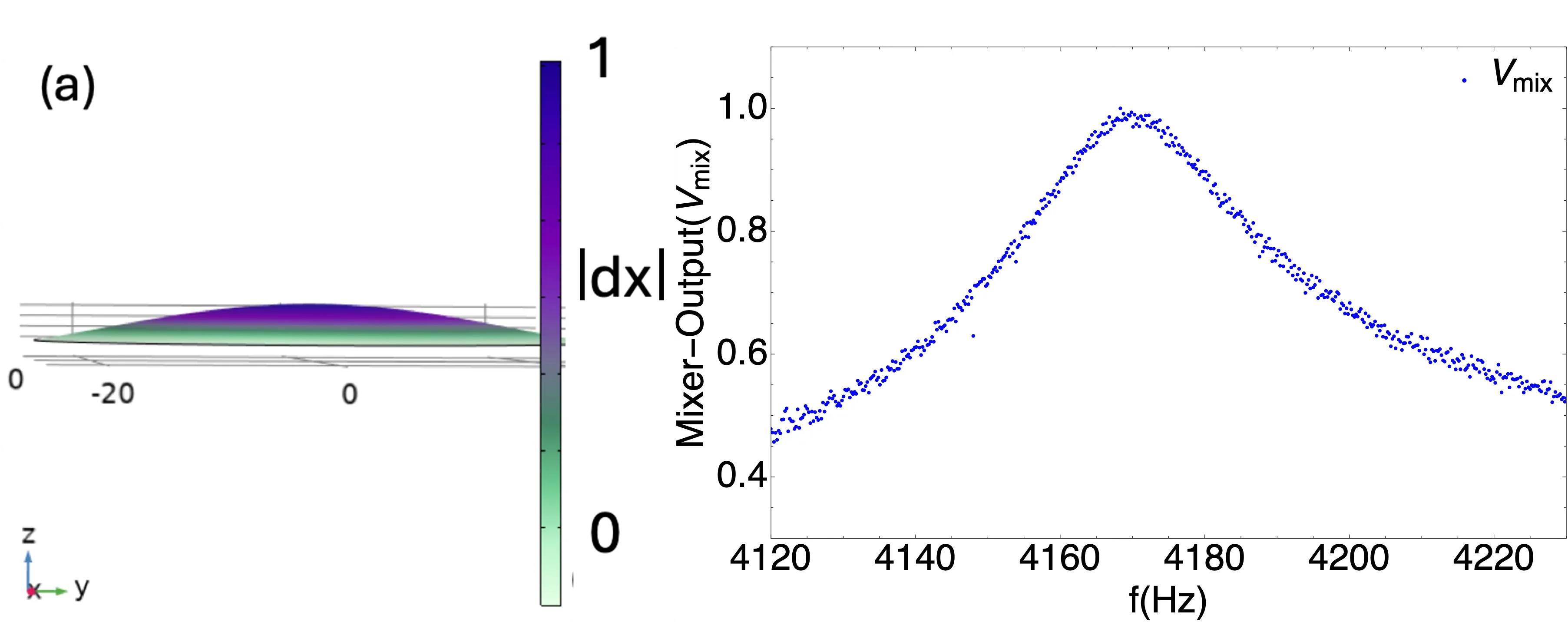
A thin film, clamped between two metal posts, trembles at the slightest nudge. Its movements are picked up by a microwave resonator — a cavity where radio waves bounce around like sound in an empty room. When the membrane shifts, the cavity's response changes. If the film sits exactly in the middle, the signal depends not on the shift itself but on its square, just as the loudness of a drum depends on the force of the strike, not on which way the drum is tilted. Spectroscopy has nothing to do with it: this is pure light–mechanics interaction.
The researchers moved the membrane with a piezoelectric actuator — a crystal that squeezes when voltage is applied. They measured how much the resonator's frequency changed at different membrane positions. At the center, the quadratic response was largest, and the signal appeared at twice the membrane's vibration frequency. Shifting the membrane to the side turned the quadratic response linear: the signal returned to the ordinary frequency. This transition is like tuning a guitar: while the string is exactly over the fret, the note is clean, but move your finger slightly and overtones appear.
This scheme is a step toward devices that can sense individual quanta of membrane motion. Then we could observe a mechanical object behaving according to quantum mechanics: being in two states at once or changing energy only in jumps. This is not science fiction but the near-term goal of labs worldwide.
The membrane in the experiment is hundreds of times thinner than a human hair, yet its trembling shifts the microwave frequency by millions of hertz.
In the novel The Three-Body Problem, ultra-precise gravitational wave detectors use similar resonators to catch the shiver of spacetime.