Meissner Effect at Room Temperature express
A magnet doesn't like its field penetrating a superconductor. An ordinary piece of lead, cooled to cryogenic temperatures, pushes out magnetic field lines, and levitates above a magnet. This is the Meissner–Ochsenfeld effect, discovered in 1933. Until now, it required intense cold because superconductivity in metals emerges only near absolute zero.
In the new work, the Meissner effect has been recorded for the first time at room temperature — in a silicon nanostructure. Conductive channels are formed along its edges, and chains of dipole boron centers with negative correlation energy (so-called negative-U centers) are deposited on top. These centers act as glue for electrons: a single charge carrier passing by binds to them and creates conditions for dissipationless transport — current flows without losses.
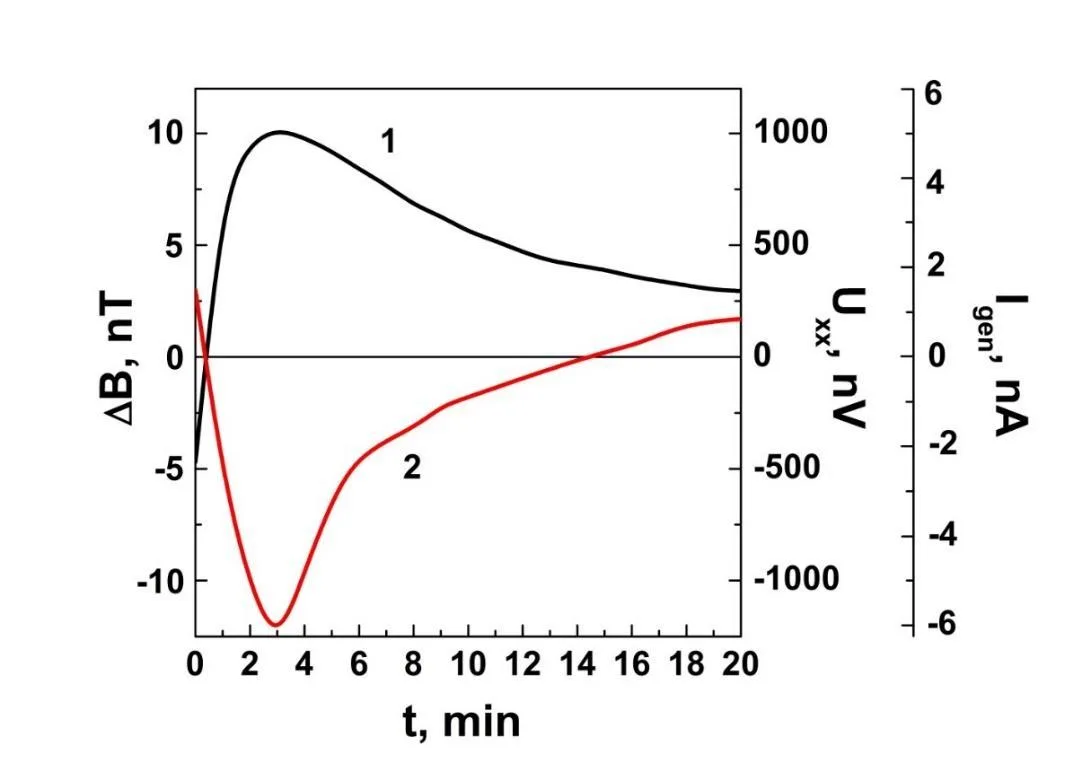
Measurements were carried out in two ways. First, the magnetization of the sample was recorded as it was placed in an external magnetic field and then removed. Second, the electromotive force arising from generation currents was registered. The results obtained with a fluxgate magnetometer and from induced EMF agree well. This confirms that the diamagnetic response is indeed associated with the edge channels, not with the bulk silicon.
The magnetization hysteresis correlates with the magnitude of the EMF from generation currents. This relationship opens the possibility of purely electrical detection of the Meissner effect — without magnetic sensors. The nanostructures are fabricated in a Hall geometry, meaning they are suitable for integration into microelectronic circuits.
Silicon is the backbone of modern electronics. If superconducting properties can be reliably reproduced in it, we could see processors without heat losses, ultrasensitive magnetic field sensors, and lossless transmission lines. For now, this is a laboratory experiment, but it shows that room-temperature superconductivity is not science fiction but an engineering challenge based on silicon technology.
The Meissner effect makes a superconductor levitate above a magnet: the expelled magnetic field creates lift. At room temperature, such levitation is not yet visible — in the experiment, only a weak diamagnetic response was recorded, but the principle is the same.
In Arthur C. Clarke's novel 'Childhood's End', aliens use room-temperature superconductors for their ships — now that's a little closer to reality.