Higgs Under the Microscope: How Its Decays Are Caught express
The Higgs boson lives an unimaginably short life — less than a billionth of a second. It cannot be caught directly, so physicists look at what remains after its decay: jets of particles, muons, neutrinos. But some information is lost if you consider only the explicit decay traces rather than the whole event.
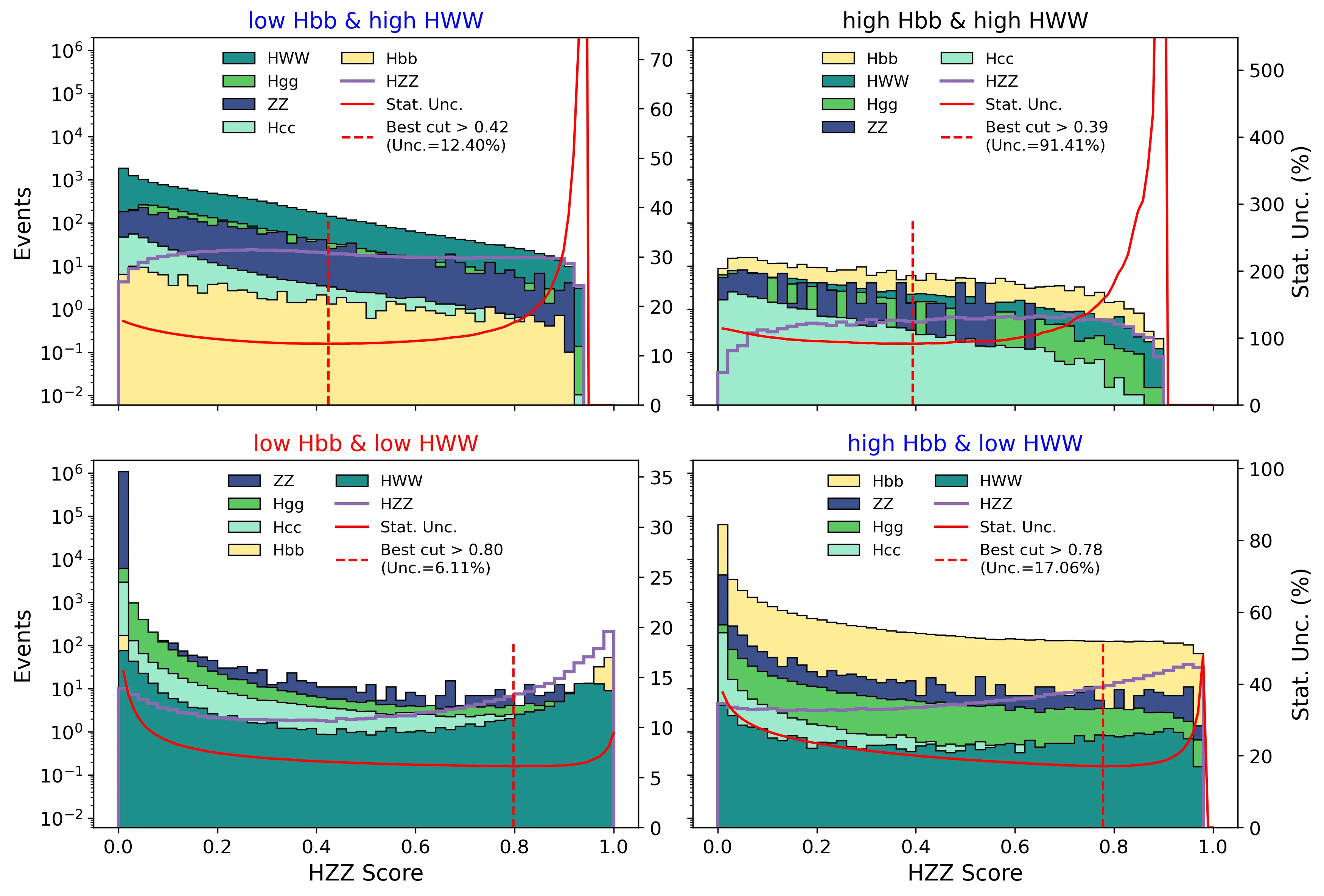
A new approach, called "holistic," uses data about all registered particles in each collision. It's like assessing a hurricane by looking not only at wind speed but also at pressure, humidity, and the surrounding air temperature. At the future CEPC collider, this method reduces the relative statistical uncertainty for Higgs decays to b-quarks, c-quarks, gluons, and pairs of W or Z bosons to 0.16–5.21% depending on the channel.
The precision grows with the size of the training sample: the more simulated events used to tune the algorithm, the smaller the uncertainty. This provides a way to test the method's reliability and estimate its systematic errors.
Original abstract
as written by the authors arXiv:2602.09354
Accurately measuring the properties of the Higgs boson is one of the primary physics objectives of the high-energy frontier. By incorporating the inclusive information of all reconstructed particles to identify the signal events, referred to as the holistic approach, we estimate the relative statistical uncertainty for the Higgs hadronic decay modes $$H \to b\bar{b}$$, $$c\bar{c}$$, $$gg$$, $$WW^{*} \to 4q$$, and $$ZZ^{*} \to 4q$$ at the Circular Electron--Positron Collider (CEPC) operating as a Higgs factory with an integrated luminosity of 21.6~ab$$^{-1}$$. In the $$Z(\mu^{+}\mu^{-})H$$ and $$Z( u\bar{ u})H$$ channels, the relative statistical uncertainties for these decay modes are projected to range from 0.36\% to 5.21\% and 0.16\% to 2.52\%, respectively. Compared to the CEPC Snowmass results, the holistic approach boosts the measurement precision by a factor of two to four. The scaling behavior, specifically the dependence of the anticipated accuracy on the training dataset size, is observed and analyzed. The precision of these leading Higgs decay modes, especially the $$H \to b\bar{b}$$ mode, is asymptotically approaching the statistical limit. The scaling behavior could also be applied to monitor the robustness and to quantify the uncertainties of the holistic approach.
The Higgs boson is the only known particle with zero spin: it doesn't spin like a top but is completely symmetric.
In Liu Cixin's novel "The Three-Body Problem," physicists face distortions of the laws of nature — precise Higgs measurements could act as a detector for such anomalies.