The branching fraction is a fundamental concept in particle physics that quantifies the probability that a given particle will decay through a specific decay channel. For example, if a particle has several possible decay modes, the branching fraction for each mode is the fraction of all decays that go through that particular channel. In the context of the η_c meson, the branching fraction for its decay into two photons is measured to be about 2.45 per 10,000, meaning that out of 10,000 η_c decays, roughly 2.45 will produce a photon pair. This number is not just a curiosity; it is a precise prediction of the Standard Model, and measuring it accurately can reveal discrepancies that point to new physics.
History
The concept of branching fractions has been used since the early days of nuclear and particle physics in the 20th century, with the term becoming standard in the 1950s and 1960s as particle accelerators began producing a variety of unstable particles. The specific measurement of the η_c → γγ branching fraction has been refined over decades, with recent results from experiments like BESIII and Belle II.
How it works
Branching fractions are determined experimentally by counting the number of decays into a specific final state and dividing by the total number of decays of the particle. This requires large datasets and careful accounting of detector efficiencies and backgrounds. Theoretically, branching fractions are calculated using quantum field theory, where the decay rate for each channel is computed from the matrix element of the interaction Hamiltonian. The sum of all branching fractions for a particle must equal 1, as it must decay via some channel. Precision measurements of branching fractions, especially for rare decays, are a key strategy in the search for physics beyond the Standard Model, as new particles can alter these rates through quantum loop effects.
In practice
Branching fractions are used in every particle physics experiment to compare theoretical predictions with observations, from measuring the Higgs boson's decay rates to searching for rare processes like neutrinoless double beta decay.
Fun fact
The branching fraction for the η_c → γγ decay is so small that it was only measured with high precision in the 21st century, using data from electron-positron colliders that produce millions of charmonium events.
At the Large Hadron Collider, protons are smashed together, and among the debris, a heavyweight particle, the lambda baryon, sometimes appears. It lives for a tiny fraction of a second before decaying into other particles.
Among the debris of particle collisions, short-lived 'guests' sometimes appear — hyperons. One of them, Σ0, lives for less than one ten-billionth of a second and decays on the fly. Catching it directly is nearly impossible, but its traces can be spotted: it leaves behind another particle, Λ, and an electron-positron pair.
An archaeologist carefully brushes away layer after layer, and each new stratum at the charmonium dig is a rare decay captured by the detector. Charmonium — a bound state of a charm quark and its antiquark — lives for mere fractions of a second, yet it manages to tell us about the forces that hold quarks together.
When a ψ(2S) particle decays into a proton and an antiproton, two different mechanisms act simultaneously: the strong interaction, like glue holding quarks together, and the electromagnetic one, like light pushing charges apart. Their contributions add up with a certain phase shift.
The antiproton is the mirror twin of the proton: same mass, but negative charge. When it hits matter, it usually annihilates instantly — disappearing in a burst of energy upon colliding with an atomic nucleus.
Imagine a football stadium where a hundred billion spectators sneeze at once, and only seven or ten do so in complete silence. That's the kind of rarity the NA62 experiment at CERN hunts for, studying the decay of a charged kaon (K+) into a pion (π+) and a pair of neutrinos (νν̄).
In 2021, the LHAASO observatory registered gamma quanta with energies above a petaelectronvolt from sources like the Crab Nebula — a supernova remnant with a pulsating neutron star at its heart.
A firework bursts, and one point explodes into four sparks at once. That's how the Z boson, the particle that carries the weak force, behaves when it decays into four charged leptons (electrons or muons). The process is extremely rare: for every million Z bosons produced, only about five decay this way.
A coin landing on its edge is about as rare as a heavy B meson decaying into a light pion and an electron-positron pair. Over a decade of collider operation, only a handful of such events have accumulated, but physicists have finally managed to spot them.
The decay probability is about 2.4×10⁻⁸.
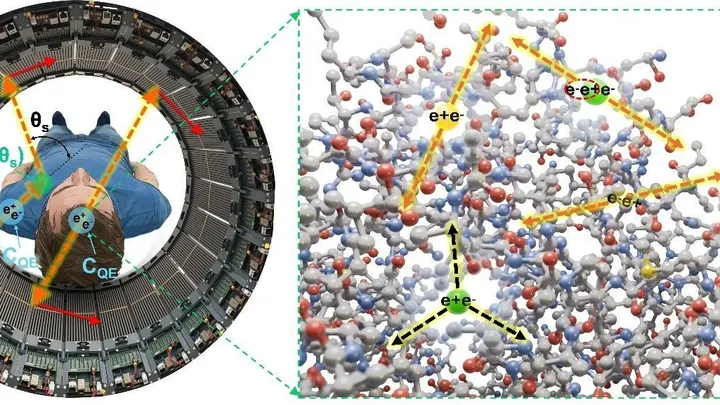
Two photons fly out from a single point in a patient's chest. They are twins: alter one, and you instantly know about the other. This connection is called quantum entanglement. In a PET scan, these pairs are born inside the body when an injected radioactive substance meets electrons in the tissues.
The degree of entanglement is not constant.
In an accelerator near Beijing, electrons collide with positrons, and for an instant, particles are born that you wouldn't find in ordinary matter. One of them is lambda-c-plus: inside it sits a heavy charmed quark, like a stone in a slingshot. Now physicists have for the first time seen this particle break apart into a neutron, a positive pion, and an eta meson.
The J/psi particle lives for an instant and then decays into lighter particles, much like a snapped string scattering into pieces. Physicists from the BESIII collaboration caught over ten billion such decays to figure out exactly what 'pieces' are produced.
Inside the proton and neutron, life is boiling: quarks exchange gluons, and for an instant pairs of particles appear and vanish. Some of them, the so-called scalar mesons, live for only 10⁻²³ seconds — less time than light needs to cross an atomic nucleus.
A tiny glass sphere floats in a laser beam like a speck of dust in sunlight. Inside it is radioactive lead, which decays from time to time. Each decay ejects charged particles, and the sphere loses or gains a tiny electric charge.
A branching network, like a river delta or a tree crown, is built on the principle of economy. The classic law, derived back in 1926, stated that the cube of the parent vessel's diameter equals the sum of the cubes of the daughter diameters. This rule worked beautifully for ideal tubes, but real arteries stubbornly gave a different exponent — around 2.7 instead of 3.
The authors of the new study found the reason.
Proton collisions at the Large Hadron Collider produce particles that live for less than a billionth of a second. One of them is the Bs meson, made of a strange quark and a bottom antiquark.
The proton is not a solid ball. Its charge, mass, and other properties are distributed differently in space, and each property has its own radius. Physicists have long been able to measure where the proton's charge is concentrated and where its mass lies.
A proton can't be seen as a simple ball. If you hit it with a photon, it can absorb energy and jump into an excited state, like a bell that starts ringing at a certain frequency after being struck. These states are called nucleon resonances, and they live very briefly before decaying into other particles.
The Higgs boson lives an unimaginably short life — less than a billionth of a second. It cannot be caught directly, so physicists look at what remains after its decay: jets of particles, muons, neutrinos. But some information is lost if you consider only the explicit decay traces rather than the whole event.
In the BEPCII accelerator, electrons and positrons collide, producing billions of particles. Among them is the J/ψ meson, which lives for less than a billionth of a second. Its decay sometimes yields an eta meson (ηc), an even shorter-lived clump of quarks.
Inside the accelerator, particles collide, and for a fleeting moment a B meson is born — a heavy particle that lives for less than a billionth of a second. Usually, it decays into a shower of debris, but sometimes it transforms into just two particles: a muon and a neutrino. This rare path is like a lottery where the winning ticket appears once in every two million draws.
In 2018, the Large Hadron Collider ran a special data-taking campaign: the CMS detector captured proton collisions at breakneck speed to collect ten billion particles containing a beauty quark.
In the air we breathe, invisible chemical events are constantly unfolding. One of them is the birth and instant death of a particle with the formula H₂COO. Known as an 'intermediate,' it appears for a split second when ozone molecules collide with organic compounds, then immediately shatters into simpler fragments.
At a particle accelerator in Beijing, electrons collide with positrons, and for a fleeting moment, a particle called eta-c is born. It lives for a tiny fraction of a second and then decays into other particles. One of the rarest paths is to split into two photons, particles of light. Until now, no one could say exactly how often this happens.
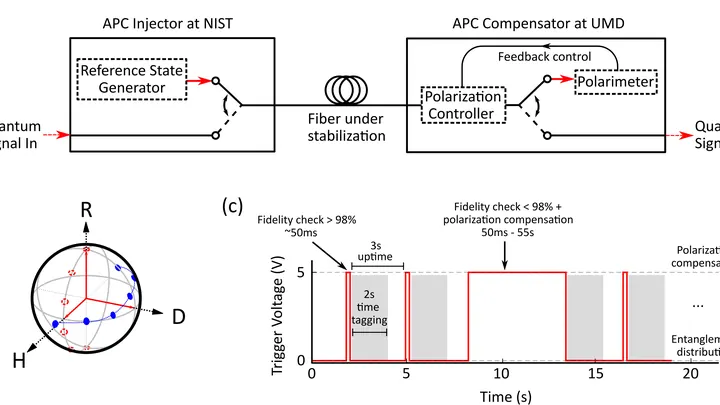
Two photons, like two halves of the same coin, fly tens of kilometers apart but remain linked: measure one, and you instantly know the state of the other. This property is called entanglement, and it underpins quantum communication.
Two particles cling to each other like climbers on the same rope and fly toward a wall. When they hit, will they bounce off together, or will the rope snap? What does it depend on? Physicists considered the simplest case: everything happens on a single line, the particles attract only when they occupy the same point, and the wall is perfectly rigid.