The W boson is a fundamental particle that carries the weak nuclear force, one of the four known forces of nature. It is responsible for processes like radioactive beta decay, where a neutron turns into a proton, emitting an electron and an antineutrino. Unlike the massless photon that carries electromagnetism, the W boson is extremely heavy — about 80 times the mass of a proton — which explains why the weak force operates only over subatomic distances and is so feeble at everyday scales.
History
The W boson was predicted in the 1960s as part of the electroweak theory by Sheldon Glashow, Abdus Salam, and Steven Weinberg, and it was first directly observed in 1983 at CERN by the UA1 and UA2 collaborations, led by Carlo Rubbia and Simon van der Meer.
How it works
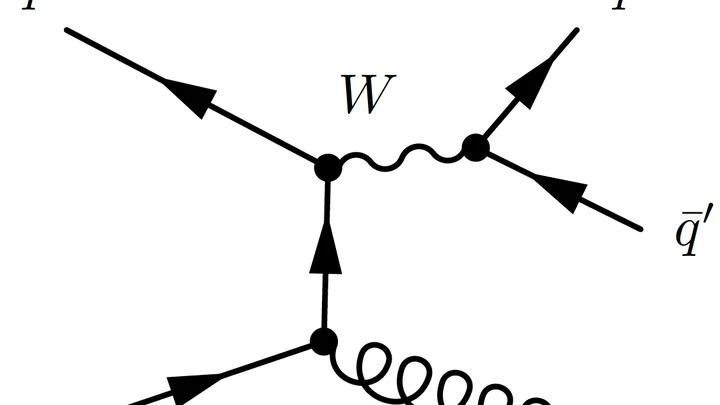
The W boson acts as a messenger: when a particle like a quark or neutrino changes its identity (its 'flavor'), it emits or absorbs a W boson. This exchange changes the particle's electric charge by one unit, which is why the W comes in positive and negative varieties. The process is governed by quantum mechanics, so the W boson exists only fleetingly as a virtual particle in most interactions, but at high energies it can be produced as a real, observable particle in particle colliders.
In practice
The W boson is central to particle physics experiments at colliders like the Large Hadron Collider, where its precise mass and interactions are measured to test the Standard Model and search for new physics.
Fun fact
The W boson is so heavy that it weighs about as much as an entire atom of bromine, yet it is a single, point-like elementary particle.
Pulsar PSR J1740+1000 is a city-sized star spinning faster than a kitchen blender. After a supernova explosion, it left behind a dense core that accelerates particles to near-light speeds. These particles fly into space, and previously it was thought they scatter in all directions, like splashes from a stone thrown into water.
In a quiet room, you can hear the faintest whisper. Likewise, in the hydrogen atom, the lightest of all, an uninvited guest is easier to spot. That guest could be the Z' boson, a mediator particle of a new force predicted by many unification theories. The Standard Model already has its own mediator — the Z boson.
At the heart of a warp drive lies Einstein's idea that massive bodies curve spacetime — the very stage on which all cosmic events unfold. Picture a bubble of such curved spacetime. Inside it, the ship floats without any G-forces, like a passenger in an airplane cabin who doesn't feel the headwind.
Two tin nuclei collide at about two-thirds the speed of light. For an instant, a hot, dense cloud forms, and protons fly out in all directions. If you catch pairs of protons and measure how often they fly off in the same direction, you can work out the size of that cloud. This method is called femtoscopy: it works like a microscope for nuclear scales.
In the CMS detector at the Large Hadron Collider, protons accelerated to nearly the speed of light collided. Among billions of such collisions, physicists searched for a rare signature: the production of a single heavy particle that immediately decays into a W boson and a b quark.
At the Large Hadron Collider, protons collide, and from the flash dozens of particles are born. Among them may be traces of rare processes — for example, the decay of a Standard Model Higgs boson into two W bosons. But these particles fly apart so quickly that their tracks merge into a single wide jet.
When a W boson, the particle that carries the weak force, decays into a quark and an antiquark, these two fragments fly off in nearly the same direction at the collider's immense speeds.
The proton is not a solid ball. Its charge, mass, and other properties are distributed differently in space, and each property has its own radius. Physicists have long been able to measure where the proton's charge is concentrated and where its mass lies.
The atomic nucleus is not a solid ball but a drop of liquid that can be squeezed. To understand how elastic it is, physicists accelerate gold nuclei and smash them into each other. On impact, the matter compresses to densities like those in a neutron star, then flies apart. The shape of this debris tells us about the properties of the matter inside.
In the first minutes after the Big Bang, the Universe was like a blazing hot stove. On it, according to the 'recipe' of the standard theory, hydrogen, helium, and a bit of lithium were supposed to cook. But telescopes see only a third of the lithium that this recipe calls for.