The Higgs field is a scalar field that permeates all of space, giving mass to fundamental particles through its vacuum expectation value. It is the only fundamental scalar field in the Standard Model of particle physics. The field's quantum excitation is the Higgs boson, discovered at CERN in 2012. Without this field, particles like the W and Z bosons would be massless, and the universe would be vastly different, with no atoms or complex structures.
History
The mechanism was proposed independently by Peter Higgs, François Englert, and Robert Brout in 1964, building on earlier work by Anderson and others. The Higgs boson was finally observed in 2012 at the Large Hadron Collider.
How it works
The Higgs field has a non-zero value everywhere in its ground state, like a field of molasses filling space. Particles interact with this field, and the strength of the interaction determines their mass — the stronger the coupling, the heavier the particle. The field's potential has a 'Mexican hat' shape, where the lowest energy state is not at zero but at a non-zero value, causing spontaneous symmetry breaking.
In practice
The Higgs field is crucial for understanding particle physics, and its study guides searches for new physics beyond the Standard Model, such as dark matter candidates.
Fun fact
The Higgs field's vacuum expectation value is about 246 GeV, which sets the scale for the masses of all known elementary particles.
In the first moments after the Big Bang, the universe expanded at an incredible rate — a phase known as inflation. Even the vacuum was restless back then: quantum jitters shook the fields like wind rustling through a wheat field.
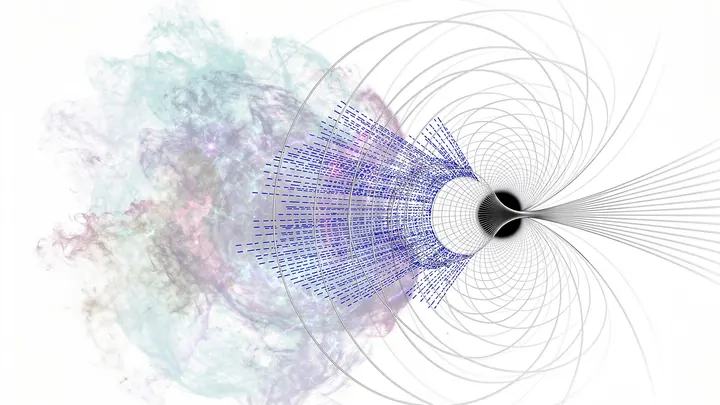
At the center of nearly every galaxy lurks a supermassive black hole. Its gravity is so strong that it warps space itself. But few stop to wonder: what does it do to the very fabric of reality — the fields that permeate the cosmos?
One such field is the Higgs field.
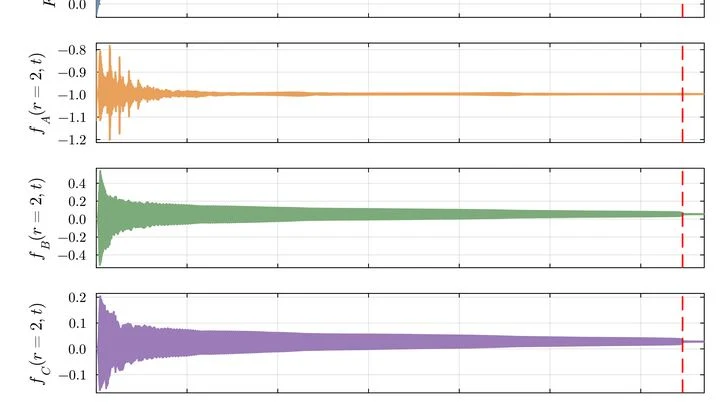
A tightly stretched string keeps vibrating after being plucked. In particle physics, there is a similar object — the oscillon. It is a clump of energy that pulses like a heart without spreading out in space. Such structures arise in the Higgs field — the very field responsible for particle masses.
The event horizon's edge is never calm. Quantum vacuum boils there, and particles sometimes burst out of this foam: that is how Stephen Hawking in 1974 discovered black hole radiation, forever linking gravity with quantum field theory.
When a particle carries a large amount of internal energy, like a massive spinning top, its motion can be split into a fast part and a slow part. The fast part is a jitter that barely affects the big picture. Physicists have developed a method to discard this jitter and keep only the slow, meaningful motion. It's like skimming the foam off boiling soup to see the clear broth underneath.
The early universe expanded at an unimaginable rate — faster than light could cross it. In this boiling cauldron, any region of space resembled an open can of paint: its boundaries continuously captured new 'vapor' from outside, while some of its own contents irrevocably escaped.
Deep inside the detector at the Large Hadron Collider, protons collide, and for a fleeting moment something heavy is born. It instantly shatters into two Higgs bosons — particles that, like nesting dolls, each hide two pairs of b-quarks.
Two blindingly bright beams smash head-on. At the point of impact, a particle is born for an instant — the very one responsible for the mass of everything in the universe. That's the Higgs boson. Usually, it's produced by accelerating protons or electrons, but here the projectiles are particles of light themselves — photons.
Dark matter is the great cosmic invisible. It neither emits, absorbs, nor reflects light, yet its gravitational grip is felt in every motion of galaxies. Seventy years ago Vera Rubin showed that the outskirts of galaxies rotate too fast — as if spurred on by an unseen shepherd.
Throw a stone into a pond — ripples spread out, changing the scale of the wave. The new theory works much the same way: it gives each particle its own "scale ripple," and it's this curvature of an invisible space that turns out to be the source of mass.
An invisible film, a quantum field, is stretched over a rubber bagel. While the bagel is small, the film stays taut and doesn't sag anywhere: the vacuum remains empty. But once you stretch the bagel to a certain size, a dent spontaneously appears in the film — the field starts to be felt at every point.
This dent is not random.
The Higgs boson is like a conductor that gives mass to all other particles. Without it, electrons would be massless and atoms would fall apart. But how does the conductor interact with itself? That is the key question a future muon collider aims to answer.
Two particles flying apart in opposite directions behave as a single whole: measuring one instantly determines the state of the other. Such quantum entanglement has long been known for light particles, but now it has been observed for the first time in heavy Z bosons — the carriers of the weak force.
An attempt to suppress room background noise by adding anti-sound turns into speaker howl if the circuit has an error. A similar glitch occurred with a theory that set out to remove the main cosmic hum — the inexplicably weak dark energy.
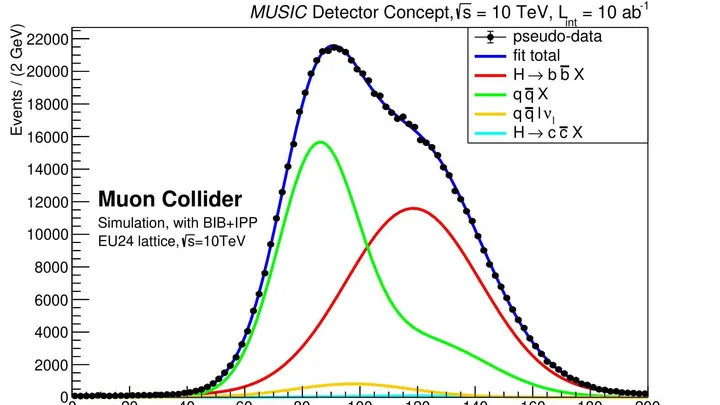
The Higgs boson lives an unimaginably short life — less than a billionth of a second. It cannot be caught directly, so physicists look at what remains after its decay: jets of particles, muons, neutrinos. But some information is lost if you consider only the explicit decay traces rather than the whole event.
Fresh after the Big Bang, the Universe fizzed like a freshly poured soda. All of space was filled with bubbles — regions of new vacuum, the kind governed by the Standard Model, pushing out the old unstable state. The walls of these bubbles accelerated to near light speed, and in head-on collisions they crumpled and burst, unleashing monstrous energy.
A century ago, Einstein's equations predicted black holes, but inside them physics broke down: particle trajectories ended at the singularity, a point of infinite curvature. It was a dead end, the end of spacetime. Now physicist Itzhak Bars proposes a radical twist: the singularity is not a wall but a door.