Higgs Under the Microscope: How Its Decays Are Caught express
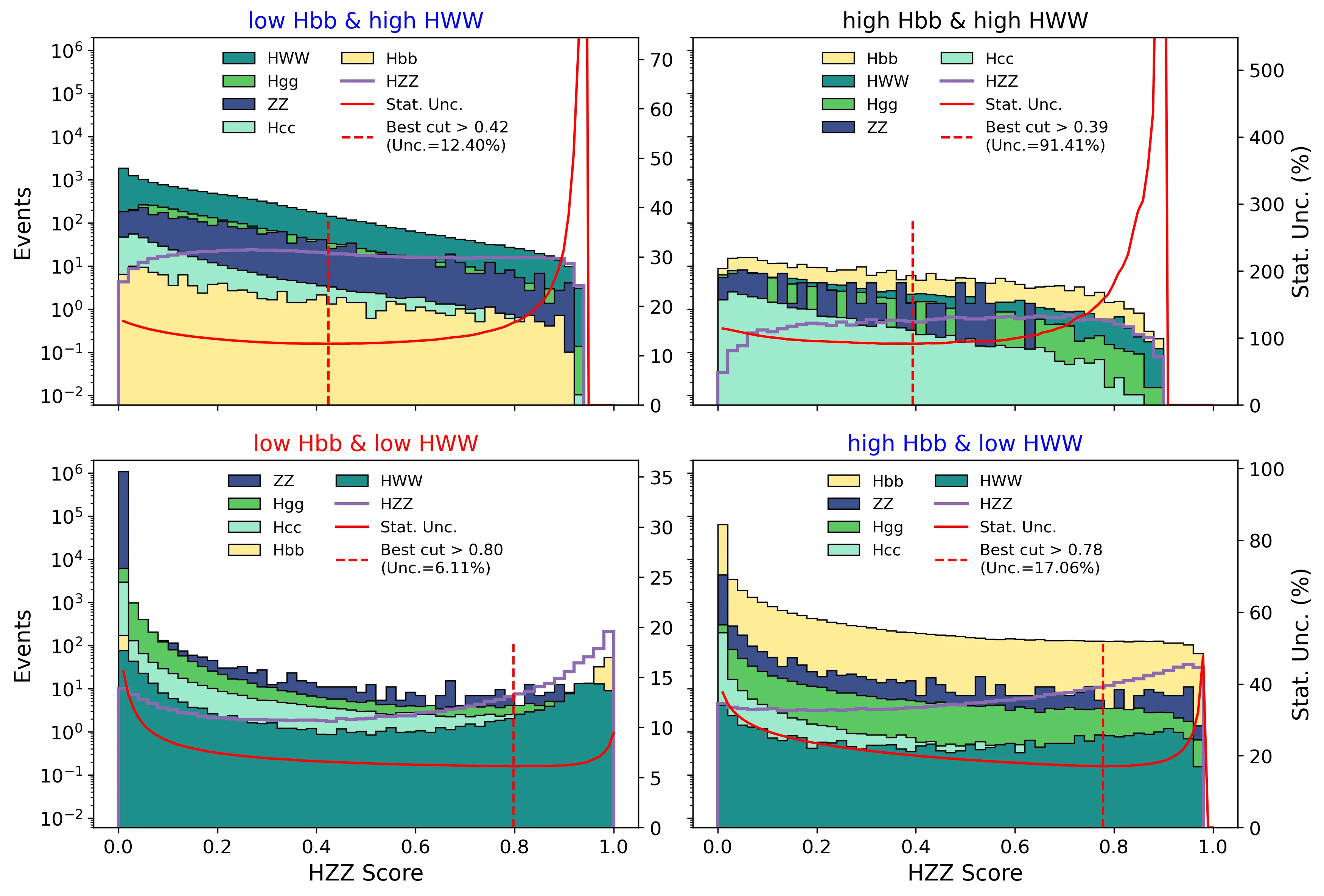
The Higgs boson lives an unimaginably short life — less than a billionth of a second. It cannot be caught directly, so physicists look at what remains after its decay: jets of particles, muons, neutrinos. But some information is lost if you consider only the explicit decay traces rather than the whole event.
A new approach, called "holistic," uses data about all registered particles in each collision. It's like assessing a hurricane by looking not only at wind speed but also at pressure, humidity, and the surrounding air temperature. At the future CEPC collider, this method reduces the relative statistical uncertainty for Higgs decays to b-quarks, c-quarks, gluons, and pairs of W or Z bosons to 0.16–5.21% depending on the channel.
The precision grows with the size of the training sample: the more simulated events used to tune the algorithm, the smaller the uncertainty. This provides a way to test the method's reliability and estimate its systematic errors.
The Higgs boson is the only known particle with zero spin: it doesn't spin like a top but is completely symmetric.
In Liu Cixin's novel "The Three-Body Problem," physicists face distortions of the laws of nature — precise Higgs measurements could act as a detector for such anomalies.