Water in the Mantle: A Hidden Ocean Beneath Our Feet express
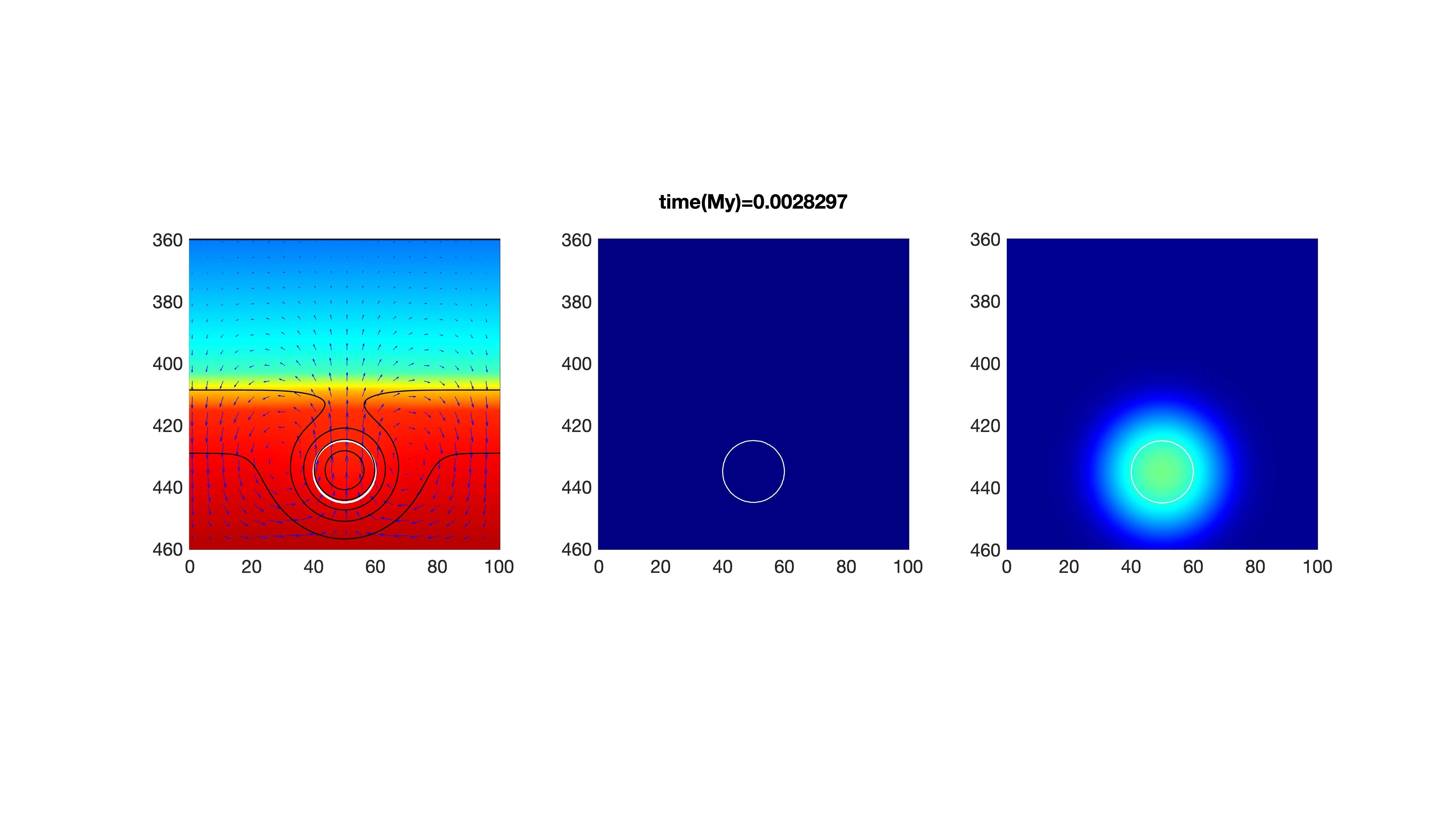
Deep beneath us, hundreds of kilometers down, lies a layer that can absorb water like a sponge. The minerals there, wadsleyite and ringwoodite, can hold up to 1–2% water by weight within their crystal lattices. That means the mantle transition zone (between 410 and 660 km) could potentially hide more water than all the oceans on the surface combined. But is this sponge actually soaked?
The authors of a new study built a computer model to trace the fate of water in this layer. They combined the physics of the solid mantle, mineral chemistry, and heat flow. The model showed that water entering the transition zone doesn't just sit there as dead weight. It makes the rock lighter, causing it to rise — slowly, at centimeters per year, but relentlessly. Over tens of millions of years, this 'wet' upwelling reaches the boundary where wadsleyite transforms into olivine, and there the water is released.
The released water lowers the melting point of the rock, forming melt droplets. These are lighter than the surrounding mantle, so they continue upward — now faster, seeping through solid grains or rising as separate 'bubbles.' A similar process occurs at the lower boundary of the transition zone: cold slabs (subducting oceanic plates) descend from above, carrying water as well. At depths around 660 km, they heat up, water is expelled, and light melts start their journey back up.
Thus, the transition zone turns out to be not a storage room but a relay point. Water lingers there for 80 to 430 million years, and at any given moment, there's not much of it — less than 0.1% by weight, meaning less than a fifth of the mass of today's oceans. But that's enough to regulate the water level at the surface. If oceans shallow, the mantle releases some moisture through volcanoes; if there's too much water, some sinks back down with the plates. Such a thermostat system might also work on other rocky planets, helping them keep their oceans for billions of years.
Original abstract
as written by the authors arXiv:2602.13820
The spinel phase (wadsleyite, ringwoodite) in the mantle transition zone (MTZ), can contain up to 1-2 weight percent of water. However, whether these water reservoirs in the MTZ are filled is debated. Here, we investigate water dynamics in the MTZ numerically by using a newly developed empirical model of deep hydrous mantle melting combined with 2D thermo-hydro-mechanical-chemical (THMC) upper mantle models. Numerical modeling results suggest that water-induced buoyancy triggers the development of hydrous solid-state mantle upwellings in the MTZ. On time scales of some tens of millions of years, they rise to and interact with the spinel-olivine phase transition. Depending on the water content and temperature of these thermal-chemical plumes, this crossing may trigger hydrous melting by water release from the wadsleyite upon its conversion to olivine. The melts are less dense than the solid matrix and continue rising upward in the form of either diapirs or porosity waives. Similar dehydration-induced melting process3 is also documented for the lower MTZ boundary, where hydrous downwellings (such as subducted slabs) generate buoyant melt diapirs rising through the MTZ. We therefore suggest that the MTZ operates as a transient water reservoir. Relatively small amounts of water (less than 0.1 weight percent, smaller than 0.2 ocean masses) and a geologically moderate duration (80-430 Myr) of the transient water storage should be characteristic for the MTZ, which may play a key role in stabilizing the surface ocean mass on Earth and Earth-like rocky exoplanets.
The mantle transition zone contains minerals that, at pressures of 130,000 atmospheres (like the weight of 1,300 elephants per square centimeter), rearrange their crystal lattice and can absorb water — in amounts comparable to the volume of several oceans.
In Jules Verne's novel 'Journey to the Center of the Earth,' the heroes find an underground ocean — our model shows that water really can hide in the mantle, but not as a sea, rather inside crystals.