Olivine is a magnesium-ironsilicate mineral that is the most abundant mineral in Earth's upper mantle, down to about 410 kilometers depth. It is the primary constituent of the rock peridotite, which makes up the bulk of the mantle. When mantle material rises toward the surface, it undergoes a phase transition: at lower pressures, olivine is stable, but at greater depths it transforms into denser minerals like wadsleyite and ringwoodite. This transformation is not just a mineralogical curiosity—it plays a key role in plate tectonics, mantle convection, and the behavior of seismic waves passing through the Earth.
History
Olivine has been known since antiquity as the gemstone peridot, but its role as a major mantle mineral was established in the early 20th century through petrological studies. The specific phase transition to wadsleyite was identified in the 1960s by experimental petrologists such as A.E. Ringwood, who synthesized the high-pressurepolymorphs and linked them to seismic discontinuities.
How it works
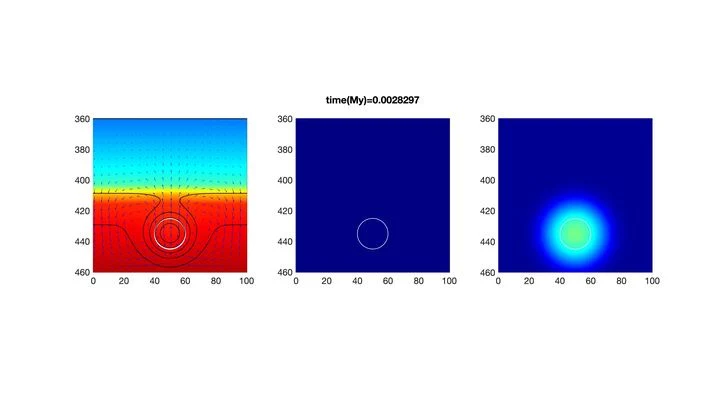
Olivine has an orthorhombic crystal structure with isolated silica tetrahedra linked by magnesium or iron ions. At high pressure (around 13–14 GPa, corresponding to ~410 km depth), the structure collapses into the more compact spinel-like structure of wadsleyite, which has a higher density. This phase change is exothermic, meaning it releases heat, and it occurs over a narrow depth range, creating a sharp seismic reflector. During upwelling, the reverse transformation from wadsleyite to olivine absorbs heat and can slow or even halt rising mantle plumes, a process that influences volcanic activity at hotspots.
In practice
Olivine is used in foundry sands, as a refractory material, and in carbon capture research, where its weathering can sequester CO2. In geophysics, its phase behavior is essential for interpreting seismic tomography and modeling mantle dynamics.
Fun fact
Olivine is also found in meteorites and on Mars, where it can indicate past water activity because it alters to iddingsite in the presence of liquid water.
Inside Earth, at depths from 660 to 2,900 kilometers, lies a layer known as the lower mantle. There, pressures reach 1.3 million atmospheres, and temperatures rival the surface of the Sun. Under these conditions, the mineral davemaoite exists as the third most abundant mineral in the lower mantle.
In a chunk of the meteorite EET 87720, found in Antarctic ice, lies a pink grain of sand. It's spinel, a mineral almost never seen in ureilites, and here it grew to half a millimeter. Such a find is like a time capsule from an early melt: it solidified when the parent body was just beginning to cool.
In 2008, the Spitzer telescope aimed at the star HD 15407A and detected a strong infrared excess. Fifteen years later, in 2023, JWST repeated the measurements. The light from the dust had dimmed by 14%. But the mineral composition of the dust remained the same, like a fingerprint taken in different years.
Hundreds of light-years away, there's a planet that looks like a giant mirror. LTT9779b reflects most of the light that hits it — far more than you'd expect from a Neptune-sized body. Astronomers have long debated what makes it so shiny: a thick carbon-rich haze or a layer of clouds.
The James Webb Space Telescope has helped settle the debate.
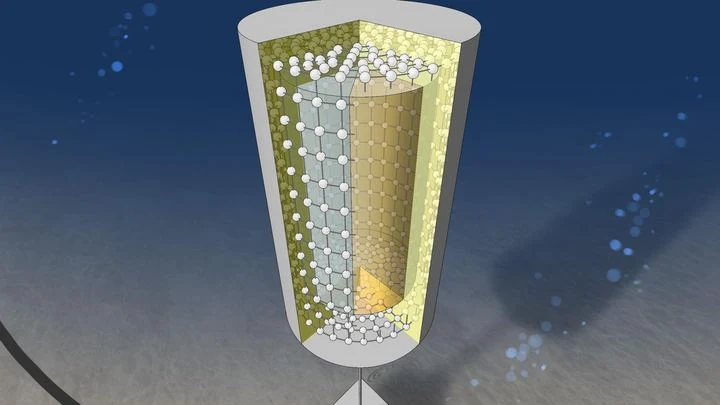
In the depths of the ocean, where light never reaches, a plan is taking shape to capture particles that barely interact with anything. Geoneutrinos, tiny messengers from the scorching mantle, are emitted during the decay of uranium and thorium. Their flux carries information about how much heat lies hidden beneath our feet.
Deep beneath our feet, in the scorching mantle, iron leads a double life. It can be divalent or trivalent, like a coin that lands heads or tails. Which side dominates determines how much oxygen stays in the planet's rocky shell and how much sinks into the core.
If you don’t stir a layered cocktail, the heavy syrup sinks to the bottom. A young planet is much the same — a seething ocean of molten rock. As it cools, minerals crystallize: some, like iron, get heavy and sink, while others float. You’d think a dense layer would pile up at the core.
When a baker kneads dough, the grains of flour can tell you which mill they came from. It's the same with Earth: the composition of iron in its depths preserves a memory of where the pieces that assembled the planet were born.
The crystal Pr₄Ni₃O₁₀ is like a three-layer sandwich: nickel oxide layers separated by praseodymium spacers. As it cools, three magnetic regimes switch on in sequence, as if, inside the sandwich, the nickel spins first align, then slightly rearrange, and finally the praseodymium spins join in.
Muons, heavy cousins of electrons, penetrate the crystal and sense internal magnetic fields.
Deep beneath us, hundreds of kilometers down, lies a layer that can absorb water like a sponge. The minerals there, wadsleyite and ringwoodite, can hold up to 1–2% water by weight within their crystal lattices.
Just as Water changes phase, freezing into ice or evaporating into vapor, forsterite, a key mineral of Earth's mantle, under pressures of hundreds of thousands of atmospheres, reassembles its crystal lattice.
Lunar dust looks like gray sand, but there's not a breath of air in it. Oxygen is there — tightly bound in the rocks, like sugar in caramel. To get it out, you need to break chemical bonds, and scientists are looking for the simplest way.
In the lab, they took artificial lunar soil made from samples from the Apollo missions and China's Chang'e.
Uranus and Neptune have long puzzled scientists: their magnetic fields are heavily tilted and tangled, nothing like Earth's. The answer lay in an exotic form of water — superionic ice, which fills their interiors.
A young sub-Neptune is a pressure cooker where hydrogen and rock simmer in the same pot. Six Earth masses, three percent hydrogen by mass, and interior temperatures above 4000 K. At that heat, silicate melt and hydrogen don't just coexist: they mix completely, forming a single supercritical fluid. There is no boundary between core and envelope.