Why Spinning Stars Stay Silent express
A star like the Sun hums like a bell: sound waves inside make its surface tremble ever so slightly. From this trembling, astronomers, like doctors reading a pulse, infer the star's temperature, density, and age. But the Kepler telescope spotted an oddity: many stars that spin fast and are covered in spots show no trembling at all. It's as if they've lost their voice.
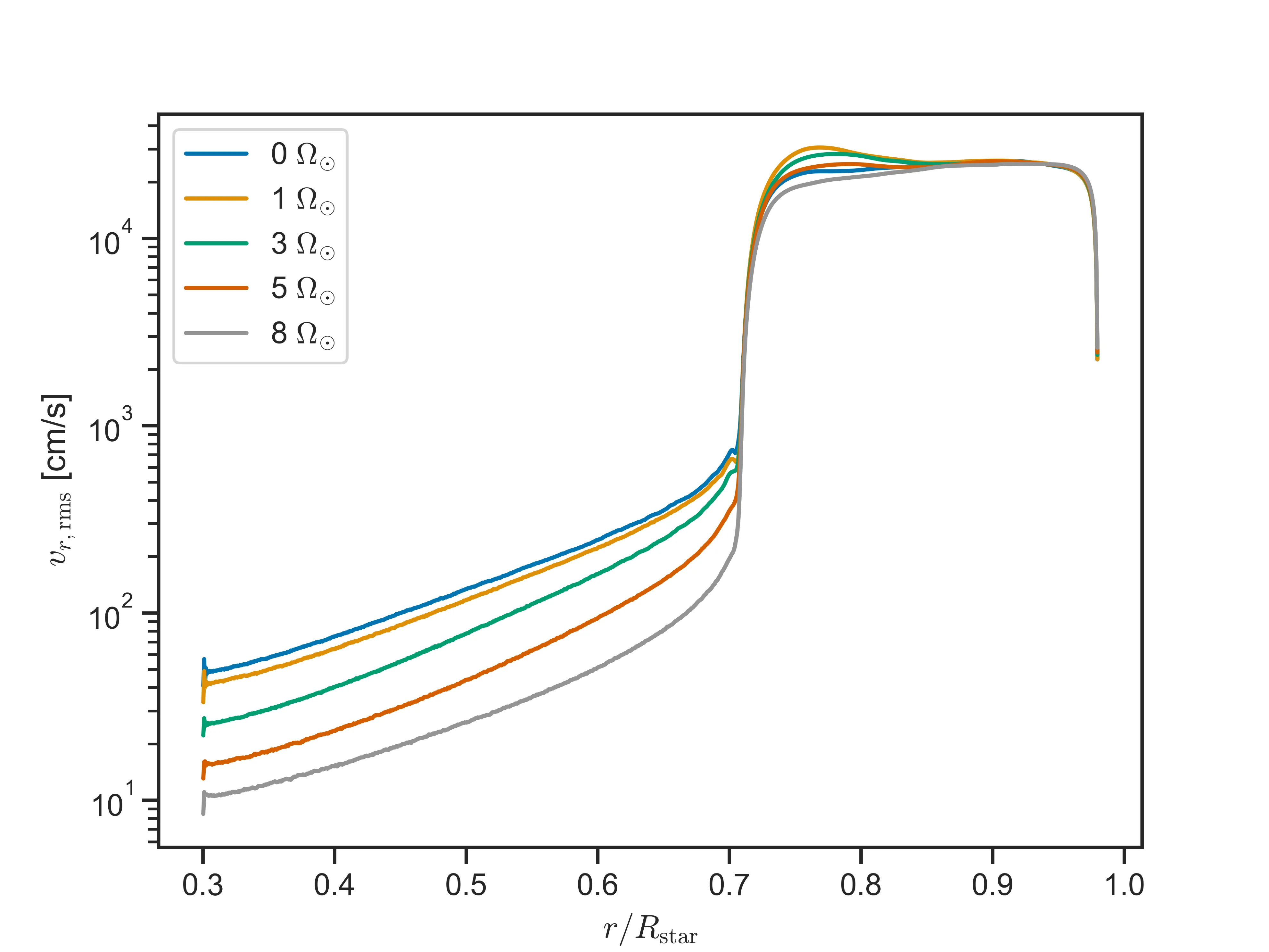
To understand why, scientists built a computer model of a star and spun it faster and faster — from zero up to eight rotations for every one rotation the Sun makes. It turned out that rotation stifles convection — the mixing of hot and cold gas layers that gives birth to sound waves. Hot bubbles can no longer rise freely, like riders on a carousel who bump into each other when it spins too fast.
So the silence of rapidly rotating stars is neither a coincidence nor a flaw in observations. Rotation itself changes a star's internal music. Astronomers who listen to stars will now have to account for their dance.
Original abstract
as written by the authors arXiv:2602.15735
In solar-like stars, acoustic modes provide the main way of probing their internal structure and dynamics. Although these modes are expected to be ubiquitous in stars with convective envelopes, Kepler observations reveal that a significant fraction of solar-like stars show no detectable acoustic modes, particularly among rapidly rotating and magnetically active stars. Recent theoretical work has proposed that rotation tends to inhibit convective motions, thereby reducing the power available for stochastic excitation of low degree acoustic modes. Here, we test this prediction using fully compressible hydrodynamical simulations of a solar-like star. We perform a series of 2.5D simulations, which consider longitudinal symmetry, using the MUSIC code spanning rotation rates from 0 to 8 $$\Omega_{\odot}$$. We find a clear and systematic decline of acoustic mode amplitudes with increasing rotation rate. In the most rapidly rotating models, mode damping rates are also enhanced. The combined reduction in excitation and increase in damping with increasing rotation rate provide a physical explanation for the observed decrease in mode detectability in rapidly rotating solar-like stars. Our results demonstrate that rotation can significantly modify oscillation properties and must be accounted for when interpreting asteroseismic observations.
The Sun takes about 27 Earth days to complete one rotation, but its equator spins faster than its poles, as if a carousel rotated unevenly.
In Stanisław Lem's novel Solaris, the planet's ocean exhibits strange activity that scientists try to understand through indirect clues — much like astronomers listen to stellar tremors to peer inside.