Hunting Dark Photons with a Mirror Telescope express
The universe is held together by an invisible scaffolding of dark matter. Part of it could be dark photons, ghostly copies of light that pass right through matter. The Dandelion experiment turned a spherical mirror into a super-sensitive ear: it gathers dark photons and translates them into the language of radio waves. 221 detectors chilled nearly to absolute zero listened for that whisper for 1480 minutes.
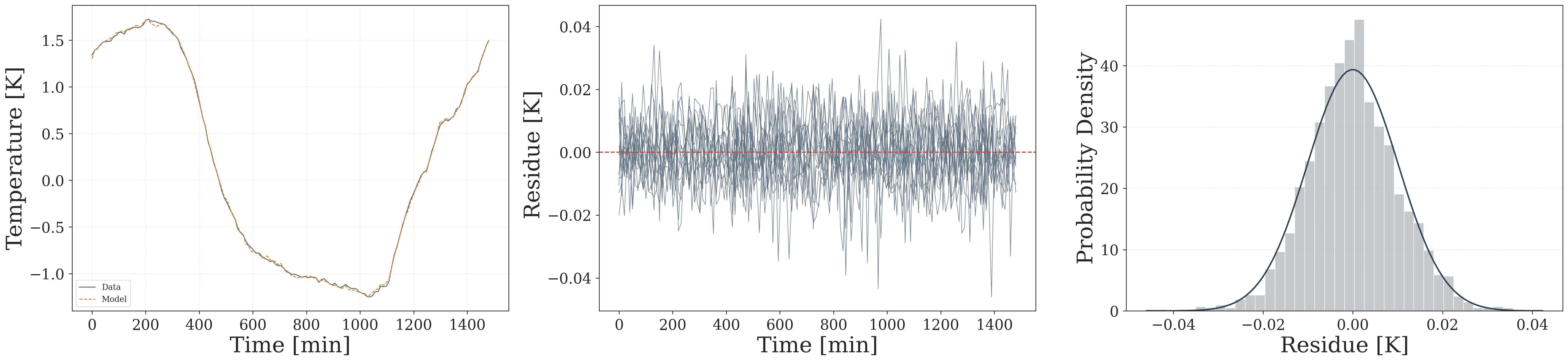
The trouble is, the whisper gets drowned out by a roar — thermal noise from the room and electronics. Physicists used spectral analysis as noise cancellation: they recorded the background from sensors not aimed at the target and subtracted it from the main data.
The silence remained absolute. But it’s not useless: the experiment, for the first time using quantum detectors for photometry, set the tightest limit yet on how likely dark photons are to turn into ordinary light in the mass range of 0.6–1.4 meV.
Original abstract
as written by the authors arXiv:2602.18218
This paper presents the first results from the Dandelion experiment, a directional detection, which searches for 1 meV dark photon dark matter. We use a spherical mirror to convert dark photons into standard millimeter-wavelength photons that can then be detected with an array of 221 Kinetic Inductance Detectors (KIDs) cooled down to 150 mK within the KISS-NIKA camera ( (KIDs Interferometric Spectral Surveyor) and operating between 150 and 350 GHz. We used 1480 minutes of data to search for the signal of dark photons in the KID detectors, which is expected to be modulated due to the Earth's rotation. Our main challenge was to deal with a large background from room temperature and stray-light fluctuations. We used a de-correlation analysis to remove these background fluctuations. Templates of the background fluctuations were constructed from a Principal Component Analysis decomposition of detector measurements outside the expected Field of View trajectory of dark photons. We found that the dark photon signal was consistent with zero, giving a new upper limit on the dark photon's kinetic mixing, $$\chi$$, with masses between 0.6 meV and 1.4 meV. These are the first constraints on dark photons as a dark matter candidate using an array of KIDs at millimeter wavelength.
A dark photon with a mass of 1 meV is half a million times lighter than an electron — the lightest particle with nonzero mass.