The neutrino background is a pervasive sea of neutrinos left over from the early universe, filling all of space. These relic neutrinos were created about one second after the Big Bang and have been streaming freely ever since, barely interacting with matter. Because they are so numerous — about 300 per cubic centimeter — they form a constant background that can interfere with sensitive experiments designed to detect dark matter. Dark matter detectors, which look for rare collisions between dark matter particles and atomic nuclei, can be fooled by neutrino interactions that mimic the same signal. This sets a fundamental limit on how sensitive such detectors can become, known as the 'neutrino floor.'
History
The existence of a cosmic neutrino background was predicted in the 1940s by George Gamow and his collaborators, and later refined by others. It was first directly observed in 2015 by the COHERENT experiment, which detected neutrinos scattering off nuclei, confirming the mechanism that limits dark matter detectors.
How it works
Neutrinos interact via the weak nuclear force, which is extremely feeble, but with billions of them passing through every detector each second, a few will occasionally scatter off nuclei. These scattering events produce tiny recoils that are nearly identical to what a dark matter particle would produce. As detectors become more sensitive, they start to see these neutrino-induced events, which are indistinguishable from dark matter signals on an event-by-event basis. The only way to tell them apart is by direction or timing, but for many detector designs, this is not possible, creating a hard limit on sensitivity.
In practice
Understanding the neutrino background is crucial for designing next-generation dark matter detectors, such as those using xenon or argon, to ensure they can push past the neutrino floor or use directional detection to separate the two signals.
Fun fact
The cosmic neutrino background has a temperature of about 1.9 Kelvin, colder than the cosmic microwave background, and its neutrinos are so old that they have been traveling for 13.8 billion years without interacting with anything.
The neutron is a particle that usually sits in the atomic nucleus and doesn't disappear. But some theories suggest that occasionally it might transform into its invisible twin — a particle that ordinary detectors can't catch.
Light from distant quasars, breaking through billions of years, leaves a pattern of dark absorption lines on the cosmic film — the spectroscopic Lyman-alpha forest. Each line is like a note in a grand score, written by the hydrogen of the intergalactic medium.
A teaspoon of neutron star matter weighs as much as a mountain. But this mountain may have an invisible twin.
Deep inside a neutron star, ordinary matter is compressed to unimaginable densities. There, protons and neutrons can dissolve into a quark soup.
A stone thrown into water leaves ripples. A satellite orbiting Earth also leaves a trace — not on water, but in the laws of physics. Its orbit is not a frozen line: it slowly rotates, like the hand of a giant clock.
Deep underground in Japan, a huge tank of ultrapure water waits for rare visitors — neutrinos arriving from distant stellar explosions. Such guests are few and far between: over years of observation, Super-Kamiokande registers only a handful of events.
Hot tea in a freezer doesn't freeze all at once. First, tiny ice needles dart around — forming and melting until the temperature drops enough for the ice to set solid. The early universe behaved similarly as it cooled and changed its internal structure.
The universe is permeated by an invisible substance, dark matter, whose gravitational influence is obvious, but whose composition remains a mystery. One hypothesis suggests it consists of ultralight particles so light that they exhibit wave-like behavior, forming a kind of cosmic ripple.
In the kitchen, there's a bucket of water and an identical bucket of sand. Pour the sand into the water, and you get a mixture where there's exactly five times more sand than water. That's roughly how our universe is arranged: one part ordinary matter — the stuff stars, planets, and we ourselves are made of — and five parts elusive dark matter.
In the mid-20th century, astronomer Vera Rubin discovered that stars on the outskirts of galaxies were moving too fast — held by an invisible mass. Thus the mystery of dark matter was born. It doesn’t emit light but reveals itself through gravity. The big question: why is there exactly as much as we see?
A dark matter detector is like a room where you're trying to hear a whisper while static electricity crackles nearby. This crackle is produced by radon atoms — a radioactive gas that seeps out from materials and air.
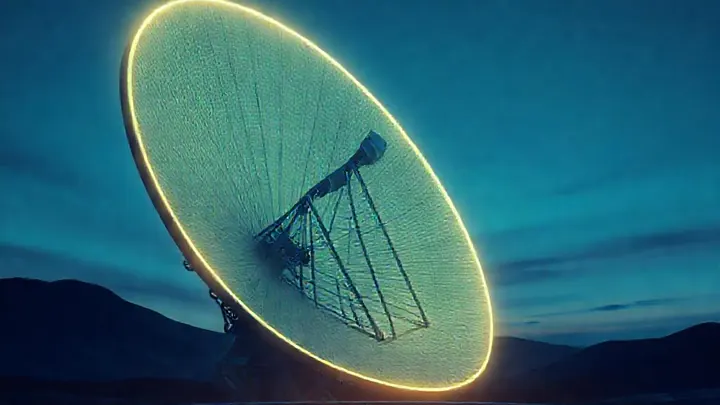
The universe is held together by an invisible scaffolding of dark matter. Part of it could be dark photons, ghostly copies of light that pass right through matter. The Dandelion experiment turned a spherical mirror into a super-sensitive ear: it gathers dark photons and translates them into the language of radio waves.
Hidden in the heart of the Alps is the Large Hadron Collider. From time to time its detectors register sudden bursts — scientists call them UFOs (Unidentified Falling Objects). According to one theory, these are not equipment malfunctions at all, but traces of dark matter.
A bullet that doesn't just pierce one target but leaves marks in several layers of armor. That's roughly how superheavy dark matter behaves, and it's what the DarkSide-50 detector was built to catch for the first time. The usual suspects for dark matter (weakly interacting massive particles, or WIMPs) pass through matter almost unnoticed, occasionally bumping into a nucleus.
Since Vera Rubin first convincingly showed that galaxies are surrounded by invisible matter, the quest to understand the nature of dark matter has remained one of physics' greatest challenges.
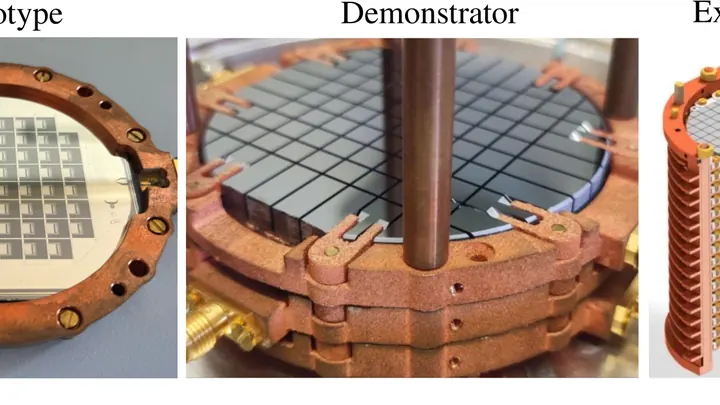
Dark matter is the invisible substance that holds galaxies together, yet it has so far escaped direct detection. The BULLKID-DM detector is designed to catch candidate particles with a mass around 1 GeV (roughly that of a proton) and an extremely weak interaction with ordinary matter — a…
Dark matter is the invisible glue that keeps galaxies from falling apart. Back in the 1930s, Fritz Zwicky suspected its existence, and in the 1970s Vera Rubin proved that without it, stars would fly apart.
Deep inside an underground laboratory, a room-sized detector waits for an event that might happen once in a hundred million billion years. That event is neutrinoless double beta decay — a process that would break one of physics' fundamental laws. To catch it, you need perfect silence: not a single stray radioactive atom in the detector's materials.