Layers as a Switch: Topology from Ordinary Components express
A stack of identical pancakes on a plate is just a stack. But if you arrange them with a certain order, something new suddenly appears: for example, a pattern that was not visible in each pancake individually. Physicists have performed a similar trick with thin layers of materials.
Topological states are usually associated with special materials where electrons or waves behave unusually at the surface. But the authors of this work took layers that are topologically trivial by themselves — nothing special. Then they imposed symmetry constraints: they required that the layers be stacked according to strict rules. And it turned out that this is enough for protected states to emerge at the boundaries of the stack.
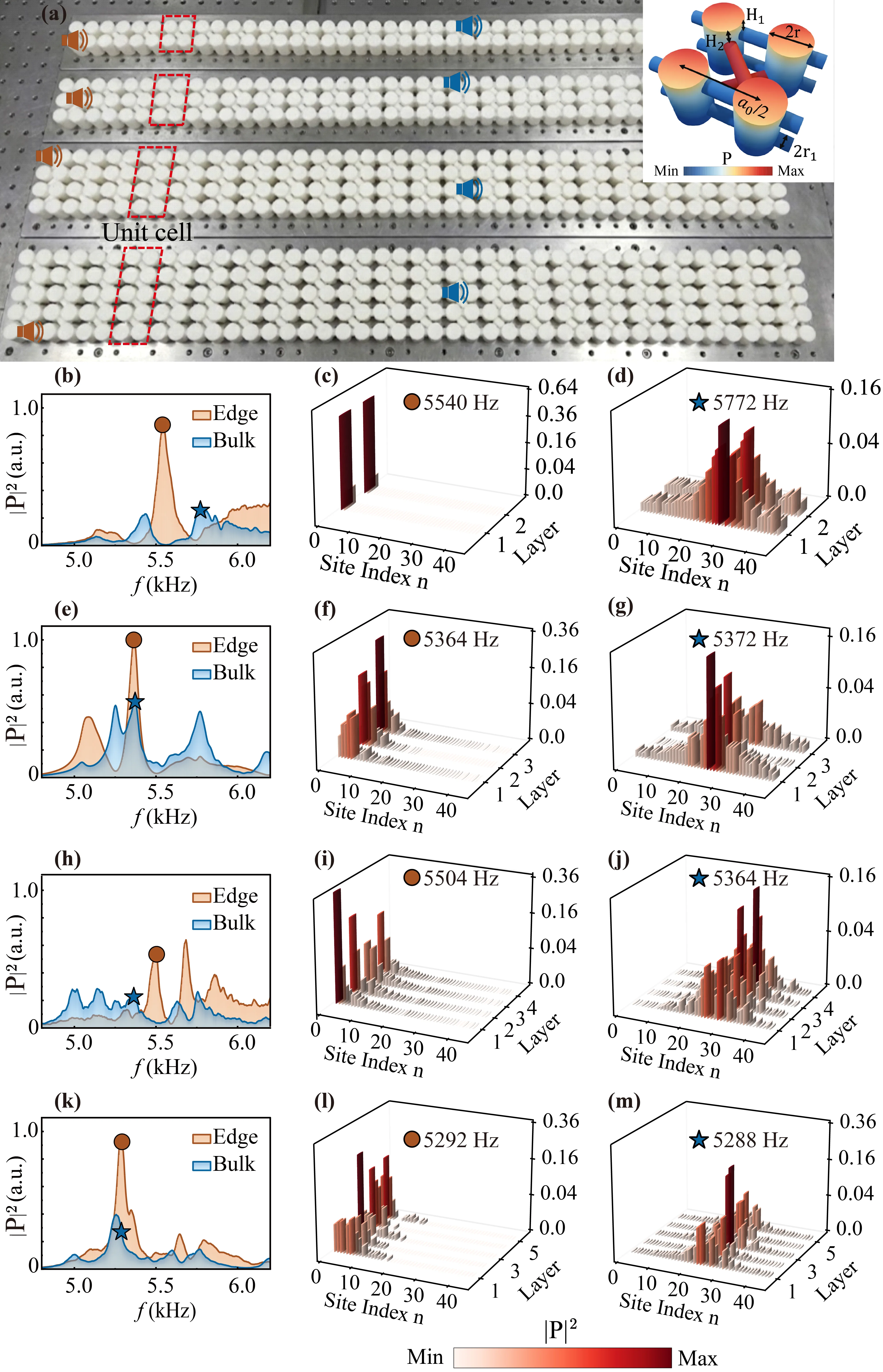
The researchers not only calculated this on paper but also built an acoustic lattice — a stack of layers through which sound waves travel. The experiment confirmed that with an odd number of layers, protected states indeed emerge. This approach is like a construction set: you take ordinary parts, assemble them according to the instructions, and get a material with unusual properties.
This opens a simple path to creating exotic states in a wide range of artificial materials — from acoustic to optical and electronic. Instead of searching for rare materials with the desired topology, you can take ordinary ones and simply stack them correctly.
Original abstract
as written by the authors arXiv:2602.18855
We demonstrate that stacking topologically trivial layers, under enforced symmetry restrictions, yields emergent topological phases with protected boundary states. Remarkably, the number of layers itself acts as a topological switch, enabling the system to host topological bound states in the continuum (BICs). We analytically show that the spectrum becomes gapless for an odd number of layers; combined with entanglement-spectrum calculations, this confirms that odd-layer systems indeed support topological BICs. We provide experimental confirmation of these phenomena in stacked acoustic lattices. Our findings establish a previously overlooked pathway to topology and demonstrate a readily applicable strategy for realizing exotic states in a wide range of artificial material systems.
Bound states in the continuum (BIC) were first proposed in quantum mechanics back in 1929, but for a long time they were considered a mathematical curiosity. Today they are actively used in lasers and sensors.
In the series "Dark", time loops and parallel worlds can be compared to topological states: they exist thanks to the global structure, not the properties of individual elements.