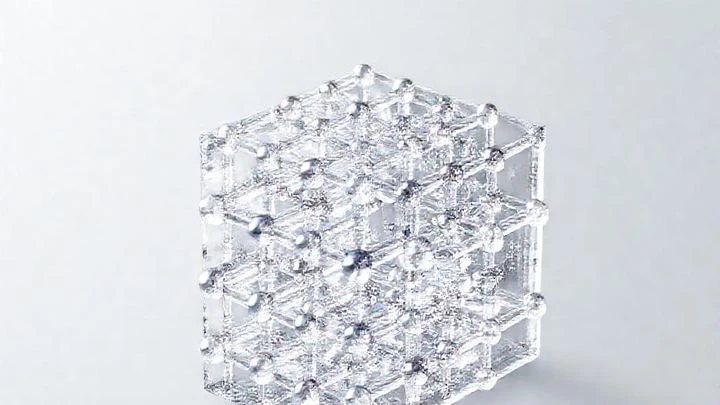
An optical lattice is a periodic potential energy landscape created by the interference of counter-propagating laser beams. It traps neutral atoms or ions in a grid-like pattern, allowing scientists to study quantum many-body systems with unprecedented control. This 'crystal of light' serves as a versatile platform for simulating condensed matter phenomena, exploring quantum phase transitions, and building quantum computers.
History
The concept was developed in the late 1980s and early 1990s, with pioneering work by Claude Cohen-Tannoudji, Steven Chu, and others on laser cooling and trapping. The first experiments with atoms in optical lattices were performed in the mid-1990s.
How it works
When two or more laser beams overlap, their electric fields interfere, creating a standing wave pattern with regions of high and low intensity. Atoms experience a force proportional to the intensity gradient (dipole force), so they are attracted to the intensity maxima or minima, depending on the laser detuning. By using multiple beams in different directions, a 1D, 2D, or 3D lattice of potential wells is formed. Atoms can be loaded into these wells, and by adjusting the laser intensity and frequency, the lattice depth and spacing can be precisely controlled.
In practice
Used in quantum simulation of the Hubbard model, studying Bose-Einstein condensates, and as a basis for neutral-atom quantum computing, where qubits are trapped in individual lattice sites.
Fun fact
Optical lattices can be used to create 'quasicrystals' for atoms, where the potential pattern never repeats exactly, mimicking the structure of quasicrystalline materials.
A light field, like a neat waffle iron, presses a regular pattern of bright and dark regions into space. Atoms get stuck in the brightest spots as if in tiny dimples: that's an optical lattice. It's a favorite tool for physicists who want to study quantum behavior of matter in its pure form.
For a long time, biologists studied cells by listening to just one voice in a polyphonic choir: measuring gene activity while ignoring how DNA is packed. It's like trying to grasp a conversation knowing only one language. LATTICE fixes this: the program learns five molecular 'languages' at once — from gene activity to spatial markers.
A magnetic field holds a tiny particle in mid-air, like an invisible dance partner. A special tuning of the field creates a trap with two "positions." In the ordinary world, a dancer occupies only one, but in the quantum world — both at once. Physicists have learned to achieve this for dust grains weighing trillionths of a gram.
An ionic conductor resembles a crowded bus where passengers (ions) try to squeeze toward the exit. Previously, it was thought that fast exit could be achieved either by a gently swaying bus (soft lattice) or by passengers standing in chaotic order (geometric disorder). The new work shows these are not two different tricks but the same one.
A flashlight beam in a dark room can hold a dust mote almost still: that's how optical tweezers work. But light doesn't just push the particle; it also jostles it with random kicks. Each absorbed photon strikes it like an invisible hammer. The authors of the new study have devised a light trap of a special shape.
A candle flame flickers in a draft but doesn't go out — the tongue of fire briefly changes shape and then returns. Optical skyrmions behave much the same way — tiny vortices in a light beam, reminiscent of swirling eddies. Until recently, they were created only in the perfect, smooth light of a laser.
Vacuum is not silent emptiness, but a boiling cauldron of quantum fluctuations, born from nothing and vanishing in billionths of a second. This invisible symphony acts like a constant wind, pressing an atom against a wall — as if a powerful bass note pushes a light ball.
Diamond is the hardest natural material, and working with it usually feels like a sculptor using a jackhammer: rough, with cracks and chips. But electronics demands jeweler-like precision, because diamond conducts heat superbly, withstands high temperatures, and can work in quantum devices.
A stack of identical pancakes on a plate is just a stack. But if you arrange them with a certain order, something new suddenly appears: for example, a pattern that was not visible in each pancake individually. Physicists have performed a similar trick with thin layers of materials.
Three charged ytterbium atoms are arranged in a triangle inside an electromagnetic trap. Normally, they all communicate with each other, like three people at a table constantly exchanging remarks. But if one of them steps into the next room, the conversation continues between the remaining two.
An ordinary laser amplifies light into a bright beam. Run the process in reverse, and you get an anti-laser — a device that sucks in light without a trace. But such a machine is finicky: even a slight disorder can ruin the absorption.
Physicists have found a way to make the anti-laser invulnerable.
Throw pebbles along a tight row of posts: they ricochet into a dense spray. Throw at an angle, and they scatter. Gamma rays in a crystal do the same: they spawn particle cascades that spread out unless the crystal’s atomic rows are perfectly aligned. Align them within a hair’s width, and the cascade sharpens into a tight beam. A small crystal then outperforms a large one.