Sharp Corners Break Superfluidity express
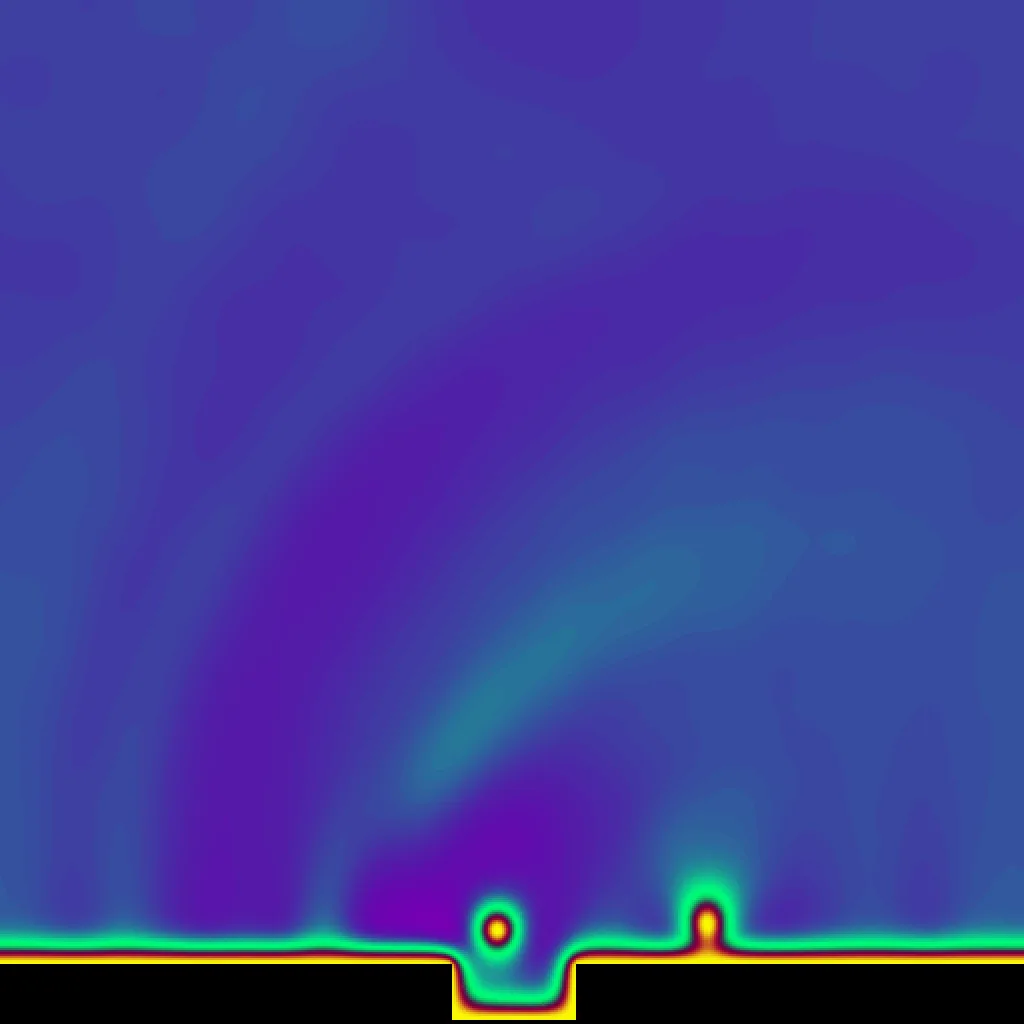
A superfluid flows without friction, like water in a perfectly smooth pipe, but the moment it hits an obstacle, the picture changes. In a new study, researchers looked at how a superfluid stream flows around rectangular walls and pits with sharp corners. It turns out that right at the corners, the flow speed jumps dramatically, like air over an airplane wing, only stronger. This acceleration, not the overall flow speed, decides when vortices, tiny quantized whirlpools, are born in the fluid.
Using a mathematical method that traces back to the work of Hermann Schwarz, the authors derived exact formulas for the critical speed — the speed at which vortices start to appear. The formulas depend only on the obstacle's width and its height or depth. Numerical simulations confirmed the theory with high precision. This means you can predict in advance at what speed a superfluid flow will lose stability, simply by measuring the obstacle's dimensions.
The results apply directly to experiments with Bose-Einstein condensates — clouds of atoms cooled to near absolute zero, where superfluidity is observed in the lab. There, obstacles with sharp edges are created with laser beams, and now one can more accurately calculate when vortices will appear. This is a step toward controlling quantum vortices — which could become components of future quantum devices.
Quantized vortices in superfluid helium were first seen in the 1950s by shooting a beam of electrons through the liquid, the vortices cast shadows like tiny tornadoes.