A Magnetic Carousel Around a Dead Star express
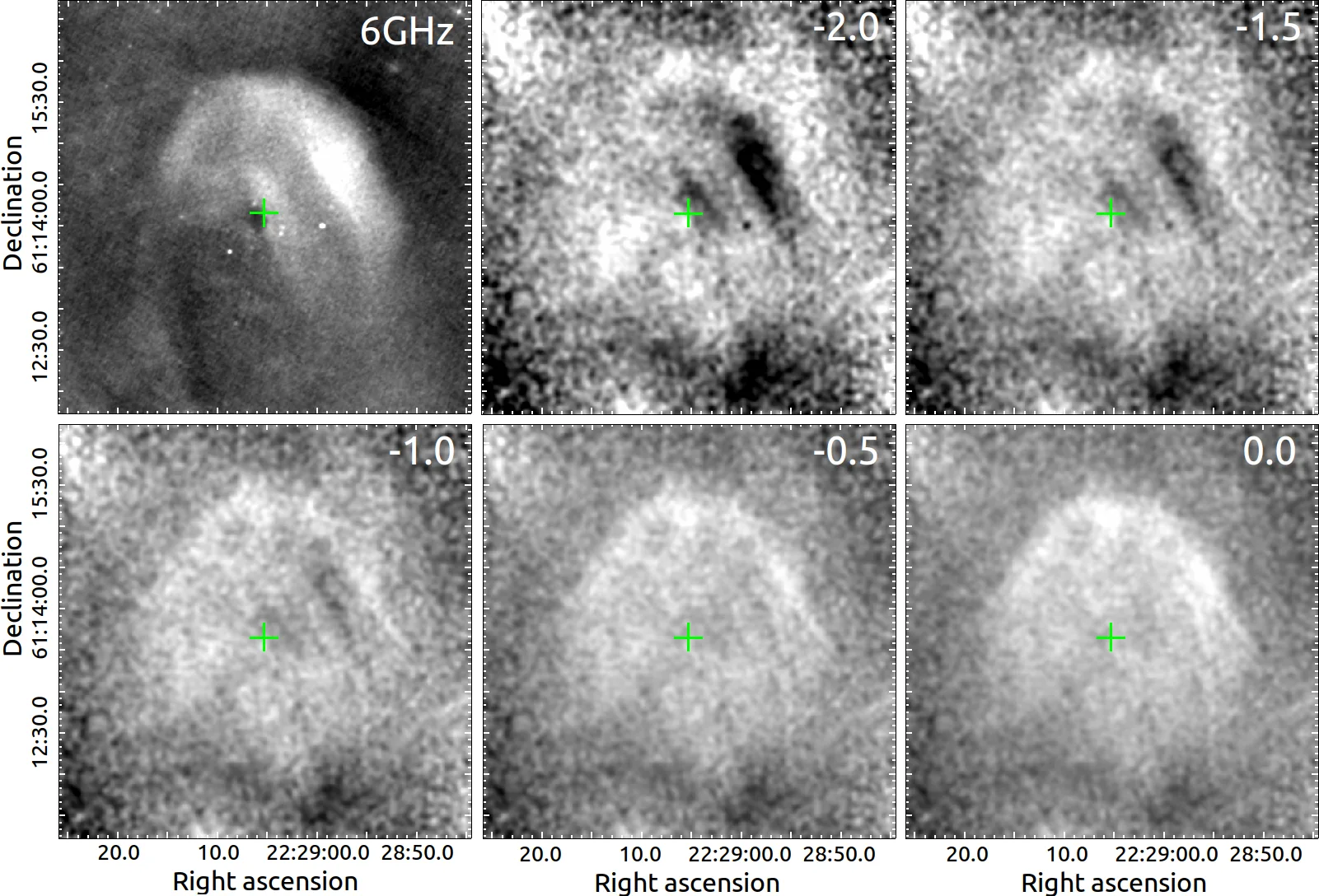
The VLA radio telescope peered into the Boomerang Nebula — a cloud inflated by the wind from a rapidly spinning neutron star. The new images reveal details as small as a lunar disk on the sky: an elongated core around the pulsar and a long arc curving around it from the north. The arc doesn't touch the core: there's a dark gap between them, like the space between a shore and a wave.
It turns out the field in the nebula is twisted like threads on a spool. The bright northwestern lobe is 60% polarized — almost the maximum that the radiation itself allows. But at lower frequencies, the signal was weaker: on its way to us, the waves passed through magnetized gas and rotated slightly. This rotation, like a compass needle twisting, revealed the field strength — about 50–105 microgauss. For comparison, at Earth's surface the field is hundreds of times stronger, but here it's stretched over light-years.
So the wind from a dead star, accelerated to nearly the speed of light, slams into interstellar gas and sculpts it into a glowing carousel. The arc, the lobe, and a tongue to the northeast are traces of this invisible work.
Original abstract
as written by the authors arXiv:2602.20230
We present a radio polarimetric study of the Boomerang pulsar wind nebula G106.65+2.96 with VLA observations at the 6 GHz band. Our high-resolution image discovers new small-scale features in the nebula, including an elliptical core of $$40''\times20''$$ surrounding the central pulsar and a $$2'$$-long arc wrapping around the core in the north. The latter shows a clear gap from the core, and it consists of a bright lobe in the northwest and a tongue-like structure in the northeast. These could be resulting from the pulsar wind interaction with the environment. Our polarization measurement reveals a highly ordered magnetic field with toroidal geometry. The small scale features are all highly linearly polarized. In particular, the lobe has a polarization fraction of $$\sim$$60%, close to the synchrotron limit. This is also much higher than the value measured at a lower frequency, implying significant depolarization. We show that this can be explained by Faraday rotation in the nebula, and we constructed a simple 3D model accordingly to infer a magnetic field strength of $$\sim$$50-105$$\mu$$G.
60% polarization is nearly the theoretical maximum for such radiation. That means the magnetic field in the lobe is surprisingly smooth, without turbulent swirls.