Magnetic Knot in a Rubber Beam express
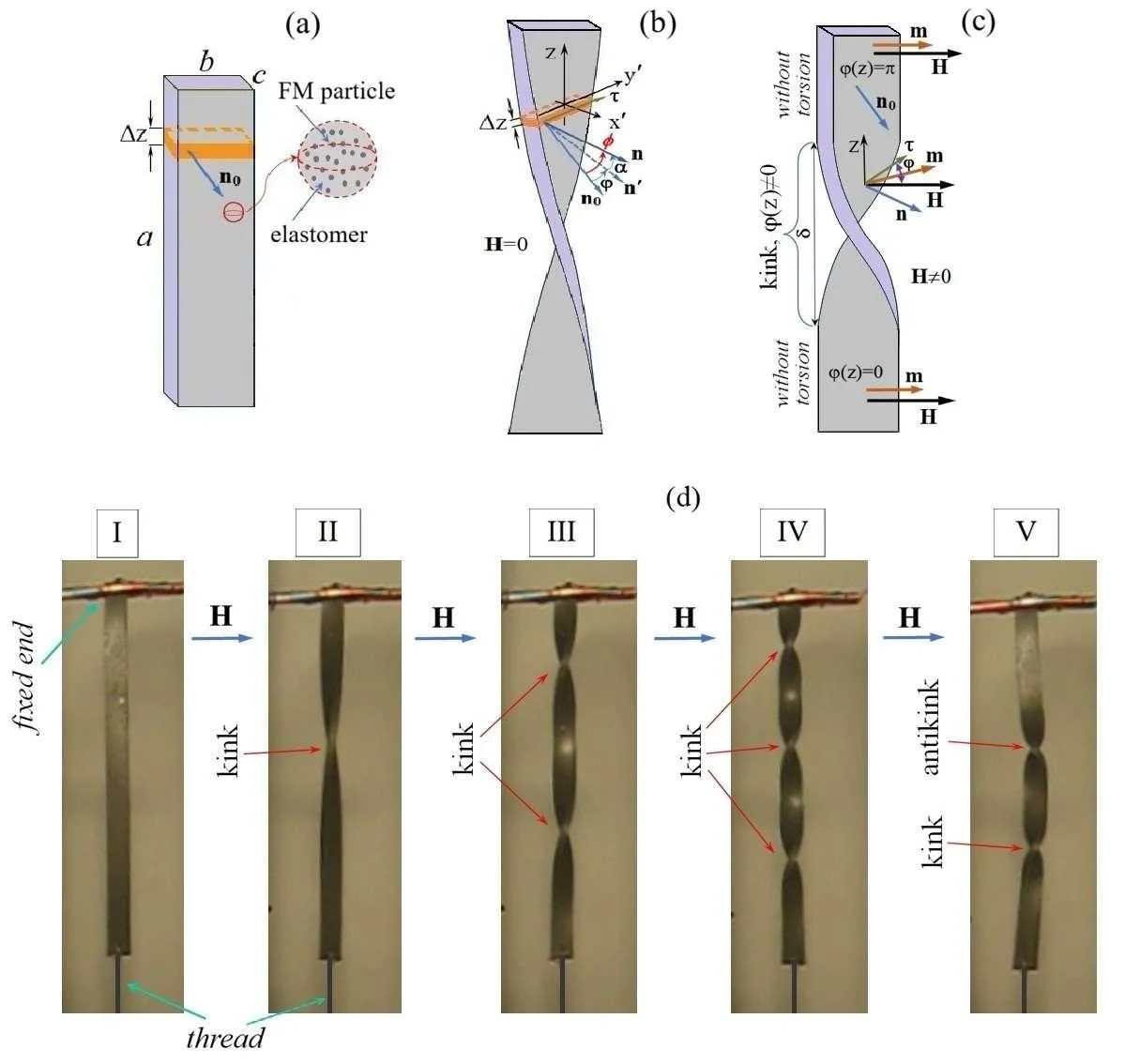
An ordinary rubber strip filled with fine iron filings doesn't just bend in a magnetic field: it ties itself into a stable knot. This effect was predicted and reproduced in experiments by physicists working with magnetoactive elastomers: a silicone base with carbonyl iron particles.
Under a uniform magnetic field, the beam stays almost straight along its entire length, but at one spot a sharp helical twist appears, as if someone had twisted a rope hard. This twist doesn't straighten out because, in that zone, the elastic moment (the rubber's tendency to regain its shape) is exactly compensated by the magnetic moment. The iron particles inside the twist align not along the field but at an angle — because of the beam's shape, the magnetization 'pushes' against its edges.
Such a knot is stable: if you nudge it slightly, the forces bring it back into place. This means the beam can be used as a switch — two straight sections with a twisted zone between them. By changing the field, you can move the knot along the beam or make it disappear. For soft robotics and magnetic actuators, this is a new way to control shape without complex mechanisms.
The knot in a rubber beam is a rare example of magnetic energy and elasticity combining into a stable structure. It resembles a knot in a shoelace that doesn't come undone on its own because friction and tension are balanced. Here, instead of friction, it's a magnetic field, and instead of a shoelace, it's a smart material.
Carbonyl iron is produced by decomposing iron pentacarbonyl — a liquid that boils at 103 °C. The resulting particles are so pure that they are used in antennas and magnetic fluids.