Dark Excitations on Clean Graphene express
A layer of graphene on silicon carbide is like a perfectly flat table onto which you need to carefully place fragile molecules. Any speck of dust or imperfection spoils the picture: molecules settle crookedly, and their quantum properties vanish. The researchers developed a cleaning method that restores the surface to a purity comparable to deep vacuum. Examination with an electron beam showed that atoms on graphene arranged into an impeccable lattice.
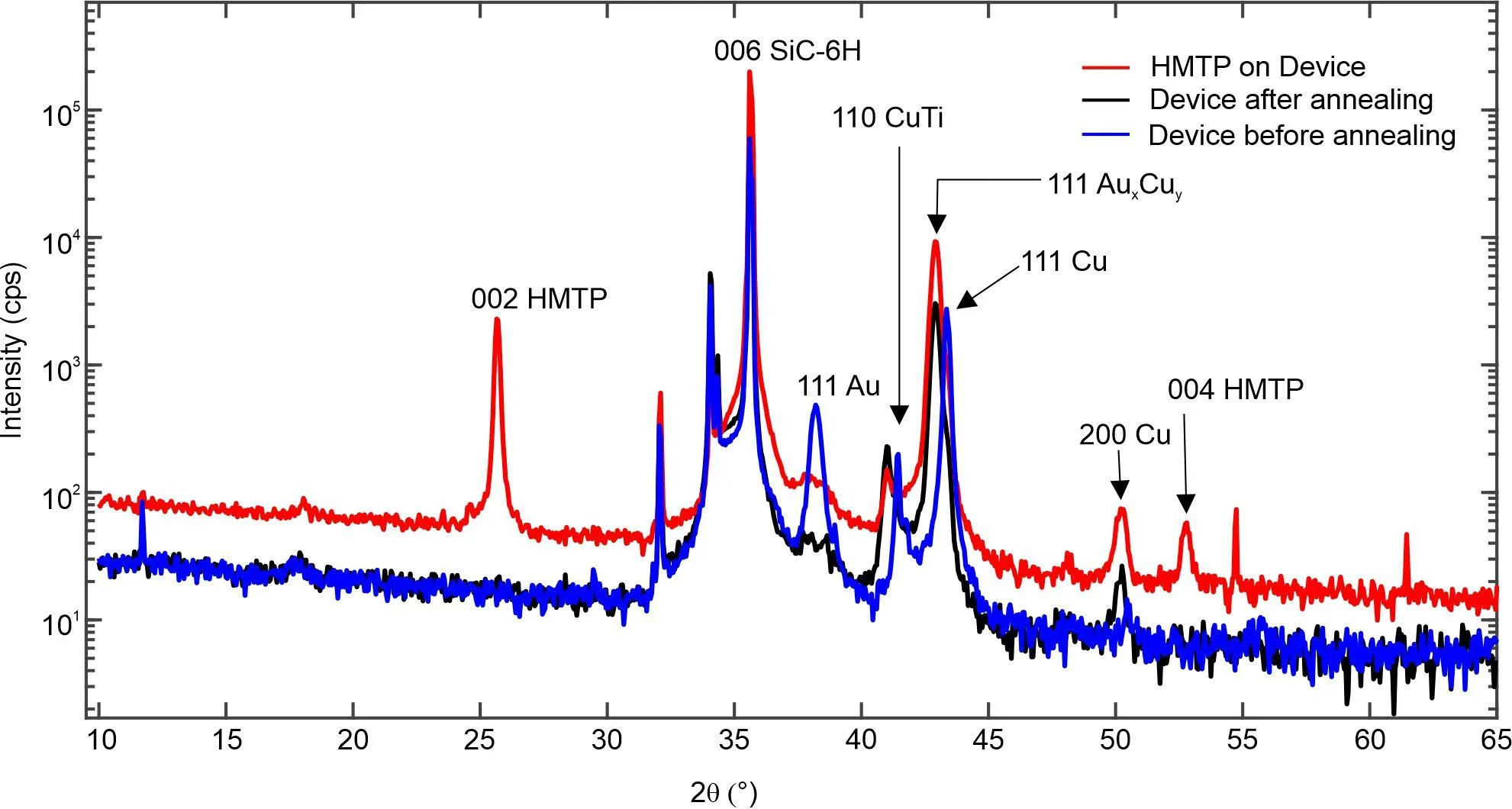
Onto this clean table, they deposited HMTP molecules — organic compounds that interact strongly with light and vibrations. Due to the symmetry of the molecular crystal packing, their ground energy state splits into two: bright and dark. The bright one quickly emits light, while the dark one lives long — energy is trapped inside like water in a sealed bottle. According to calculations, it is the dark states that dominate light emission: they slowly release energy through molecular vibrations.
To understand how energy flows within the molecular layer, the scientists combined three methods: they measured electric current under light, sample luminescence, and molecular vibrations. Calculations based on these data showed that energy first goes into the dark state, and only then into light. This is like a train that takes a detour instead of a direct route: it takes longer, but without losses.
This approach, combining industrial graphene technology with molecular precision, opens the way to creating solid-state quantum devices. Dark excitations can store information longer than bright ones, and thus become the basis for quantum computer memory.
Original abstract
as written by the authors arXiv:2603.02301
The realization of high-fidelity organic-inorganic quantum emulators is frequently hindered by the interfacial imperfections introduced during device fabrication. Here, we demonstrate a robust nanofabrication protocol that restores the atomic-scale purity of epitaxial graphene on SiC to UHV-equivalent levels, as confirmed by Low-Energy Electron Diffraction, and Microscopy. This pristine interface enables the emergence of macroscopic excitonic coherence in epitaxial overlayers of 2,3,6,7,10,11-hexamethoxytriphenylene (HMTP), a model molecular system characterized by intense electron-phonon coupling. Through a combination of high-sensitivity Fourier Transform Photo-current Spectroscopy, photoluminescence, and dynamic Raman mapping, we resolve a complex vibronic manifold governed by Davydov splitting. We show that the $$P6_3/m$$ crystalline symmetry of the HMTP overlayer lifts the degeneracy of the HOMO-LUMO transition, creating discrete bright and dark excitonic branches. Using an analytical tight-binding model parameterized by ARPES-derived intermolecular coupling and Raman vibrational modes validated by molecular dynamics simulations, we quantify the polarization energy, the Huang-Rhys factor, and Herzberg-Teller corrections to the Franck-Condon model. Our results reveal that the dark-state branch dominates the radiative channel, following a polaron-mediated relaxation pathway consistent with Kasha's rule. By reconciling macroscopic device architecture with UHV-level surface science, this work establishes a scalable platform for the study of dark-exciton dynamics and the development of solid-state molecular quantum memories.
Dark excitations got their name because they do not emit light directly: their energy can only be seen indirectly, through heat or faint glow.
In the series 'The Expanse', quantum computers use exotic states of matter for instantaneous computations — dark excitations could be a real step toward such science fiction.