The Hidden Pulsar in a Globular Cluster express
In a dense ball of hundreds of thousands of stars, what astronomers call a globular cluster, radio telescopes have picked up a faint but very steady rhythm. Every 2.45 milliseconds, that's 408 ticks per second, a radio pulse arrives. This is the signature of a new millisecond pulsar: a dead star the size of a city, spinning faster than helicopter blades.
The pulsar, named PSR J1716-2808A, is not alone. It circles a lightweight companion star with a mass about one-tenth that of the Sun. A full orbit takes just 10 hours — shorter than a workday. And the pulsar doesn't hide behind its companion: its signal never fades, with no eclipses in sight.
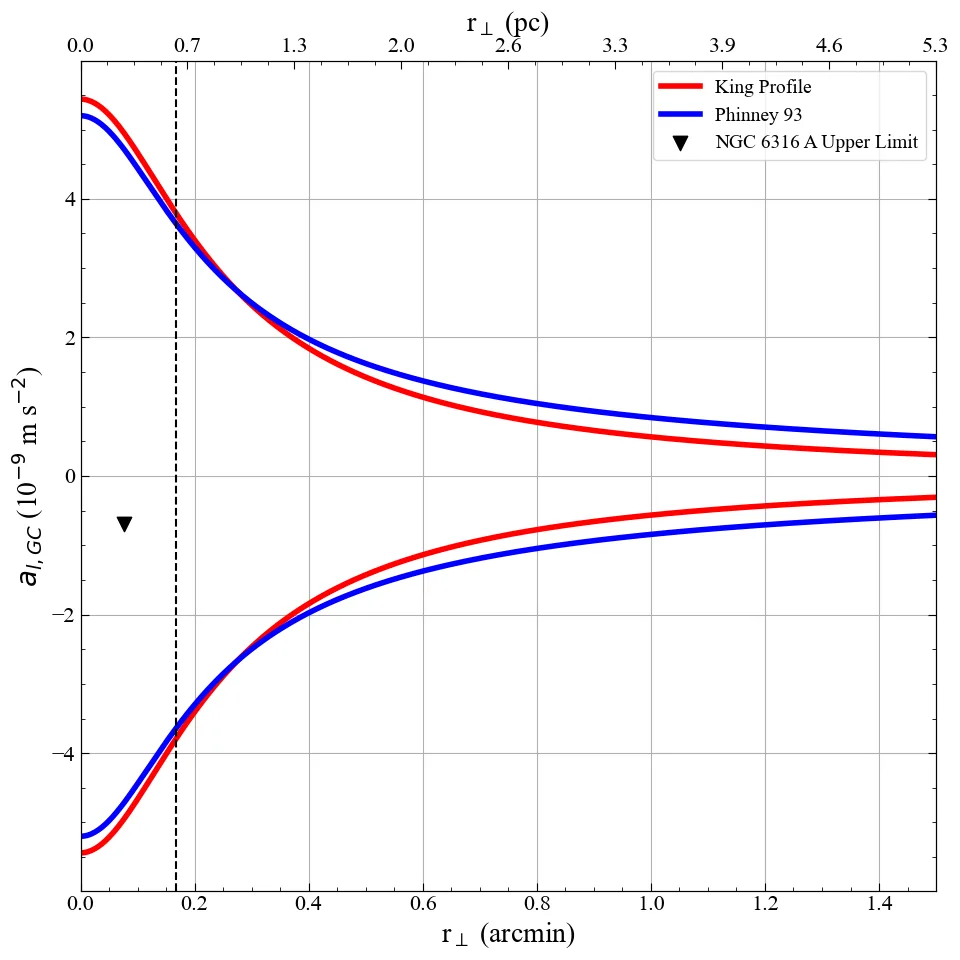
The most intriguing part: the pulsar is slightly "early." Its pulses arrive a bit more often than they would if it were stationary. That happens when a pulsar is moving toward us: its own motion squeezes the gaps between signals. Astronomers calculate the pulsar's acceleration at about 2.3×10⁻¹⁸ per second per second. It sounds like nothing, but for such precise clocks, it's noticeable.
This acceleration is not just a curiosity. It reveals that the pulsar truly lies deep inside the cluster, not merely aligned with it by chance. The cluster pulls on it like an invisible spring. And the strength of that spring tells us how much mass is hidden in the cluster.
Now astronomers will keep watching this pulsar for years. The longer the observations, the more precisely they can weigh the cluster and understand its structure. And if they're lucky enough to find a few more such pulsars, NGC 6316 will stop being a mystery and become one of the best-studied stellar "apartment buildings."
Millisecond pulsars are the most accurate clocks in the universe. Some of them lose less than a second over a billion years.