The kilometer per second per megaparsec (km/s/Mpc) is the standard unit for the Hubble constant, which describes the rate of expansion of the universe. It expresses how fast galaxies recede from us per unit distance. This unit is fundamental in cosmology, as it quantifies the expansion rate and helps determine the age and fate of the universe.
History
The unit was established after Edwin Hubble's 1929 discovery of the expansion of the universe, though the concept of a constant expansion rate was earlier proposed by Georges Lemaître.
How it works
The Hubble constant is measured by observing the redshift of distant galaxies and estimating their distances. The unit km/s/Mpc means that for every megaparsec (about 3.26 million light-years) of distance, a galaxy's recession velocity increases by the given number of kilometers per second. Measurements from different methods, such as Cepheid variables, supernovae, and cosmic microwave background, sometimes yield slightly different values, leading to the 'Hubble tension'.
In practice
It is used to calculate the age of the universe, map cosmic expansion, and test cosmological models, including dark energy theories.
Fun fact
The Hubble constant is often cited as about 70 km/s/Mpc, meaning a galaxy 1 megaparsec away moves away at 70 km/s, and one 10 megaparsecs away at 700 km/s.
Systems:SIOne kilometer per second per megaparsec is defined as the velocity change of 1 kilometer per second per megaparsec of distance, equivalent to approximately 1.0227 × 10^-18 per second.
In the heart of an old city stands a clock tower whose hands have never been adjusted since it was built. By how far it runs slow, you can calculate how much time has stretched since then. In space, the role of such towers is played by relic galaxies — dense stellar systems that formed in the first few billion years and have since neither merged with neighbors nor given birth to new stars.
Six runners sprint down the track, and officials time their speed without noticing a tailwind. The wind blows at their backs, and the stopwatches show a better result than the truth. Roughly this is how six megamasers — natural cosmic lasers in distant galaxies — misled astronomers measuring the expansion rate of the universe.
Measuring distances in the universe is no easy task. Almost all methods rely on light, which can be absorbed by dust, scattered, or distorted along the way. It's like trying to spot a distant lighthouse through fog and haze. Neutrinos are a different story. These ghostly particles pass through anything without noticing obstacles.
Strike a tuning fork. The frequency is 440 Hz. That's the note A — the standard of sound.
In the world of numbers, there's a standard too. It's tuned not to sound, but to prime numbers. Though their distribution seems random, it obeys strict laws. All primes resonate together. There's just one value: λ∞ ≈ 0,674036.
The cosmological orchestra doesn't tune to a single tuning fork. There are two groups of instruments: one listens to the hum of the young universe — the cosmic microwave background, while the other reads notes from mature galaxies and supernovae.
The universe abhors monotony. A century ago, Edwin Hubble and Georges Lemaître gave us an elegant picture: an expanding cosmos, smooth as the surface of an inflated balloon.
The universe keeps a tally of every newborn star. Over 13.8 billion years, galaxies have ignited so many stars that their 'census' can reveal the nature of the cosmos itself, just as tree rings reveal past climates.
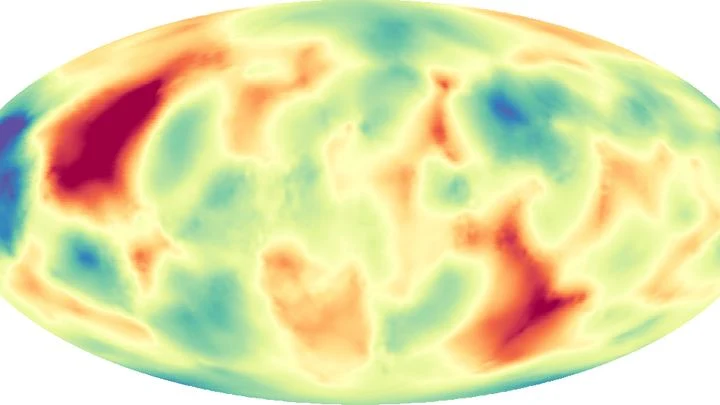
Cosmologists have measured how fast distant galaxies are receding in different parts of the sky. To do this, they used two kinds of "cosmic rulers": galaxy clusters and a certain type of supernova explosion. Both methods showed the same thing: in one direction, the Universe is expanding slightly faster than in the opposite direction.
The Universe is expanding, but at what speed? Astronomers have been arguing for decades about the precise value of the Hubble constant. Two classic methods give slightly different results. Now there's a third — using mysterious radio bursts.
When a massive star explodes, its remnants fly apart like fragments of fireworks. But how do we know how far away such an explosion occurred? Astronomers have found a way: they look at the gas clouds that these remnants collide with.
The idea is simple. Supernova remnants are often surrounded by clouds of cold molecular gas.
Rhythmic flashes of a lighthouse in thick fog: that's what searching for pulsars looks like. The lighthouse spins, and its beam periodically sweeps across the telescope. But the fog smears the light, making the period seem slightly different. If the same lighthouse was observed twice, you can compare: the periods should nearly match, and the smearing should be similar.
In a dense ball of hundreds of thousands of stars, what astronomers call a globular cluster, radio telescopes have picked up a faint but very steady rhythm. Every 2.45 milliseconds, that's 408 ticks per second, a radio pulse arrives.