Room-Temperature Superconductivity Just Got a Step Closer express
Superconductivity is the ability of a material to conduct electricity without losses. Ordinary wires heat up, and some energy is lost as heat, but a superconductor carries current with zero resistance. Until now, however, this state could only be achieved at extremely low temperatures or under enormous pressure, which has kept it out of everyday use.
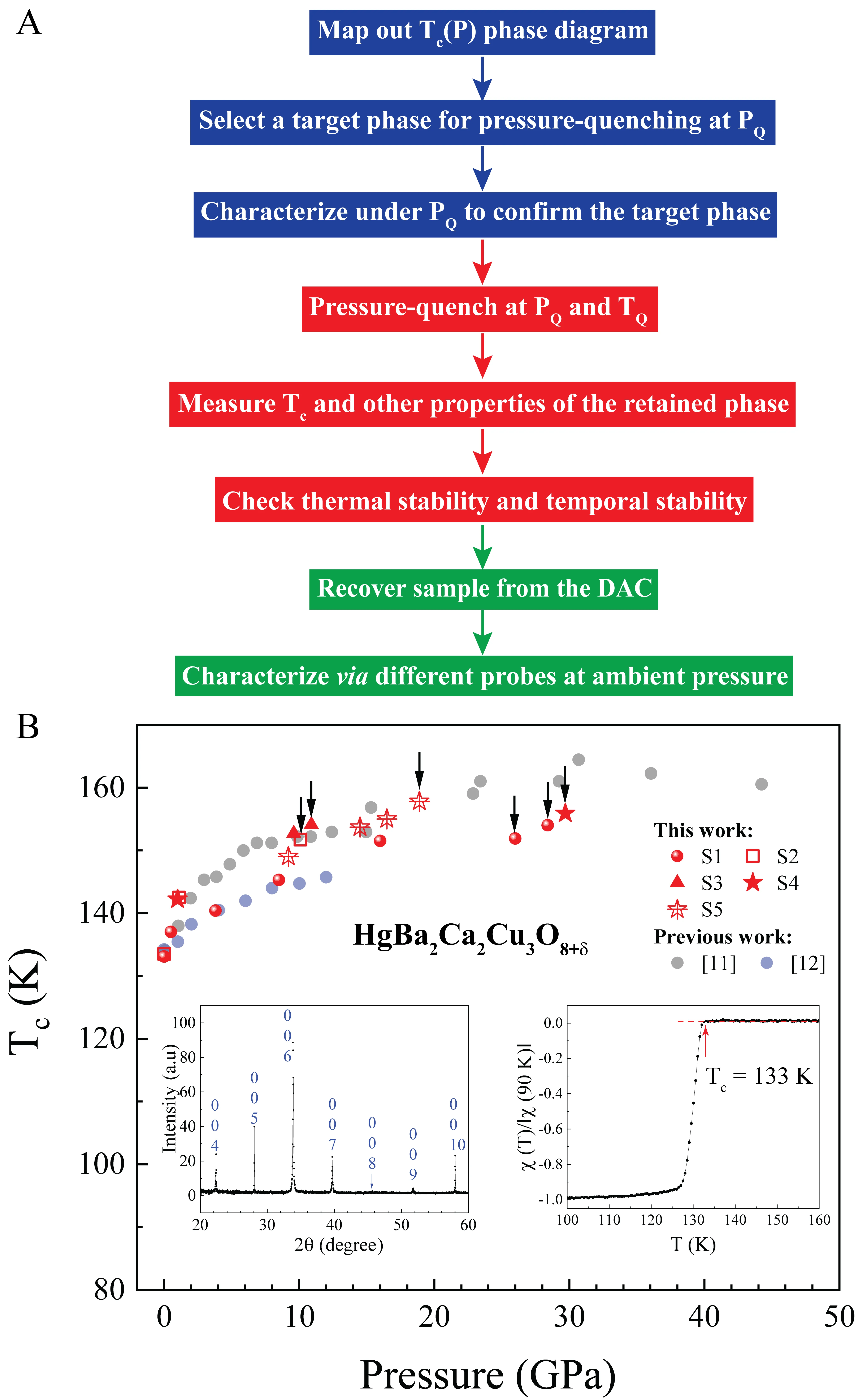
Physicists at the University of Houston, led by Paul Chu, have figured out how to "quench" the superconducting state created under pressure so that it persists under normal conditions. They took a ceramic made of mercury, barium, calcium, copper, and oxygen (HgBa₂Ca₂Cu₃O₈₊δ) — a material that was already a record holder for transition temperature. First, they compressed the sample to enhance superconductivity, then slowly released the pressure following a special protocol. Remarkably, after this treatment, the material remains superconducting at 151 K (−122 °C) — a new record for ambient pressure.
To make sure the effect wasn't a fluke, the team examined the material's structure using synchrotron X-ray radiation and calculated how atoms vibrate in the lattice. The calculations confirmed that after pressure release, the crystal lattice retains a favorable atomic arrangement that stabilizes the superconducting state. This approach — the "pressure-quench protocol" — could also work for other materials where superconductivity appears only under pressure.
If we can push the temperature even higher, humanity could get lossless power lines, powerful magnets for maglev trains, and compact particle accelerators. Most importantly, superconductors could help confine plasma in fusion reactors, bringing us closer to an inexhaustible energy source.
The record temperature of 151 K is −122 °C, which is roughly the temperature on the shadowed surface of Jupiter's moon Europa.
In Arthur C. Clarke's novel "Childhood's End," aliens use superconductors for levitation and instant energy transfer — our reality is slowly catching up with science fiction.