A pressure sensor is a device that measures atmospheric pressure at a single point, typically at the ground. It is a common instrument in meteorology, aviation, and various industrial applications, providing essential data for weather forecasting, altitude measurement, and monitoring environmental conditions. The sensor converts the force exerted by the air column above into an electrical signal that can be read and recorded.
History
The first practical pressure sensor was the mercury barometer, invented by Evangelista Torricelli in 1643. Modern electronic pressure sensors, based on strain gauge technology, were developed in the mid-20th century.
How it works
Most pressure sensors operate on the principle of a deformable diaphragm or membrane that flexes in response to pressure changes. This deformation is then measured using strain gauges, capacitive changes, or piezoelectric effects, which produce a proportional electrical output. Some advanced designs, like those using resonant elements or optical methods, offer higher sensitivity and stability, as seen in the 'membrane-tuning fork for vacuum' or 'diamond dust and spectroscopy' approaches mentioned in the titles.
In practice
Pressure sensors are used in weather stations, aircraft altimeters, tire pressure monitoring systems, and in scientific research to measure pressure in extreme environments, such as deep inside planets or in vacuum chambers.
Fun fact
The pressure sensor in a smartphone barometer is sensitive enough to detect a change in altitude of just a few centimeters, which is why it can help with indoor navigation.
Miners took canaries underground not for their songs. The bird would fall off its perch before the miner noticed carbon monoxide. In ultrahigh vacuum, the canary's role is played by a cloud of one hundred thousand lithium or rubidium atoms.
The electron beam of a microscope usually flies through emptiness, like a courier on an empty highway. Any air molecule is a bump that makes it bounce and lose direction. So before, to examine a sample, you had to freeze it, dry it, or coat it with metal—and still you could only look in a vacuum.
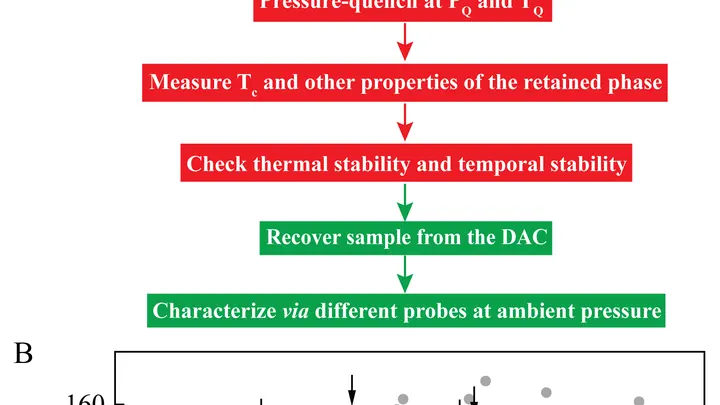
A superconductor is a material in which electricity flows without loss, like water through a perfectly smooth pipe. But if you squeeze it slightly, like a spring, its properties change. Scientists have long wanted to measure how much heat such a compressed material absorbs, but instruments couldn't fit into the cramped setup. Now they've devised a way around this obstacle.
In a quiet room of a Budapest laboratory, a bracelet lies on the table, and instead of a strap, it has a thin conductive thread stretched in a zigzag. It doesn't heat up or glow, but when pressed against the wrist, it starts to listen. Each heartbeat sends a pressure wave through the radial artery, and the thread, deforming, changes its electrical resistance.
Deep underground, iron glows white-hot, and the pressure is so intense that an ordinary instrument would be crushed flat. To peer into this world, physicists built a special microscope based on tiny diamond defects (so-called NV centers).
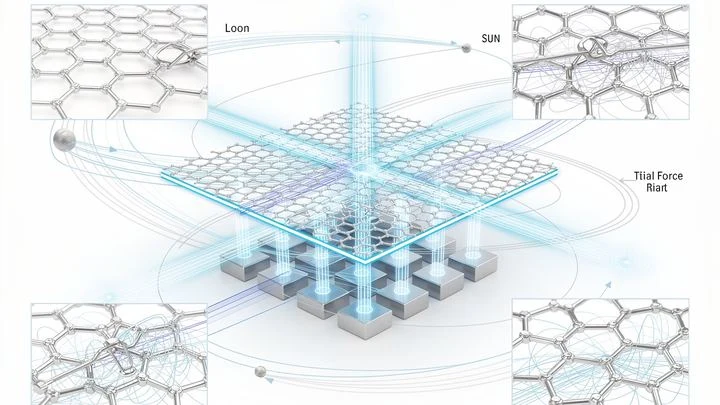
In the quiet of a laboratory, a graphite flake hovers above a magnetic grid. This is not just a demo of diamagnetism's magic — it's listening to the Universe. Like a spider casting its web to catch vibrations from an invisible world, this flake has become a gravitational web.
On a scorching afternoon, a stifling haze hangs over the city, and not a single cloud is on the horizon. Usually, in such weather, all you can do is wait for nature to take pity and send some cool relief. But what if shade and rain could be switched on schedule, like a light in a room?
An ordinary thread sewn into fabric can listen to the body. It feels the chest rising with each breath, a finger bending, and the pulse beating at the wrist. All this — without stiff patches or wires, just as part of your clothing.
The sensor is made from a flexible thread that changes resistance when stretched or pressed. It is woven into fabric in a triangular pattern, like a fine mesh.
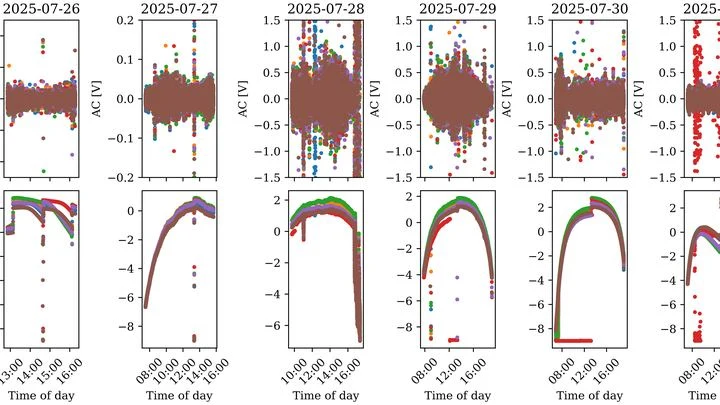
By day in Chile's Atacama Desert, the air shimmers with heat like the haze above a hot skillet. Sunlight passing through this shimmer begins to dance and flicker. Astronomers call this airy trembling "seeing" — and it keeps telescopes from getting a sharp view of the stars.
To fight this nuisance, engineers have built a special instrument — a solar seeing monitor.
A metal needle descends onto a piece of superconductor. All of this happens inside a refrigerator that cools the sample to 30 thousandths of a degree above absolute zero — a hundred times colder than outer space. A weak current is passed through the needle, and by how electrons travel through the tiny contact point, physicists read what is happening inside the material.
Superconductivity is the ability of a material to conduct electricity without losses. Ordinary wires heat up, and some energy is lost as heat, but a superconductor carries current with zero resistance.
A fingernail-sized piece of ceramic is squeezed in a vise, and its internal structure rearranges like clay under your fingers. Inside, orderly rows of tiny domains line up where they were once randomly oriented. After this 'massage,' the crystal lets light through almost like glass and, at the same time, generates a strong electric charge when bent or pressed.
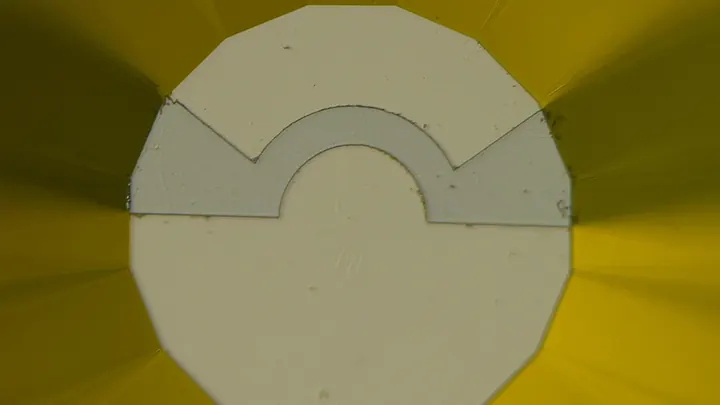
A thin film of silicon nitride is stretched over a frame like the skin of a drum. The slightest nudge from gas molecules makes it tremble. A laser beam delivered through a glass fiber picks up that trembling and turns it into a pressure reading. The whole setup fits in a pocket, not on an optical table.
The scorching gas streaming from the Sun is not a continuous flow but rather a soup of charged particles. In this soup, waves constantly boil up: electric fields flare and fade like ripples on water from a tossed stone. One such wave is the ion-ion acoustic wave.
In diamond, you can embed a “spy.” Simply replace a carbon atom with nitrogen: you get a defect that responds to magnetic fields and sends a light signal.
For 36 days, tropical cyclone Freddy raged over the Indian Ocean, the longest-lived cyclone on record. Meteorologists tracked it from satellites, aircraft, and ground stations. But one detail eluded all instruments: the precise air density deep within the vortex. And that density determines where the cyclone will turn tomorrow.
Inside a diamond anvil cell, a device where two diamonds squeeze a sample to hundreds of gigapascals, pressure is distributed unevenly. Some regions are compressed more, others less. This affects experimental results: the material may behave differently than under perfectly uniform compression.