Gravitational Waves: Echo of the Cosmic Bounce express
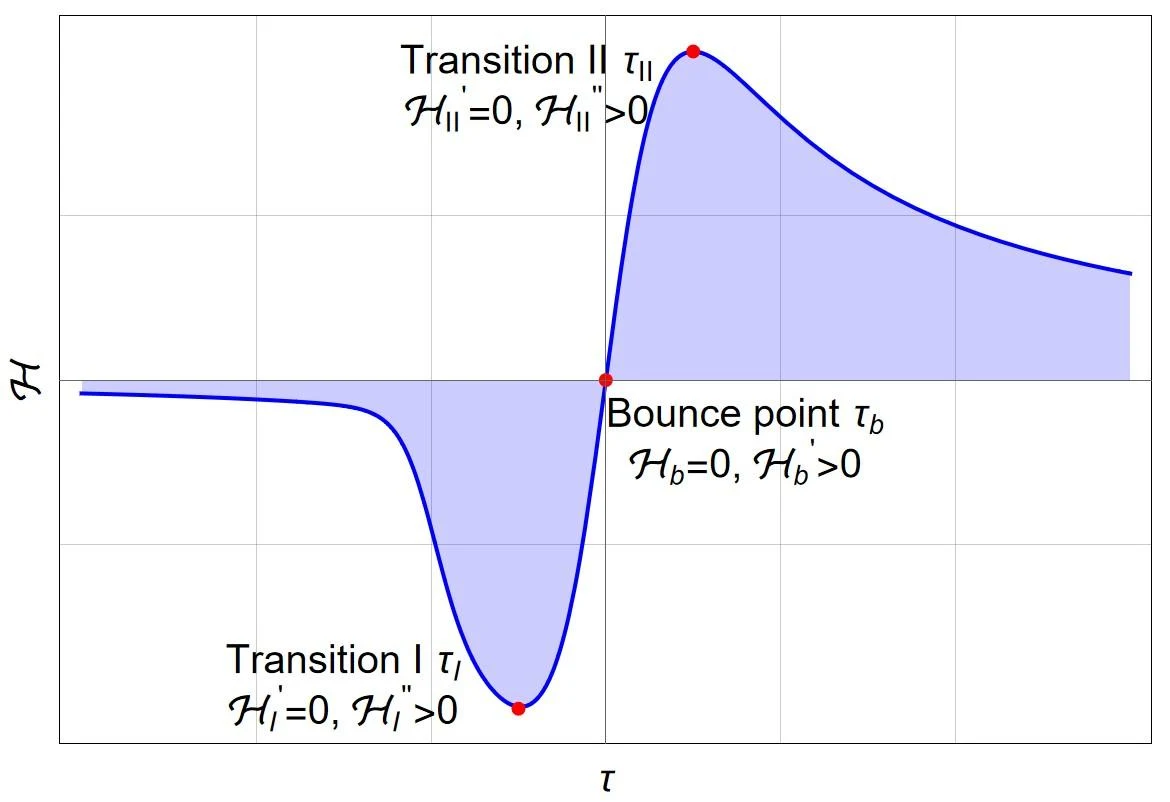
Standard theory paints the birth of the Universe as an explosion from a point of infinite density. But there is an alternative: first, the cosmos squeezed down to tiny dimensions, and then began to expand — it bounced back, like a spring. This double process left a trace in gravitational waves — ripples in spacetime that still cruise through the cosmos.
Just as two echoes from different walls merge into a shimmering sound, the waves from contraction and expansion overlapped, producing a clear rhythmic pattern. At high frequencies, it looks like an alternation of spikes and dips, unlike the chaotic noise expected from a standard Big Bang.
If Earth-based detectors catch this pulsation, it will confirm that the expansion of the Universe began not from a singularity, but from a bounce. Astonishingly, the signal strength is sufficient to be noticed by already existing observatories. Perhaps we will hear the bounce echo in the coming years.
Original abstract
as written by the authors arXiv:2603.13924
We report a novel feature of relic gravitational waves (GWs) in non-singular bounce cosmologies that is testable in light of GWs astronomy. In non-singular bounce cosmologies, the effective potential $$M_p^2 a^{\prime \prime}/a$$ that governs the evolution of primordial GWs contains two peaks due to the existence of contraction phase prior to the standard expansion phase. Accordingly, relic GWs interference between the two peaks in the effective potential. This interference results in a distinctive oscillatory feature in the energy density spectrum of GWs, analog to the resonant tunneling effect in quantum mechanics. As a result, the GWs spectrum exhibits an oscillatory patterns on high frequency regime, distinctive to other cosmological scenarios such as inflation. We show that the amplitude of GWs spectrum is high enough to reach the sensitivity of current and forthcoming GWs instruments, making our predictions falsifiable. Hence, our finding offers a promising way to experimentally test the non-singular bounce scenarios and search for new physics in early universe cosmologies.
Gravitational waves from the Big Bang are chaotic, like radio static, while those from the bounce are rhythmic, like a heartbeat.
Hear the rhythm of the cosmic bounce.