Gravitational Waves: Echo of the Cosmic Bounce express
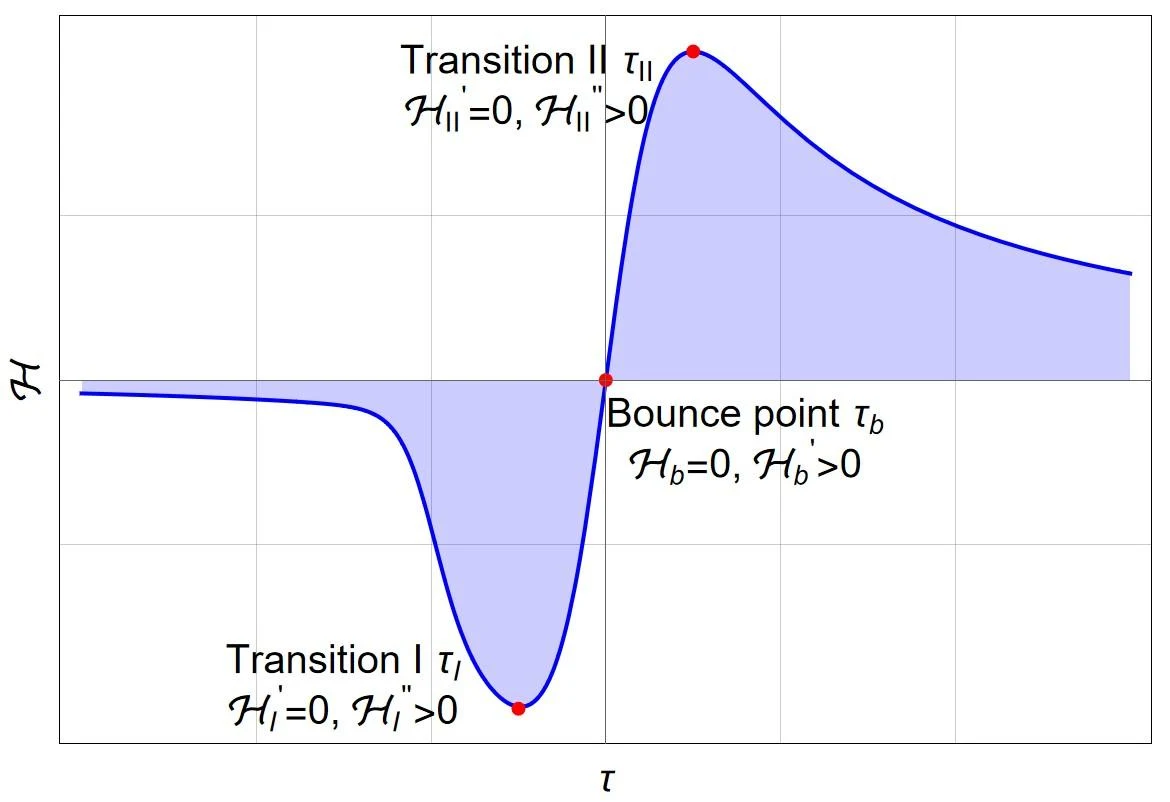
Standard theory paints the birth of the Universe as an explosion from a point of infinite density. But there is an alternative: first, the cosmos squeezed down to tiny dimensions, and then began to expand — it bounced back, like a spring. This double process left a trace in gravitational waves — ripples in spacetime that still cruise through the cosmos.
Just as two echoes from different walls merge into a shimmering sound, the waves from contraction and expansion overlapped, producing a clear rhythmic pattern. At high frequencies, it looks like an alternation of spikes and dips, unlike the chaotic noise expected from a standard Big Bang.
If Earth-based detectors catch this pulsation, it will confirm that the expansion of the Universe began not from a singularity, but from a bounce. Astonishingly, the signal strength is sufficient to be noticed by already existing observatories. Perhaps we will hear the bounce echo in the coming years.
Gravitational waves from the Big Bang are chaotic, like radio static, while those from the bounce are rhythmic, like a heartbeat.
Hear the rhythm of the cosmic bounce.