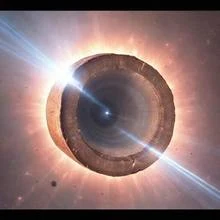
Black hole recoil, also known as gravitational wave kick, is the phenomenon where a black hole receives a velocity boost after merging with another black hole. This happens because gravitational waves are emitted asymmetrically during the merger, carrying away momentum in a preferred direction. The recoil velocity can be significant, potentially ejecting the merged black hole from its host galaxy.
History
The theoretical prediction of black hole recoil was made in the 1970s by Fitchett, who calculated the kick for equal-mass black holes. More detailed calculations including spin effects were performed in the 2000s using numerical relativity simulations.
How it works
When two black holes spiral together and merge, they emit gravitational waves in all directions. If the black holes have unequal masses or spins, the emission is not symmetric, and the merged black hole experiences a net recoil in the opposite direction of the stronger emission. The magnitude of the kick depends on the mass ratio and spin orientations of the merging black holes, and can range from a few kilometers per second to thousands of kilometers per second.
In practice
Understanding black hole recoil is important for predicting the final location of merged black holes and for interpreting observations of gravitational wave events, as a kicked black hole may be displaced from its original environment.
Fun fact
The fastest predicted black hole recoil velocities can exceed 5,000 kilometers per second, which is fast enough to escape most galaxies entirely.
A balloon that lets out air in bursts zips around the room — the jet blasts first one way, then another. A dying star behaves the same way as it sheds its bloated shell. Only instead of air, it's superheated gas, and instead of a balloon, it's a future white dwarf (the dense stellar remnant about the size of Earth).
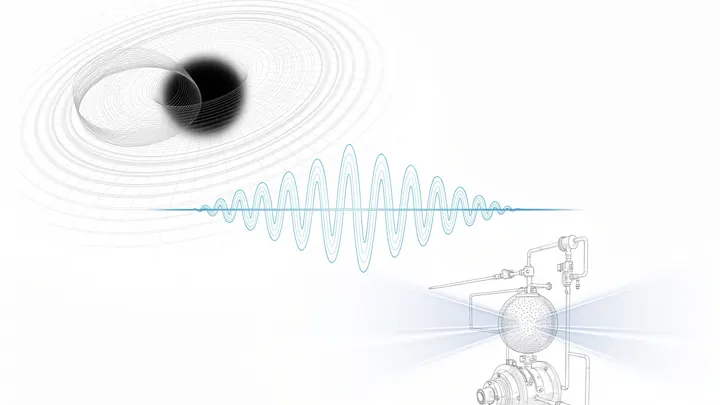
Two black holes circle in a cosmic dance, spiraling closer together. In the end, they merge into one, and that moment unleashes a powerful burst of gravitational waves, ripples in spacetime itself. But what remains after the merger?
The fastest wind in the Universe travels at 0,58 times the speed of light. It covers the distance from Earth to the Moon in two seconds. This wind is not a jet stream but a broad flow of gas erupting from the center of a galaxy. Not all black holes work the same: some create such hurricanes, while others produce narrow plasma beams.
The LIGO detectors caught the signal GW250114—a gravitational wave from the merger of two black holes. After the main burst, a decaying 'tail' remained — direct waves from the newborn hole's horizon. It was expected that their damping would reveal the gravitational strength at the horizon's surface. But the measured value came out smaller.
At the center of many galaxies lurks an invisible cloud — a halo of dark matter. If this matter is cold and light enough, it behaves like a superfluid: it flows without friction, and any rotation in it twists into tiny quantum vortices — threads the size of an atomic nucleus.
In the ocean of space, every storm of birth or merger of supermassive black holes generates ripples — gravitational waves traveling at the speed of light. Over billions of years, these waves superimpose, merging into a low-frequency hum, like a distant surf.
The cosmos sets its own lenses in the path of gravitational waves. When two black holes merge, the resulting ripple travels through the universe. If it encounters a massive galaxy cluster along the way, its gravity bends the path of the waves — much like glass focuses light.
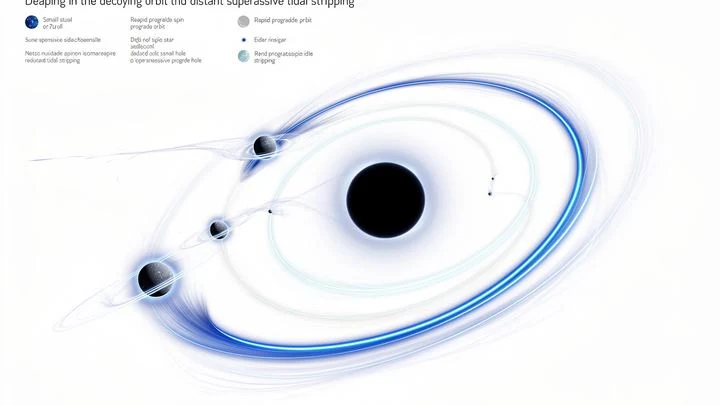
In the centers of galaxies, where supermassive black holes lie dormant surrounded by stellar swarms, lights of monstrous power sometimes flare up — tidal disruption events. But some of these events behave oddly: they repeat again and again, and each new ignition is dimmer than the last.
Usually, black holes inch closer gradually, circling in a tightening spiral. This dance births a long ripple of gravitational waves — a tremor in the very fabric of spacetime. Detectors LIGO and Virgo routinely catch such mergers.
But GW190521 is the exception.
In 2017, detectors picked up a tremor in space — gravitational waves from the merger of two neutron stars. At the same moment, telescopes saw a flash. For the first time, one event spoke in two languages at once: light and gravity.
When a neutron star and a black hole merge, they send out gravitational waves — ripples in spacetime that reach Earth. These ripples carry the imprint of their final dance: the orbit before the collision is often elongated, like an ellipse.
In the quantum world, electrons can behave like waves. If you create the right conditions for them, these waves start to feel something akin to gravity. In crystals known as Weyl semimetals, electrons move as if they were massless, and their energy depends on direction, like a tilted cone.
When two heavy bodies collide, they don't always stay put. Merging black holes get a powerful kick, like the recoil of a gun, but instead of gunpowder, it's the curvature of spacetime doing the work. This kick can send the new hole flying out of a galaxy's center or even beyond its outskirts.
A spinning top on a table wobbles: its axis is tilted, and the motion becomes unsteady. Black holes surrounded by a disk of gas and dust behave similarly. If the rotation axes of the black hole and the disk do not align, the whole system begins to vibrate, producing ripples in spacetime — gravitational waves.
When two black holes merge, space shudders with gravitational waves, and the newborn hole receives a powerful kick, like a cannon recoiling. In the centers of galaxies, it often slams into a gas disk — a swirling cloud of matter, like a cosmic bullseye.
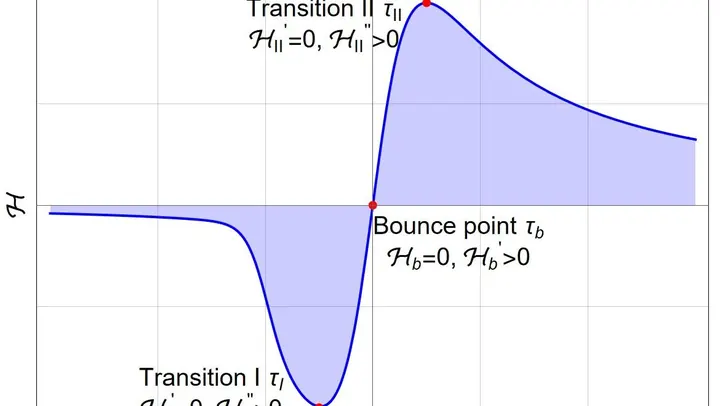
The standard cosmological model describes the birth of the universe as an explosion from a singularity — a point of infinite density and spacetime curvature.
Gamma-ray burst 230307A lit up the sky like a thunderclap: in seconds, it released more energy than the Sun will emit over billions of years. Three detectors—GECAM-B, GECAM-C, and Fermi/GBM—were looking in the right direction at that moment.