Gravitational Waves: Echo of a Cosmic Rebound express
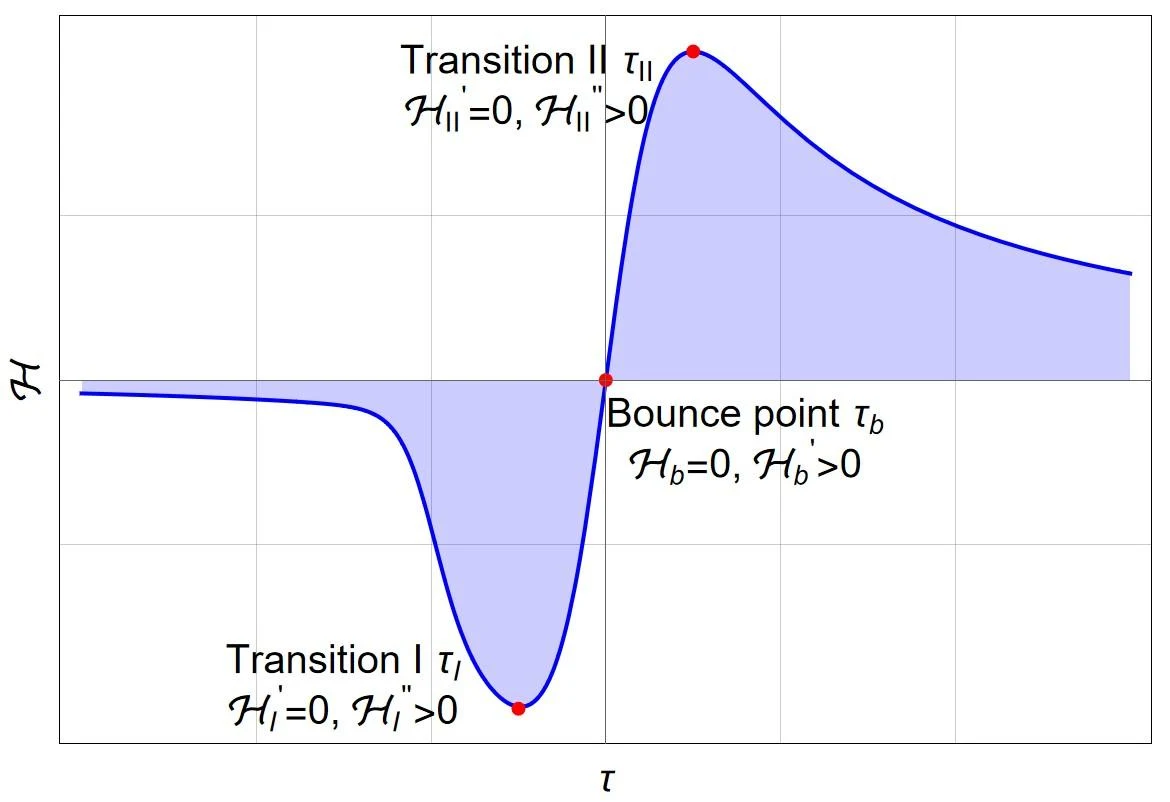
The standard cosmological model describes the birth of the universe as an explosion from a singularity — a point of infinite density and spacetime curvature. However, an alternative scenario exists: initially, the cosmos contracted to extremely small sizes, after which a 'rebound' occurred — a transition from contraction to expansion, much like a spring compressed to its limit springing back. This two-phase process, contraction followed by expansion, would have generated a distinctive imprint in gravitational waves — ripples in the fabric of spacetime that, according to predictions, still permeate the cosmos.
We can explain the mechanism behind this imprint through an acoustic analogy. Imagine clapping your hands in a room with two walls at different distances: the sound reflects off each wall, and the two echoes, reaching your ears with a slight delay, merge into a shimmering, rhythmic sound. Similarly, gravitational waves from the contraction and expansion phases have overlapped, creating a clear rhythmic pattern — oscillations with alternating peaks and troughs. At high frequencies, this pattern appears as a regular sequence of bursts and decays, contrasting with the chaotic, broadband noise expected from the standard Big Bang. (Note that this analogy simplifies: in reality, the waves are not sound waves but deformations of the spacetime metric, propagating at the speed of light.)
If existing ground-based detectors, such as LIGO or Virgo, register this characteristic pulsation, it would be strong evidence that the expansion of the universe began not with a singularity but with a rebound. Remarkably, calculations show that the expected signal is strong enough to be detected by currently operating observatories. Thus, the echo of the cosmic rebound could be captured in the coming years, opening a new chapter in our understanding of the origin of our universe.
Gravitational waves from the Big Bang are chaotic, like radio static, while those from a rebound are rhythmic, like a heartbeat.
Hear the rhythm of the cosmic rebound.