Tiny Detectors Catch the Light of the First Moments express
Light that has traveled to us for nearly 14 billion years is like an old photograph whose details emerge with careful processing. The cosmic microwave background (the afterglow of the Big Bang) holds the imprint of the universe's first moments, but its signal is faint and distorted. To discern the subtle patterns of polarization, the direction of oscillation of light waves, we need ultra-sensitive instruments.
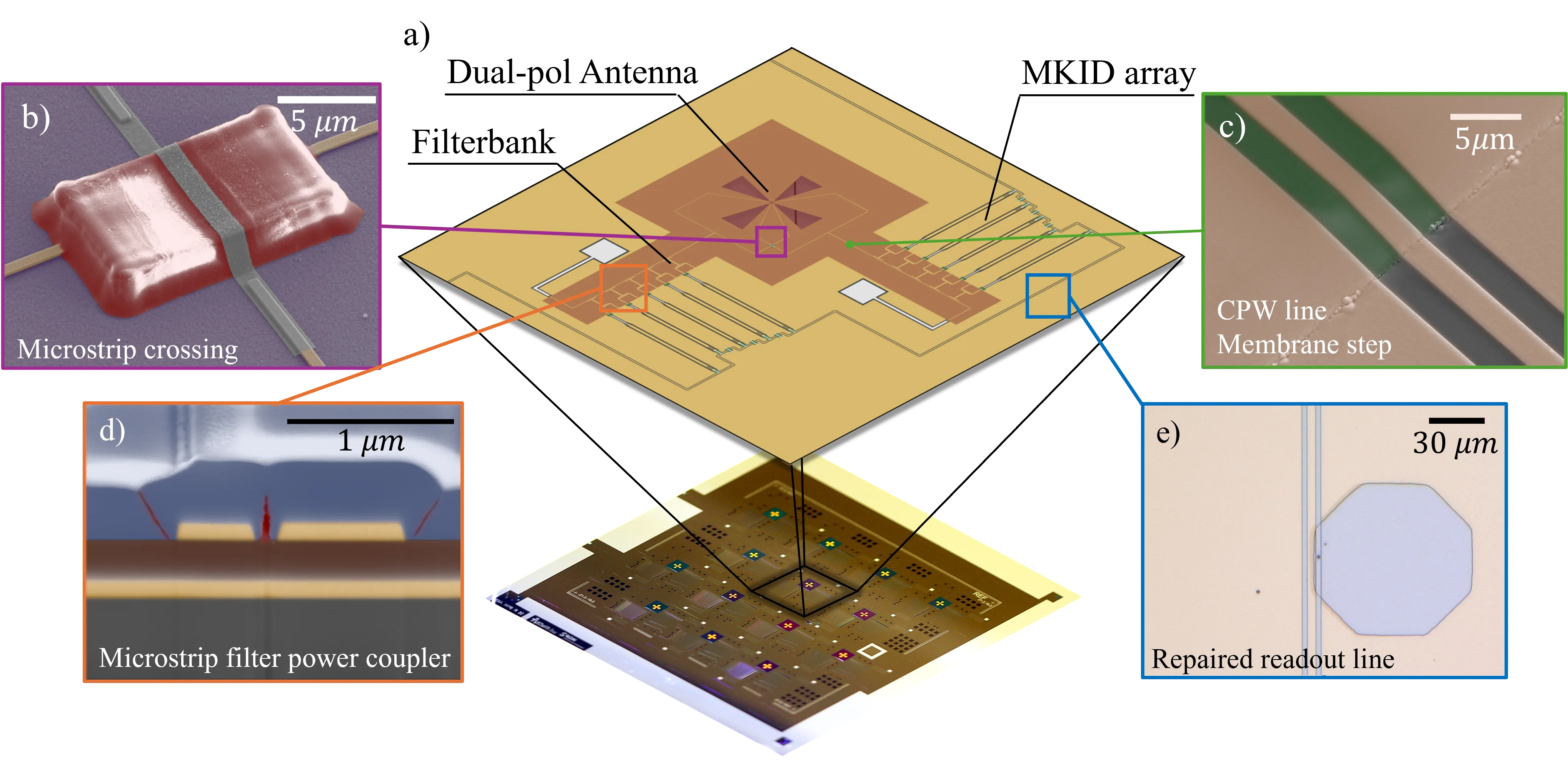
Conventional telescopes take years to scan the entire sky. The new superconducting spectrometers, the size of a postage stamp, operate at temperatures colder than deep space and capture light with minimal noise. Engineers added cross-shaped traces on the chip that split the signal by polarization, much like a railway switch directs trains onto different tracks. A dielectric layer, a material that does not conduct electricity, allowed each detector to be tuned more precisely to its target frequency.
After eliminating random short circuits in the lines, the team assembled an array of fourteen independent spectrometer pixels. This is the first working prototype, ready for field tests. If all goes well, astronomers will be able to quickly map the cosmic microwave background and compare those maps with infrared background maps — the light from distant galaxies. Such a comparison will reveal how galaxy clusters have grown and changed over the past 10 billion years and test whether the universe really did expand faster than light in the first fractions of a second.
Original abstract
as written by the authors arXiv:2603.16627
Studying the polarization and spectral distortion of the Cosmic Microwave Background (CMB) in tandem with intensity fluctuations of the Cosmic Infrared Background (CIB) allows us to verify our assumptions on cosmic inflation and investigate the dynamics and evolution of galaxy clusters in the last 10 billion years. Because of its broadband emission and being an all-sky extended source, observing the entire CMB in detail is a very time-consuming and expensive exercise. Fortunately, in the last few years, the on-chip superconducting spectrometer technology has moved out of the lab and into the telescope. With its compact size and background-limited sensitivity, this family of instruments is particularly well-suited for fast and large area observations in a relatively unexplored range of the electromagnetic spectrum. However, recent examples of this technology do not yet reach the requirements needed for large spectroscopic and polarimetric surveys of the CMB. We formulate several of these requirements and introduce novel on-chip components and fabrication techniques. We introduce a cross-over to enable distinguishing signal polarization, minimize signal loss by locally optimized lithography of a coplanar-waveguide (CPW), lower the spectral resolution of microstrip filters by deposition of a dielectric layer, and increase the yield of the spectrometer array by removing individual line shorts. These together have culminated in the successful fabrication of a fourteen-spaxel IFU.
Superconducting detectors are so sensitive that they can spot a single photon, as if you could hear a grain of sand falling from the top of the Eiffel Tower.