Light in Superstrong Magnetic Fields express
A magnetar is a neutron star with a magnetic field hundreds of millions of times stronger than Earth's. If you brought an ordinary magnet near such a field, it would instantly lose its magnetism, and atoms would stretch into thin filaments. Under these conditions, light and electrons interact in unusual ways: the familiar rules of quantum electrodynamics break down, and calculations need to be rethought.
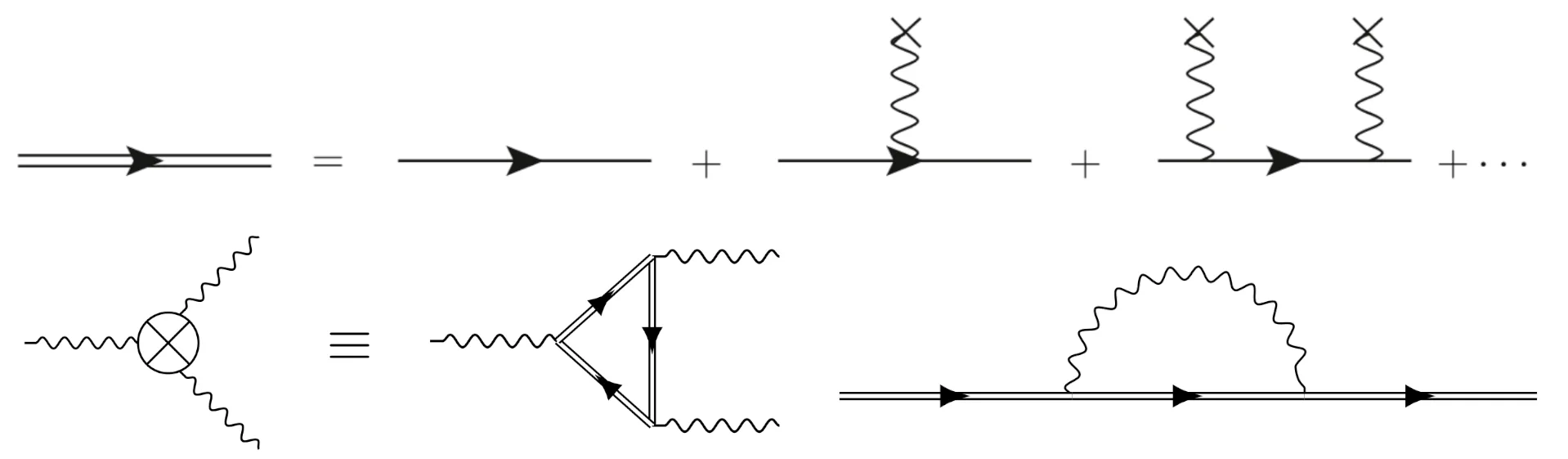
Scientists applied a method previously used for hot quark-gluon plasma to describe light scattering in a superstrong field. For the first time, they systematically accounted for the fact that excited electron levels (Landau levels) do not live forever but decay over a finite time. It's like calculating the bounce of a ball off a wall and taking into account that the wall gives a little rather than being perfectly rigid.
The results showed that accounting for the finite lifetime of levels noticeably changes scattering cross sections: that is, the probability of how light gets deflected or changes energy. This is important for understanding how energy is transported in a magnetar's atmosphere and why its radiation has an unusual spectrum. All calculations are available in an open Python package so other researchers can use them in their models.
Original abstract
as written by the authors arXiv:2603.25491
The magnetospheres of magnetars, a class of highly magnetized neutron stars, host magnetic fields exceeding the Schwinger limit, where Quantum Electrodynamics (QED) becomes nonlinear. In such environments, QED scattering processes are strongly modified, which may affect plasma dynamics. In this work, we apply a formalism originally developed for the study of magnetic-field effects in hot quark-gluon plasma to strong-field QED. The method resums interactions between virtual electrons and the external magnetic field, consistently incorporating the finite decay widths of excited Landau levels derived from the fermion self-energy. Using this framework, we perform the first systematic analysis of tree-level QED scattering processes in strong magnetic fields, concentrating on the processes of highest relevance for the plasma dynamics of magnetars. All resulting cross sections are provided in an open-source Python package.
The magnetic field of a magnetar is so strong that if such an object were at the distance of the Moon, it would erase the information from all magnetic storage media on Earth.