Vacuum Controls Magnetism
In a pot of boiling water, steam bubbles appear and disappear — a similar struggle takes place in two-dimensional materials. Here, electrons both create magnetism and try to extinguish it.
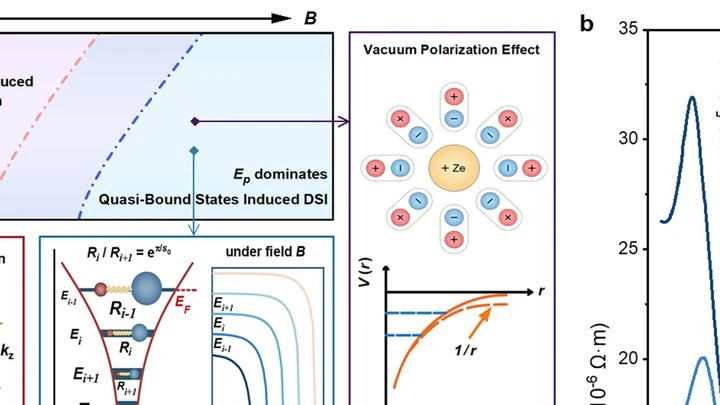
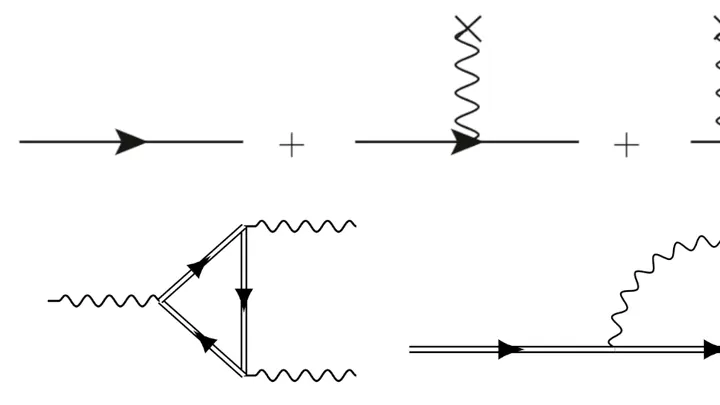
Quantum effect where virtual particle-antiparticle pairs alter the properties of the vacuum near strong fields.Vacuum polarization is a quantum electrodynamics (QED) effect where the vacuum—far from being empty—is filled with fleeting virtual particle-antiparticle pairs. In the presence of a strong electromagnetic field, these pairs are distorted, effectively screening or enhancing the field. This alters the observed properties of charges and fields, such as the strength of the Coulomb force at short distances or the behavior of light near a nucleus.
The concept was introduced by Werner Heisenberg and Hans Euler in 1936, who derived the effective Lagrangian for strong fields. It was later formalized in the framework of QED by Julian Schwinger in the 1950s.
According to quantum field theory, the vacuum constantly creates and annihilates virtual electron-positron pairs. An external electric field polarizes these pairs: the virtual positrons are attracted to the negative charge, and virtual electrons are repelled, creating a net charge distribution that partially cancels the original field. This is analogous to how a dielectric material polarizes in an electric field, but here the 'material' is the vacuum itself. The effect becomes significant when the field strength approaches the Schwinger limit (~10^18 V/m).
Vacuum polarization is crucial for precise calculations in atomic physics (e.g., the Lamb shift) and for predicting the behavior of ultra-strong lasers, where it could lead to observable photon-photon scattering.
Vacuum polarization makes the vacuum act like a nonlinear optical medium, so in extremely strong magnetic fields, light can travel faster than the speed of light in a vacuum—a phenomenon known as vacuum birefringence.