Europa's Ice Under Electron Fire express
Europa's surface is an icy armor continuously bombarded by charged particles from Jupiter's magnetosphere. Electrons slam into the ice's crystal lattice, lose energy, and kick off chemical reactions. Until now, there was no tool to show how deep such bombardment pierces the ice. Now there is.
The authors took the Geant4-DNA program, which can simulate particle passage through matter, and taught it to work with two forms of ice: amorphous (disordered, like glass) and hexagonal (ordinary, like in earthly snowflakes). For each, they calculated how electrons scatter and lose energy. The result is a transport model ready for use in Monte Carlo simulations.
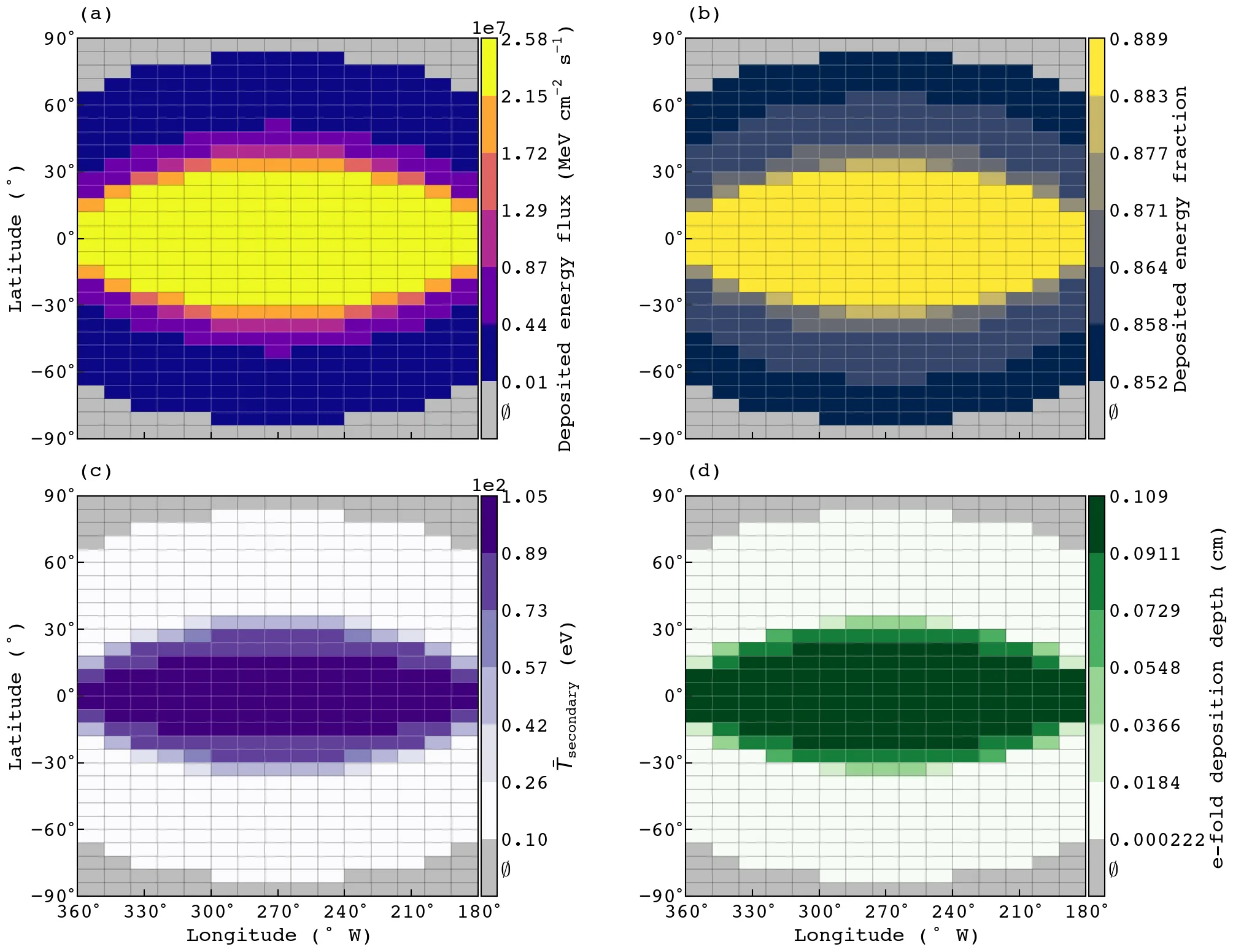
The model was applied to Europa. On the trailing hemisphere (the one facing backward along the orbit), electrons arrive slowly. They deposit their energy in a top layer less than a millimeter thick. On the leading hemisphere, electrons are fast and penetrate tens of centimeters. The difference is huge: like the difference between a raindrop hitting asphalt and a bullet burying itself in the ground.
This picture explains observations: near the equator of the trailing hemisphere, radiolysis products (substances born from radiation) gather in lenses. Slow electrons don't let them go deep, so chemistry concentrates at the surface. Now it's possible to model not only electrons but also ions and chemical transformations in ice with impurities — for example, with salts that make Europa's ice reddish.
Original abstract
as written by the authors arXiv:2604.01927
Energetic particles continuously process water ice across astrophysical and planetary environments, from interstellar clouds and comets to icy planetary surfaces. Interpreting the resulting observables requires a physically grounded description of the underlying interactions, both to identify radiation-driven signatures and to distinguish them from superimposed chemical, thermal, and microphysical effects. We present Geant4-IcyMoons, an extension of Geant4-DNA developed for irradiated water ice and, ultimately, for materials embedded within it. In this study, we model the elastic and inelastic interactions of electrons with amorphous and hexagonal ice. For the first time, this enables a transport-ready Monte Carlo simulation of electron irradiation in water ice, linking incident-particle environments to the evolution of icy surfaces. We apply this framework to Jupiter's moon Europa as a representative case of electron bombardment of an icy surface. We show that, on the trailing hemisphere, the stronger low-energy electron bombardment confines much of the deposited energy to the upper $$\lesssim 0.1$$ cm, whereas on the leading hemisphere, the more energetic incident population drives deposition patterns to depths of tens of centimeters. This may contribute to the observed lens-like enrichment of radiolysis products centered on the equator of the trailing hemisphere. This work lays the foundation for treatments of ion irradiation and radiation chemistry in water ice and embedded materials.
On Europa's trailing hemisphere, electron energy stays within a layer thinner than a millimeter, as if the icy crust is being sanded with sandpaper rather than pierced.