Ghost Nuclei: When Neutrons Run Free express
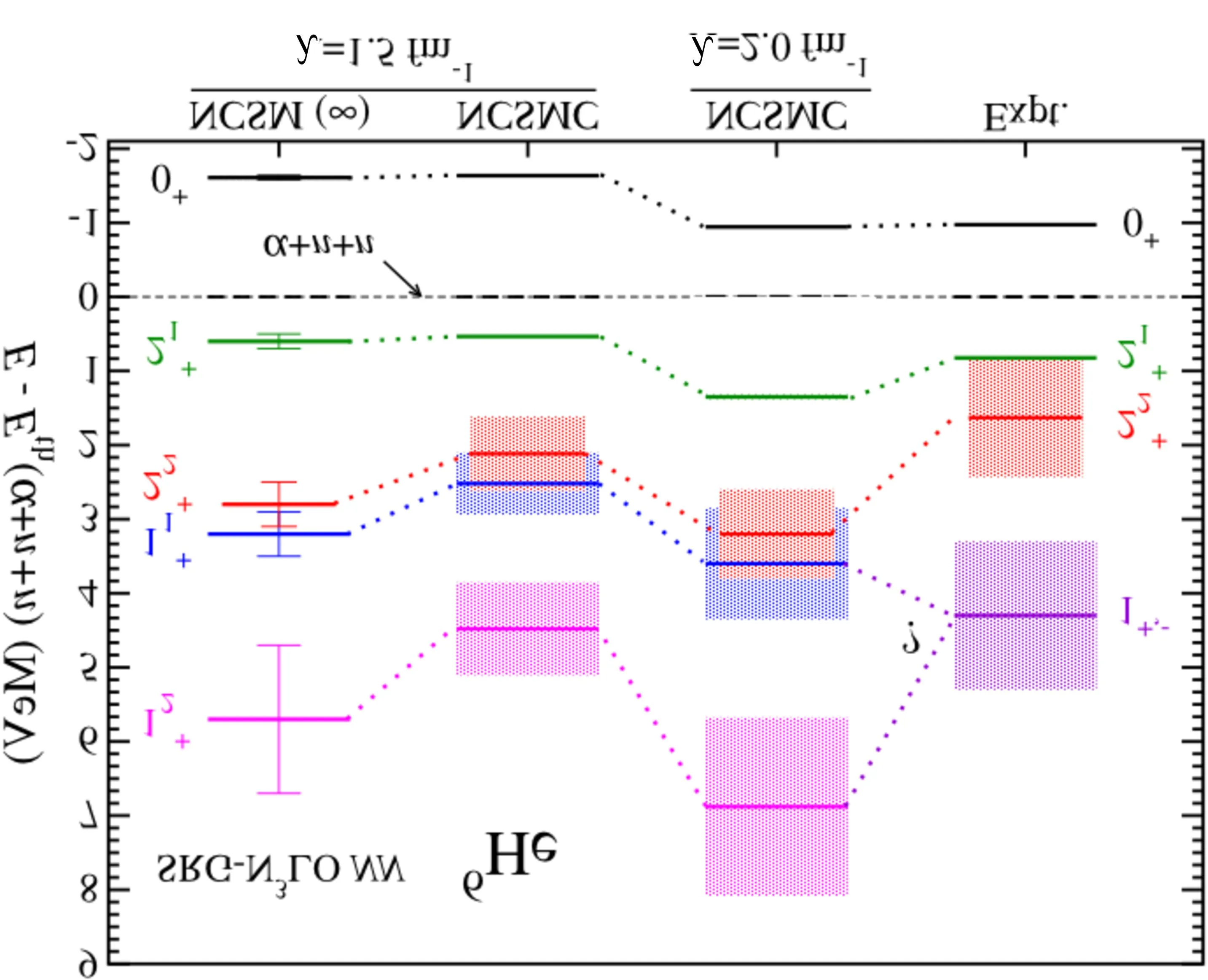
An ordinary atomic nucleus is like a tight ball: protons and neutrons are packed closely together. But some light nuclei, such as helium-6, are different. Two neutrons seem to step aside and form a dilute cloud around the nucleus — called a halo. This cloud is so loose that the nucleus becomes several times larger than it should be based on the number of particles.
To describe such nuclei, scientists have developed a new computational approach. It is called the "shell model with continuum" and works like a universal translator: it describes both bound states, where particles stay together, and scattering states, where the nucleus decays. Previously, different tools were needed for these, but now everything is unified in a single calculation. It is based only on fundamental interactions between nucleons — without fitting to known experimental data.
Using this method, physicists calculated the properties of several exotic nuclei: helium-6, boron-8, beryllium-11, and carbon-15. For example, they were able to describe how carbon-15 is produced when a neutron is captured by a carbon-14 nucleus — a reaction important for understanding stellar processes. Helium-6 was of particular interest: its three particles, two neutrons and a helium-4 nucleus, are bound together as a trio, but no pair is bound on its own. This structure resembles three stones that stand only if leaned against each other.
The calculations also showed that excited states of beryllium-10 may have a one-neutron halo, and for lithium-11 they performed a large-scale simulation that will serve as a basis for even more precise descriptions of this system. Such work tests how well we understand nuclear forces — because if a calculation without fitting matches experiment, then the nuclear physics is correctly described.
In the end, the new approach opens the way to predicting properties of yet undiscovered nuclei and to more accurate descriptions of nuclear reactions that occur in stellar interiors and supernova explosions.
The helium-6 halo nucleus is almost as large as a lead nucleus, even though it has only 6 particles compared to 208.