The Hidden Metal Inside Superconductors express
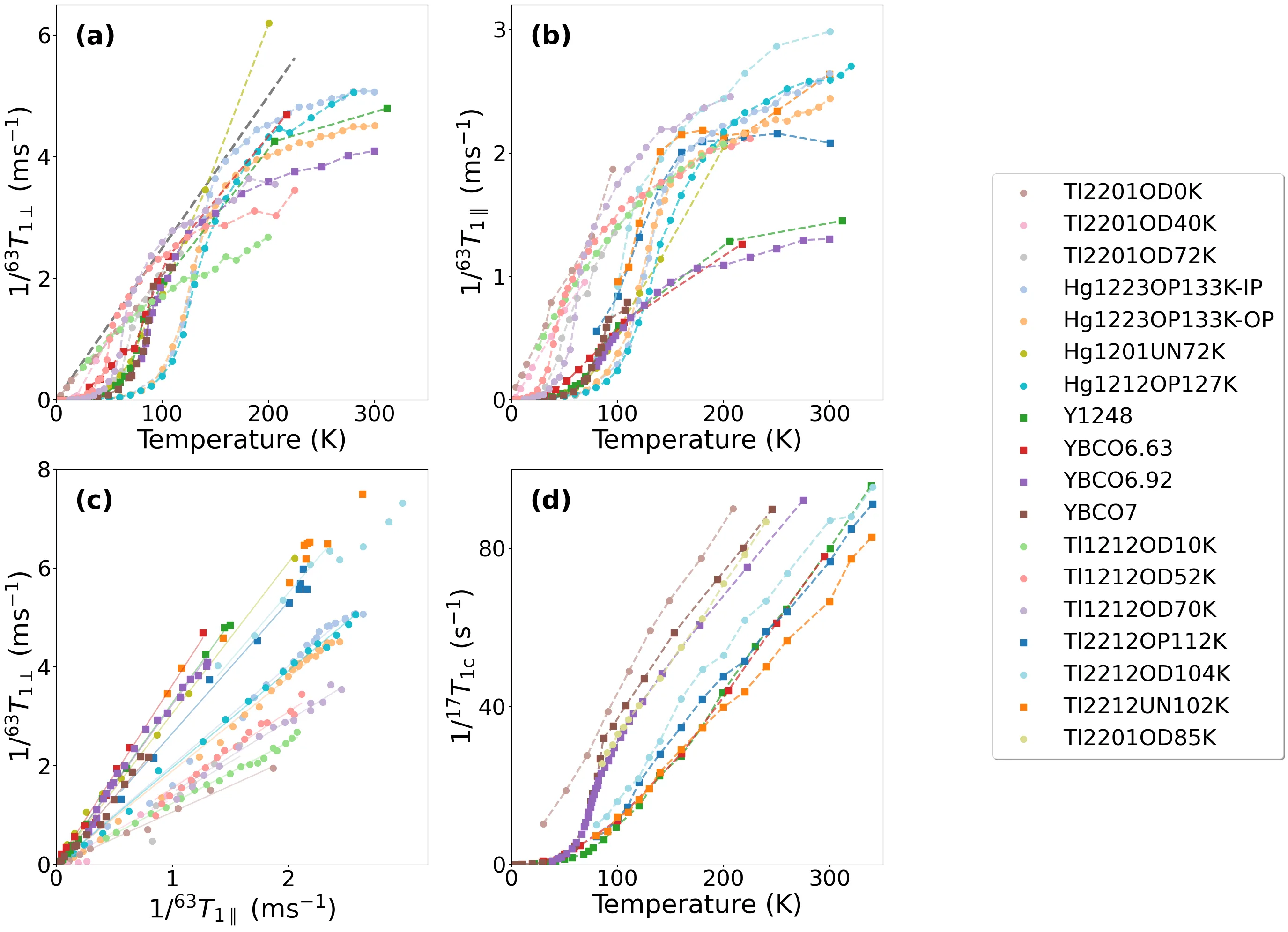
Inside copper-based superconductors, materials that carry current without loss at unexpectedly high temperatures, there is a hidden phase. It behaves like an ordinary metal, but it's invisible in standard measurements. Scientists gathered data from around the world on all known copper-based superconductors and found that below a certain temperature (the pseudogap line), the material always transitions into this hidden metallic state.
From this hidden metal, the superconductor condenses into the superconducting state, much like steam turning into water droplets. The decay rate of magnetic signals (nuclear relaxation) becomes the same for all samples, as if all roads in a city had the same speed limit. This universal rule helps explain why superconductivity in these materials is so robust.
This anisotropy is strictly linked to the maximum superconducting transition temperature. The higher the transition temperature, the stronger the difference between directions. It seems that in the hidden metal, two nearly independent spin components coexist, and their interaction determines the properties of the superconductor. This approach provides a new foundation for understanding these enigmatic materials.
Original abstract
as written by the authors arXiv:2604.10133
Nuclear relaxation is a very robust probe of electronic excitations in superconducting materials, above and below the critical temperature of superconductivity, $$T_\mathrm{c}$$. Here, a phenomenology of it in cuprate superconductors is established based on essentially all cuprate data available in the literature from the CuO$$_2$$ plane. A universal 'hidden metal' with $$1/T_1 T = const$$ reigns below the pseudogap line, and, similar to usual superconducting metals, all cuprates condense at $$T_\mathrm{c}$$ out of this metal and relaxation ceases rapidly. There is no Hebel-Slichter peak. Above the hidden metal, a renormalized two-component metal is found. Therefore, the hidden metal is identified as the pseudogap matter, which has other important properties. It predominantly lacks a uniform response, unlike the normal metal above $$T^*$$, and it does not significantly relax planar O. However, for planar Cu it exhibits a special relaxation anisotropy. With the field in the plane, it causes a relaxation rate that is very similar for all cuprates, $$1/{^{63}T}_{1\perp}T\approx 25/$$Ks, while with the field parallel to the $$c$$-axis, $$1/{^{63}T}_{1\parallel}T$$, the proportional rate (in the pseudogap range) changes as a function of doping and material. This relaxation anisotropy is strictly correlated with the maximum critical temperature, $$T_\mathrm{c,max}$$, of all cuprates. It is stipulated that two partially independent spin components are needed to understand this behavior. The new phenomenology will be discussed and should give a better foundation for the understanding of the cuprates
Nuclear relaxation is like the fading of an echo: after excitation by a magnetic pulse, atomic nuclei return to their initial state, and the speed of this return tells us about the properties of the surrounding electrons.