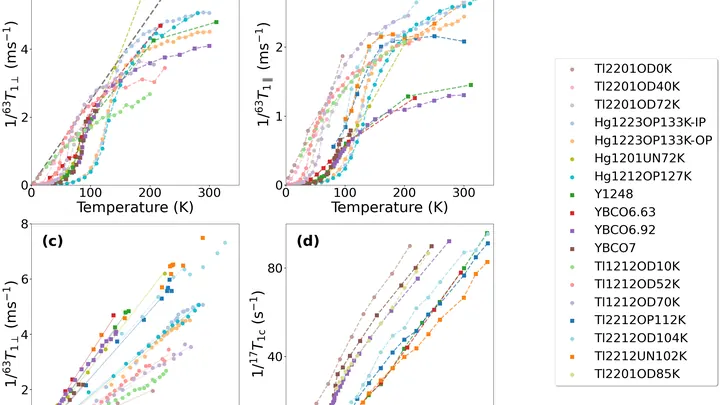
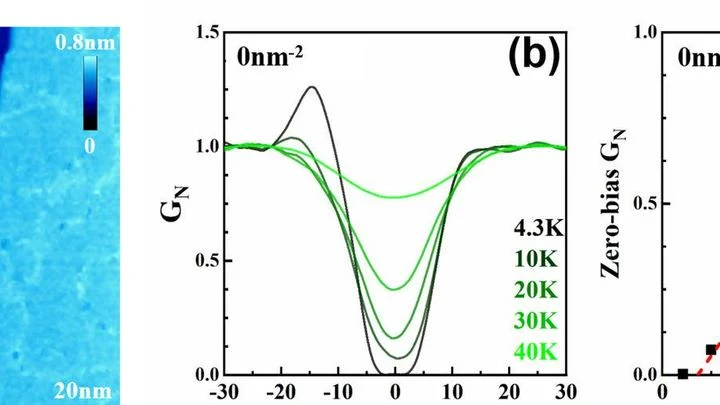
The pseudogap is a range of energies in a material where the density of states is suppressed, but not completely zero, even though the material has not yet become a superconductor or superfluid. It is a mysterious phase that appears in high-temperature superconductors and ultracold atomic gases, and understanding it is considered a key to unlocking the mechanism of high-temperature superconductivity.
History
The term 'pseudogap' was first used in the context of high-temperature superconductors in the late 1980s, following the discovery of these materials in 1986. The concept has since been extended to other systems, including ultracold atomic gases.
How it works
In a normal metal, electrons can occupy any energy state up to the Fermi level. In the pseudogap phase, a partial gap opens in the energy spectrum near the Fermi level, meaning that some electronic states are forbidden, but others remain. This is often interpreted as the formation of pre-formed pairs of electrons (Cooper pairs) that are not yet coherent enough to superconduct. The pseudogap is characterized by a suppression of the density of states at low energies, but with a finite value, unlike a true gap where the density is zero.
In practice
Research on the pseudogap is crucial for understanding high-temperature superconductors, which could lead to lossless power transmission and more efficient electronic devices if their mechanism is fully understood.
Fun fact
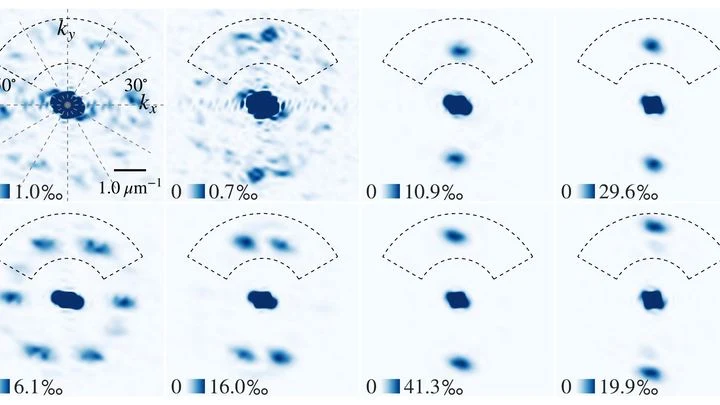
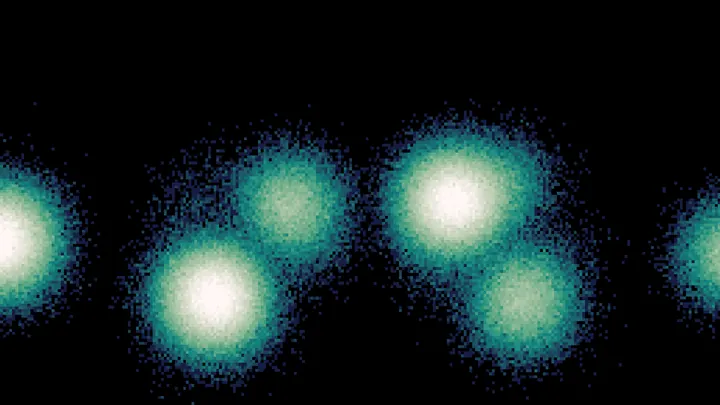
In ultracold atomic gases, the pseudogap can be directly imaged using techniques like momentum-resolvedphotoemission spectroscopy, providing a clean experimental platform to study this elusive phase.
Two dancers on one stage: the triangle and the stripe. In a quantum gas of dysprosium atoms cooled to 62 nanokelvin, these two spatial structures have met for the first time in a single experiment. The gas is held in a trap shaped like a surfboard, and its atoms are among the most magnetic in the periodic table.
An empty dance floor where people occasionally appear. Each moves on their own, chaotically, with no connection to the others. But when the right music starts and the hall cools down a bit, the dancers suddenly begin to form long chains and move in unison. That's roughly how electrons behave in a dilute three-dimensional gas.
A tiny sandwich of oxides, grown layer by layer, becomes perfectly conducting at about minus 200 degrees Celsius. This is not a magic trick but a new chapter in the search for high-temperature superconductors.
A piece of metal is cooled to minus two hundred degrees, and electric current begins to flow through it without the slightest friction, like water in a pipe flowing without touching the walls. This behavior is called superconductivity.
Graphene, a two-dimensional carbon crystal, has long tantalized physicists with the hope of high-temperature superconductivity. Its electrons obey the relativistic equation of Paul Dirac, racing at tremendous speed, barely noticing each other.
Neutron stars are cosmic alchemical retorts: at supranuclear densities, hadrons melt into quark-gluon plasma (QGP), and at the very core where pressure peaks, a color superconductor (CS) is born.
A translator hears not just words, but intonation, pauses, the tremor in a voice. Ordinary entropy analysis of cosmic perturbations is like meeting minutes: it records facts but loses the nuances. Pseudoentropy entropy is a new tool that captures the hidden "music" of the early universe.
In some materials, electric current can flow without any loss: this is superconductivity. But before becoming a superconductor, a substance often passes through a strange state: electrons already sense each other and form pairs, yet they cannot move in unison.
Imagine an orchestra where every musician plays their own part without listening to the others. Suddenly, without any visible command, neighboring musicians begin to sync perfectly, yet there is still no overall melody.
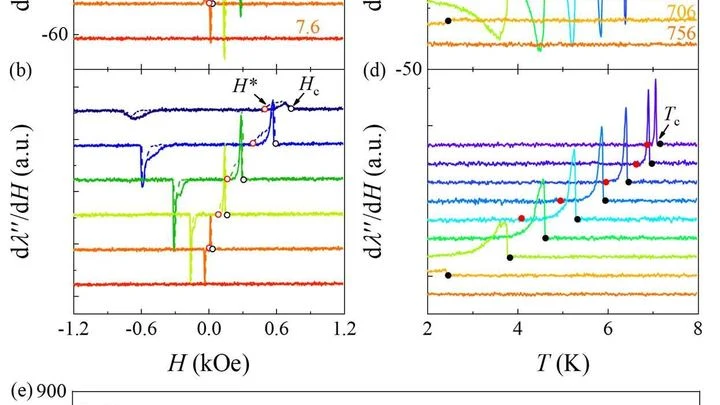
Ordinary magnetic measurements only see the surface of a superconductor, where barriers and viscous flows of magnetic field get in the way. Inside, in the so-called intermediate state, superconducting and normal domains coexist, separated by thin walls. These walls can oscillate, but hearing them directly has been difficult.
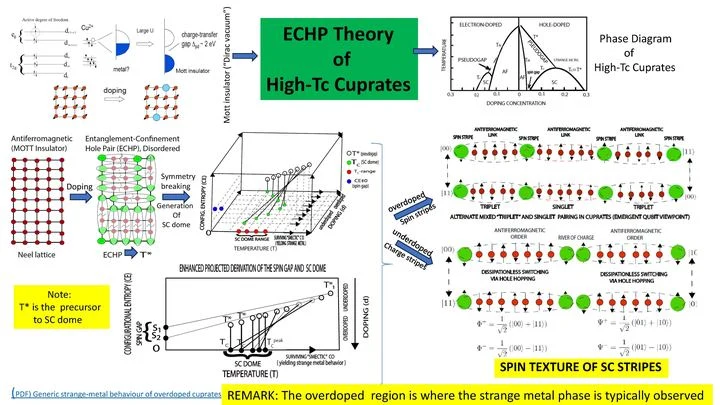
Inside copper-based superconductors, materials that carry current without loss at unexpectedly high temperatures, there is a hidden phase. It behaves like an ordinary metal, but it's invisible in standard measurements.
A copper crystal is squeezed in diamond anvil cells. As pressure mounts, a battle unfolds inside the material between two states: one prepares electrons for superconductivity, the other hinders their pairing. Scientists tracked this struggle using ultrashort laser pulses.
In a pot of boiling water, bubbles of steam are born and pop, but the water itself remains a liquid. Something similar happens in an ultracold atomic gas: atoms constantly form pairs and then fly apart again, even though superfluidity has not yet set in.
A uranium crystal the size of a grain of rice was cooled to one-fiftieth of a degree above absolute zero. At such temperatures, heat is not transported chaotically but strictly according to the rules of the quantum world.
A superconductor carries current without loss, like a perfectly smooth road where cars glide with no friction. But what if you scatter rocks and potholes across that road? Scientists decided to find out by adding disorder to a superconducting material just one atom thick.
The layered material (SnS)1.15(TaS2) resembles a stack of paper, where the sheets conduct electricity and the interlayers prevent them from sticking together. At ambient pressure, this material conducts current without resistance, making it a superconductor.
Layered cuprate crystals resemble a stack of pancakes: each pancake is a plane of copper and oxygen atoms, with spacer layers of other elements in between. Usually, superconductivity is studied in the whole stack, where layers influence each other.
In NaAlSi, as it cools, electrons form fleeting ripples — stripes that appear and vanish, like patterns on water stirred by wind. These stripes intertwine with superconductivity, a state where current flows without resistance. Typically, for this, electrons pair up with uniform binding energy.
At a temperature of 4.3 degrees above absolute zero, a crystal of palladium telluride stops resisting electric current. Electrons pair up and move without loss, like a crowd holding hands. But this superconductor seems to have not one but two different ways of pairing.
Magnetic vortices in superconductors, like whirlpools in water, typically scatter energy and quickly vanish due to internal friction — dissipation. This hampers their use in quantum chips. But in a film of tiny aluminum grains, a vortex gets trapped and resembles a whirlpool in a narrow well: it spins either one way or the other.
In 1976, Gerard 't Hooft noticed that the vacuum of a gauge theory is not as simple as it seems: it possesses a topological structure that manifests itself in a nonzero topological susceptibility.