Unconventional superconductivity refers to materials that superconduct — conduct electricity with zero resistance — but whose behavior cannot be explained by the standard BCS theory, which successfully describes conventional superconductors like lead or aluminum. In BCS theory, electrons form pairs (Cooper pairs) via vibrations of the crystal lattice (phonons), and these pairs condense into a single quantum state. Unconventional superconductors, such as high-temperature cuprates, iron-based superconductors, and heavy-fermion systems, exhibit pairing mechanisms that are not phonon-mediated, often involving magnetic fluctuations or other exotic interactions. These materials typically have higher critical temperatures (the temperature below which they superconduct) than conventional ones, and their properties challenge our understanding of quantum matter.
History
The concept emerged in the late 1970s and 1980s with the discovery of heavy-fermion superconductors (e.g., CeCu2Si2 in 1979) and later the high-temperature cuprates in 1986 by Bednorz and Müller. The term 'unconventional' was coined to distinguish these from BCS-type superconductors.
How it works
In unconventional superconductors, the electron pairing is not mediated by lattice vibrations. Instead, the pairing glue is often thought to be magnetic spin fluctuations — the collective motion of electron spins in the material. This leads to a different symmetry of the superconducting order parameter (the wavefunction describing the paired state). For example, in high-temperature cuprates, the pairing has 'd-wave' symmetry, meaning the probability of pairing depends on the direction of electron momentum, unlike the 's-wave' symmetry of conventional superconductors. The exact mechanism is still an active area of research, and it may vary between different families of unconventional superconductors.
In practice
Unconventional superconductors are used in research to explore quantum phenomena and have potential for high-field magnets, power transmission, and quantum computing, though practical applications are limited by the difficulty of fabricating these materials.
Fun fact
Some unconventional superconductors, like certain cuprates, superconduct at temperatures above the boiling point of liquid nitrogen (−196°C), making them much easier to cool than conventional superconductors.
Old treasure maps were drawn from hearsay: someone found gold by a river, someone else in the mountains, and each person dug in their own spot. High-temperature superconductors went the same way: cuprates were found in some compounds, iron pnictides in others, nickelates in yet others, and there was no common map.
Current in an ordinary metal flows like a crowd of people down a straight street: each electron is on its own, and if you turn on a magnetic field, the whole crowd shifts slightly sideways. This shift is called the Hall effect.
A superconductor is like a perfect wire — current flows through it with zero loss. The catch is that you have to cool it way down. Physicists have long hunted for materials that superconduct at more practical temperatures. One approach: don't wait for nature to oblige — build your own material, layer by layer, like a Lego set.
Hidden within thin layers of tantalum selenide (TaSe₂) is a property that defies conventional physics. When guest atoms were added between the layers of this material, the structure lost its center of symmetry, and inside, superconductivity with armor emerged.
The universe right after the Big Bang was like a boiling cauldron: bubbles of a new state of matter were bursting and growing everywhere. These were first-order phase transitions — exactly like water boiling, only at temperatures reaching trillions of degrees.
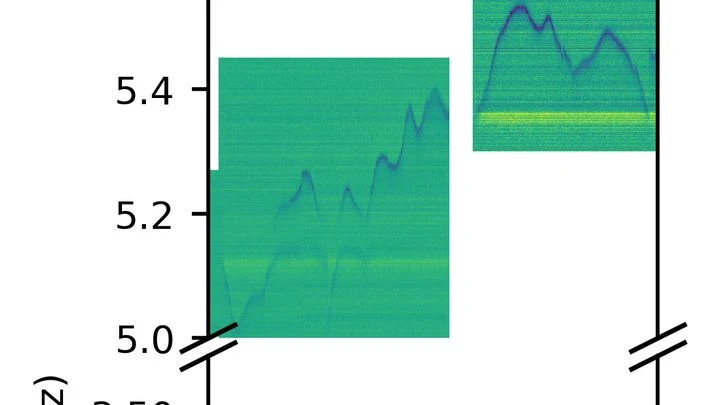
Some 123 parsecs from Earth, in the constellation Corona Australis, drifts the neutron star RX J1856.5-3754. Its diameter is about 12 kilometers, smaller than Moscow's Ring Road, but its surface temperature reaches 460 000 kelvin. The star emits a slow, almost inaudible exhalation.
Superconductivity is often pictured as a frozen dance of electrons: they pair up and move without resistance, like figure skaters on perfect ice. But in high-temperature superconductors, that ice turns out to be not so smooth.
Imagine a skyscraper assembled not from individual bricks but from entire studio apartments. That's exactly how the Au₆Te₁₂Se₈ crystal is built: its nodes are not atoms but superatomic clusters of gold and chalcogens that behave as single quantum objects.
In the crystal CsV3Sb5-xSnx, which becomes a superconductor at low temperatures, current does not flow as a uniform stream but along narrow, winding paths. A scanning microscope with a sensitive magnetic field sensor helped reveal these paths: it picks up the faintest currents, much like a sonar probes the seafloor.
A handful of matches falls on the table. Each lies however it lands, but in our minds we turn each into an arrow — from one end to the other. Now ask: can you get from one point to another by moving only in the direction of the arrows? A group of points where you can reach any one from any other is called a strongly connected cluster.
In familiar metals like copper, electrons move almost independently, like cars on an open highway. Resistance arises from rare collisions and can be described by simple formulas.
A stone falls into a pond, and ripples spread across the water. But if the stone is very small and the water is not quite ordinary, the ripples pass right through it, as if it weren't there.
Inside a superconductor, a magnetic field typically twists into tubes, vortices, each carrying one quantum of magnetic flux. That's how the classic Abrikosov lattice works. But in LiFeAs crystals, the picture is different.
Muon spectroscopy showed that the field penetrates not as individual vortices but as stripes. Each stripe contains pairs of 'coreless' vortices.
An orchestra where every musician plays their own part, and the conductor tries to catch the overall melody. That's roughly how physicists view electrons in cuprates — ceramic materials that conduct electricity without resistance at temperatures above liquid nitrogen.
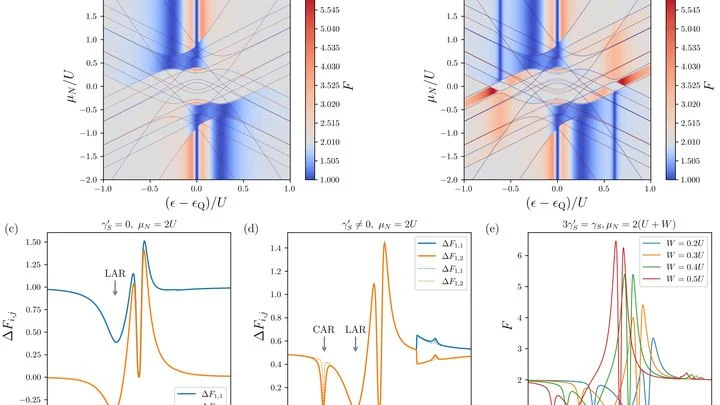
In the world of superconductors, electrons don't like to be alone. They typically pair up into Cooper pairs and move without resistance, like figure skaters holding hands. But you can make them dance in fours. The authors of this work propose a scheme where Cooper quartets, groups of four electrons exchanging partners in a rapid rhythm, are born.
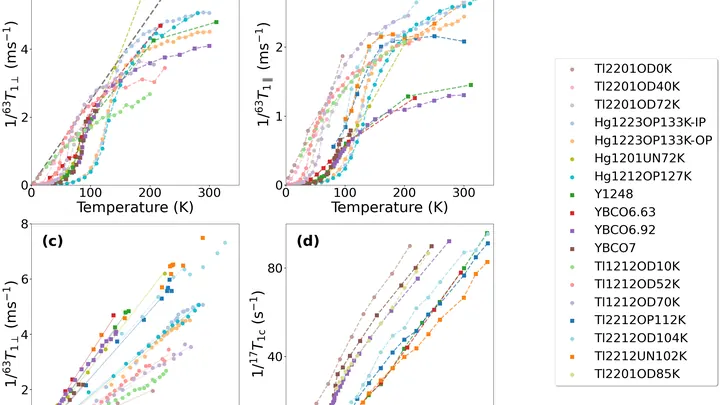
Inside copper-based superconductors, materials that carry current without loss at unexpectedly high temperatures, there is a hidden phase. It behaves like an ordinary metal, but it's invisible in standard measurements.
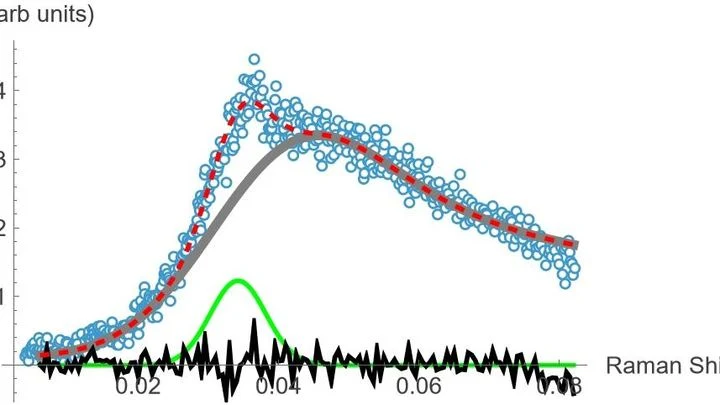
In a pot of boiling water, bubbles of steam are born and pop, but the water itself remains a liquid. Something similar happens in an ultracold atomic gas: atoms constantly form pairs and then fly apart again, even though superfluidity has not yet set in.
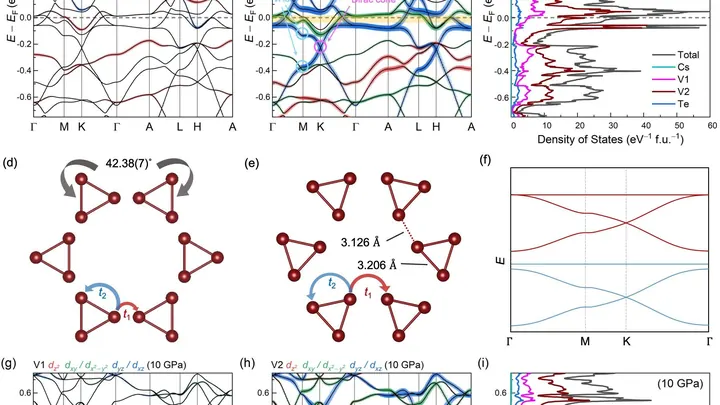
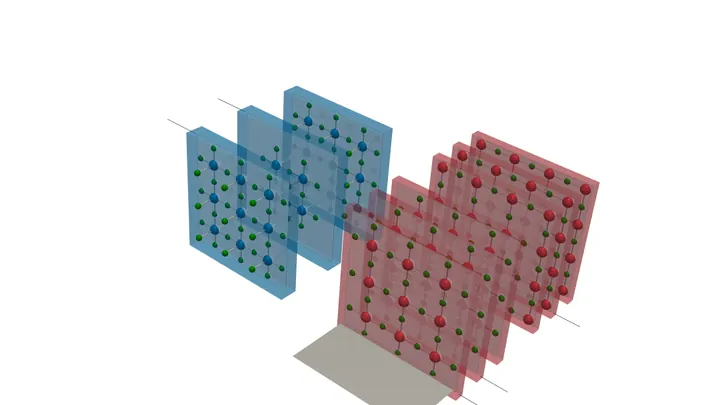
A woven basket made of willow twigs holds its shape thanks to the interweaving. A similar pattern, triangles linked into a flat network, has been found in a new crystal with the formula Cs₃V₉Te₁₃. Here, vanadium atoms form two sets of triangles that pierce each other like threads in fabric.
This pattern is not just pretty: it forces electrons to move along special "flat" energy pathways.
Niobium is a metal that, when cooled to a few degrees above absolute zero, conducts electricity without resistance. In labs, it is deposited as thin strips onto a substrate, like frosting on a cake. But during deposition, oxygen from the special mask seeps into the metal, and it spoils the superconducting properties.
In a superconducting resonator, light doesn't just bounce around: it embraces the qubit so tightly that their joint dance can no longer be described by old textbooks. The researchers took an indium arsenide nanowire, turned it into a superconducting qubit, and placed it inside a microwave resonator.
At ambient pressure, the LBCO-0.125 crystal barely conducts electricity without loss. Inside, electrons arrange into stripes with alternating magnetization, and these stripes act as barriers: superconducting pairs form but cannot flow freely through the whole sample.
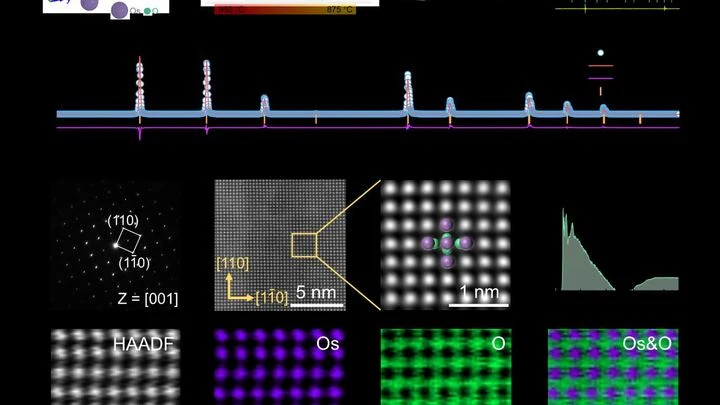
A crystal of osmium dioxide, OsO₂, is like a stubborn teenager: under ordinary conditions it behaves like a typical metal, but press hard enough and its character changes.
A metal alloy is like a cocktail: mix a few elements and you get a material with new properties. But while a bartender tastes the drink, engineers need to know in advance how an alloy will behave in service.
The classic BCS theory of superconductivity, developed by John Bardeen, Leon Cooper, and Robert Schrieffer, describes the mechanism by which electrons pair up into Cooper pairs and move without resistance.
The crystal of RbMn6Bi5 resembles a five-story building of manganese atoms, where the residents on each floor form a pentagon. At room temperature, the magnetic moments of the atoms fluctuate chaotically, like compass needles during a magnetic storm.
Electrons in a metal are like a crowd in a subway: each on their own, but at the slightest push, everyone moves at once. Physicists call this collective oscillation of the electron gas a plasmon. In superconductors, these oscillations are especially important because they reveal how electrons interact with each other.
Ordinary wires: electrons jostle, lose energy, and heat up: that's resistance. In superconductors, some electrons pair up in sync, like dancers swirling without collisions. But these pairs hide: you can't see them directly, only infer their presence from flawless coordination.
At 78 K, a crystal of Mn₃Si₂Te₆ turns into an inductor that needs neither copper wire nor a superconductor. The electrons inside it spontaneously organize into closed vortices with a definite sense of rotation: chiral orbital currents.