A phase of matter in certain superconductors above their critical temperature where resistance grows linearly with temperature and conventional metal theory breaks down.
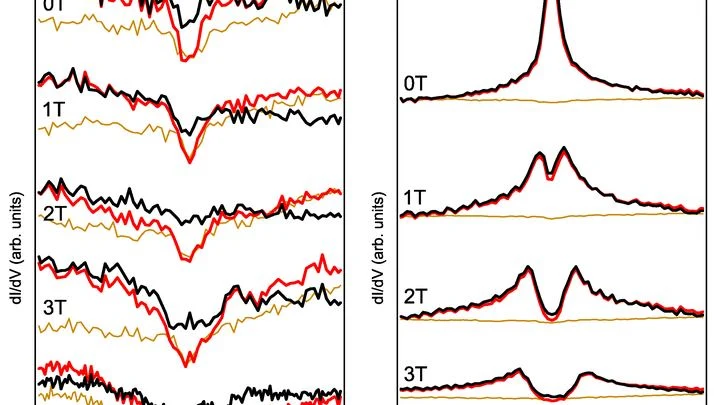
Strange metals are a phase of matter observed in certain high-temperature superconductors and other strongly correlated electron systems. Unlike conventional metals, where electrical resistance decreases with temperature and eventually becomes constant, strange metals exhibit a linear increase in resistance with temperature over a wide range. This behavior defies the standard Fermi liquid theory, which successfully describes ordinary metals. Strange metals are also characterized by a universal scattering rate that is proportional to temperature, hinting at a deep, yet not fully understood, quantum mechanical principle.
History
The term 'strange metal' was coined in the 1990s to describe the anomalous properties of copper-oxide high-temperature superconductors above their critical temperature. The concept has since been extended to other materials, including heavy-fermion compounds and certain organic conductors.
How it works
In ordinary metals, electrons behave as weakly interacting quasiparticles that scatter off impurities and lattice vibrations, leading to a resistance that scales with temperature squared at low temperatures. In strange metals, this quasiparticle picture breaks down: electrons appear to lose their individual identity, and the scattering rate becomes set by temperature alone. This suggests that the electrons are strongly entangled and that quantum fluctuations play a central role, possibly related to a quantum critical point—a phase transition at absolute zero where competing orders fluctuate violently.
In practice
Understanding strange metals is crucial for developing room-temperature superconductors, which would revolutionize power transmission, magnetic levitation, and medical imaging. They also serve as a testing ground for new theoretical frameworks beyond Fermi liquid theory.
Fun fact
In strange metals, the electrical resistance increases exactly linearly with temperature, even down to a few kelvin—a behavior that has no analogue in any known conventional metal.
The map of dense nuclear matter resembles a road map: lines of phase transitions cross at critical points, like highways at intersections. Until now, only two intersections were known on such a map: the nuclear liquid-gas and deconfinement, where hadrons dissolve into quarks.
Old treasure maps were drawn from hearsay: someone found gold by a river, someone else in the mountains, and each person dug in their own spot. High-temperature superconductors went the same way: cuprates were found in some compounds, iron pnictides in others, nickelates in yet others, and there was no common map.
Current in an ordinary metal flows like a crowd of people down a straight street: each electron is on its own, and if you turn on a magnetic field, the whole crowd shifts slightly sideways. This shift is called the Hall effect.
Current in an ordinary metal flows like a crowd of people down a straight street: each electron is on its own, and if you turn on a magnetic field, the whole crowd shifts slightly sideways. This shift is called the Hall effect.
A neutron star is the remnant of an exploded star, compressed so tightly that a teaspoon of its material would weigh as much as a mountain. Inside such an object, protons and neutrons are packed tightly together, and under enormous pressure, hyperons, particles containing a strange quark, can appear.
A hunter sets snares in the woods. They know the animal's habits but not whether it will ever show up. In much the same way, physicists set up detectors in hopes of catching particles of dark matter — the invisible substance thought to make up most of the Universe's mass.
A new study offers hunters an unusual tool: not a trap, but a measuring tape.
A tiny sandwich of oxides, grown layer by layer, becomes perfectly conducting at about minus 200 degrees Celsius. This is not a magic trick but a new chapter in the search for high-temperature superconductors.
The wind carries pollen, and each grain moves as if on its own. But once the air swirls into a vortex, the pollen trajectories can no longer be separated: they are tangled. This is roughly how electrons behave in a strange metal: their motion is so strongly coupled to soft fluctuations of the medium that the usual particle carriers disappear.
Superconductivity and magnetic field are age-old foes: the field barges in like a whirlwind, tearing apart the delicate pairing of Cooper pairs, destroying order.
The nickelate family consists of layered crystals, like a stack of pancakes: nickel and oxygen layers alternate with lanthanum spacers. Two years ago, superconductivity was discovered in them — the ability to conduct electricity without resistance when cooled.
Using laser spectroscopy — a method akin to listening to the echo from a crystal — physicists examined the layered material. They found regions where electrons move freely (Fermi pockets) and noticed that each such region behaves in its own way.
A handful of sand weighing as much as a small mountain: that's roughly what strangelets are like: tiny clumps of 'strange' quark matter where particles are squeezed to unimaginable densities. In a new study, astrophysicists tested whether such objects could exist in nature and what they would look like.
A metal bar suddenly becomes stiff when heated, and at the same time loses or gains magnetic properties. In alloys based on nickel and manganese, such transformations occur not smoothly but abruptly — atoms rearrange into a new order, and the material changes its behavior.
A pot of water on the stove: the hotter the burner, the faster ice turns to water, and water to steam. Heat destroys order. But sometimes nature pulls a trick, and heating makes a liquid freeze, like a puddle turning to ice on a frosty morning.
In familiar metals like copper, electrons move almost independently, like cars on an open highway. Resistance arises from rare collisions and can be described by simple formulas.
A stone falls into a pond, and ripples spread across the water. But if the stone is very small and the water is not quite ordinary, the ripples pass right through it, as if it weren't there.
A crystal is like a city: if the streets are crooked, traffic jams. In a crystal, the streets are atomic rows, and the traffic is the flow of electrons. Any tiny imperfection, impurity, or atomic displacement makes electrons scatter. Scientists from several labs have learned to grow crystals so that the "streets" are almost perfectly straight.
The method is called horizontal vapor transport.
Inside copper-based superconductors, materials that carry current without loss at unexpectedly high temperatures, there is a hidden phase. It behaves like an ordinary metal, but it's invisible in standard measurements.
A laser strikes the crystal, and it responds with flashes of light, like a bell ringing after a blow. But if the bell is warm, its sound wavers and fades. Same here: the crystal's atoms constantly jitter from heat, and this jitter disrupts the electrons' smooth flight, making the light dim and blurry.
A tiny magnet, made from just two molecules, was placed on a metal surface, and it behaved like a temperamental conductor. Normally, electrons in a metal move in a coordinated way, like a crowd on an escalator. But when cooled significantly, this order breaks down, and the motion becomes unpredictable.
Water in a kettle, as it boils, clearly separates into liquid and steam. But under enormous pressure, the boundary vanishes: the substance enters a supercritical state — neither one nor the other, but something in between.
Black holes can do this too.
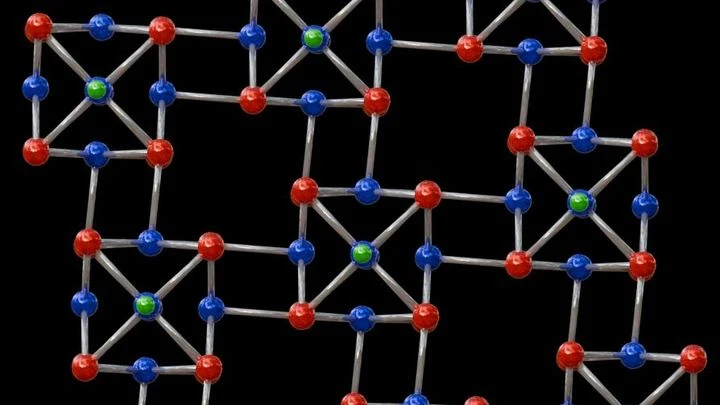
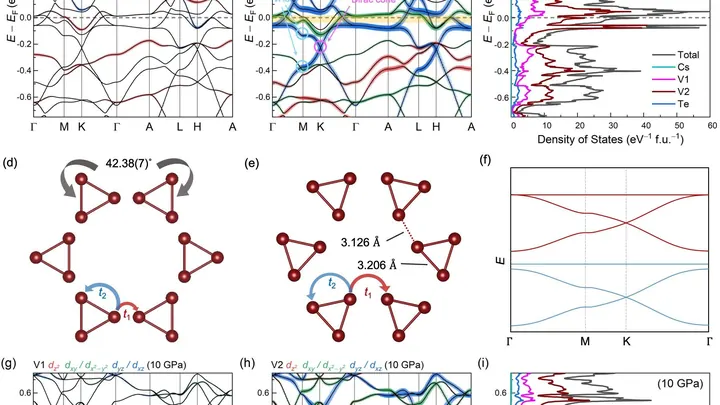
A woven basket made of willow twigs holds its shape thanks to the interweaving. A similar pattern, triangles linked into a flat network, has been found in a new crystal with the formula Cs₃V₉Te₁₃. Here, vanadium atoms form two sets of triangles that pierce each other like threads in fabric.
This pattern is not just pretty: it forces electrons to move along special "flat" energy pathways.
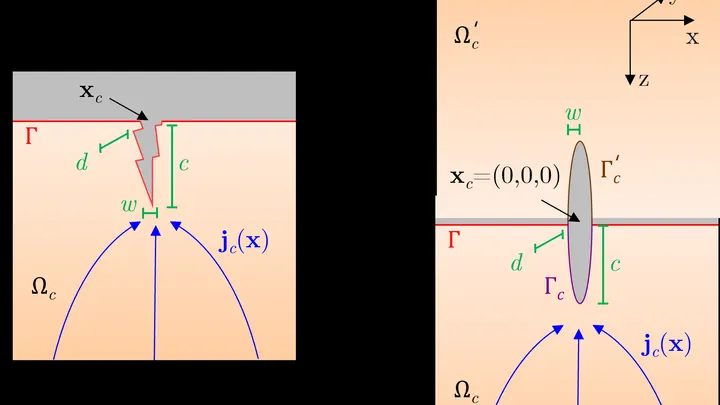
A metal filament as thin as a hair grows through the ceramic like a root through asphalt. In solid-state batteries, such filaments are called dendrites, and they appear when the charging current exceeds a critical threshold. The ceramic electrolyte is solid but brittle, like glass.
Ordinary window glass may seem frozen forever, but inside, atoms never stay still. In amorphous germanium telluride (GeTe)—a material used in rewritable discs and non-volatile memory — physicists have for the first time directly tracked how atomic bonds stretch and bend in trillionths of a second.
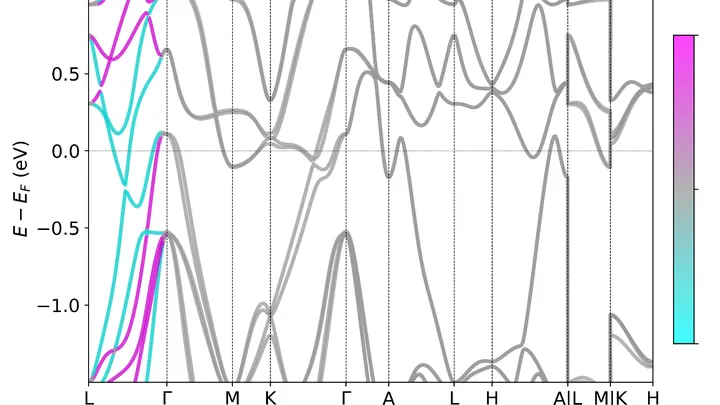
Electrons in a CrSb crystal behave like a school of fish: inside the material, they dart along their "corridors," and at the boundary with vacuum, they arrange themselves into intricate patterns. These patterns are the Fermi surface — a map of all allowed electron velocities. You can't reach out and touch it, but you can "feel" it with a magnetic field.
The crystal CeRh₂As₂ behaves like a switch: cool it down and it becomes a superconductor, then bring a magnet close and it abruptly jumps to another superconducting state. Such behavior is rare: most superconductors have only one state, but here there are two, separated by a sharp boundary.
The crystal of RbMn6Bi5 resembles a five-story building of manganese atoms, where the residents on each floor form a pentagon. At room temperature, the magnetic moments of the atoms fluctuate chaotically, like compass needles during a magnetic storm.
In NaAlSi, as it cools, electrons form fleeting ripples — stripes that appear and vanish, like patterns on water stirred by wind. These stripes intertwine with superconductivity, a state where current flows without resistance. Typically, for this, electrons pair up with uniform binding energy.
Dark matter is the invisible scaffold of the cosmos, its existence betrayed by whirls of galaxies to Fritz Zwicky and Vera Rubin. What it is made of remained a mystery for half a century.
A new hypothesis paints an unusual picture.