How Cyanamid Is Born on Ice express
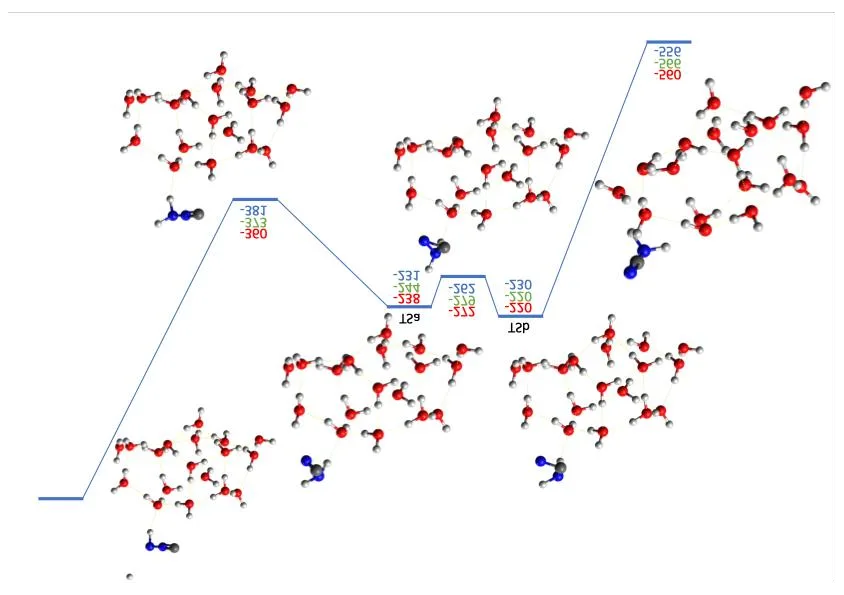
In cold clouds between the stars, dust grains are coated with ice, like windows covered with frost in winter. On this icy crust, chemical reactions take place that do not occur in gas. One such reaction is the encounter between a carbon atom and a nitrogen molecule. In gas, they barely react, but on ice they combine immediately, without an energy barrier.
The resulting molecule CNN then picks up hydrogen atoms. It is like assembling a construction set: first attach two blocks, then add more. Eventually, the bond between the two nitrogen atoms breaks, and the chain rearranges into the N-C-N skeleton — the basis for cyanamide (NH2CN) and its isomer carbodiimide (HNCNH). Calculations showed that all steps proceed easily, with low barriers.
When these reactions were added to a model of protostellar evolution, it turned out that the icy pathway is the main supplier of these molecules. Carbon and hydrogen on cosmic dust do what had been unexplained for years.
Original abstract
as written by the authors arXiv:2604.15930
Reactions occurring on the ice-covered surfaces of interstellar dust grains are considered to be among the most important sources of complex species in the interstellar medium. Despite this, molecules such as cyanamide, NH2CN, are largely underpredicted by current astrochemical models suggesting that the network of reactions currently used to describe this species and its tautomer carbodiimide, HNCNH, are incomplete. Here, we performed a theoretical investigation of the reaction of ground state atomic carbon C(3P) with molecular nitrogen N2 in both the gas-phase and on the surface of amorphous solid water (ASW) clusters to examine its potential importance in the formation of NH2CN and HNCNH. We show that the reaction of gas-phase C-atoms with N2 molecules already present on the ASW surface results in the barrierless formation of CNN. Following exothermic hydrogenation reactions, the N-N bond of the C-N-N bearing intermediates is broken allowing the formation of molecules with N-C-N backbones through cyclic intermediates over low barriers. To test the importance of these processes to NH2CN and HNCNH formation, these reactions were included in a three-phase astrochemical model of low-mass protostellar evolution employing a reaction network that was updated to better describe the formation and destruction pathways of related small nitrogen bearing molecules. These simulations demonstrate that the ice surface reaction between C and N2 represents by far the dominant source of NH2CN and HNCNH in protostellar environments and in dense clouds.
Cyanamide is a simple compound, but on Earth it is used as a fertilizer and a raw material for pharmaceuticals, and in space it may have been one of the building blocks for prebiotic chemistry.
In Carl Sagan's novel Contact, the alien signal contains complex molecules — possibly including cyanamide born on ice.