Quartets of Electrons: A Dance in Four Steps express
In the world of superconductors, electrons don't like to be alone. They typically pair up into Cooper pairs and move without resistance, like figure skaters holding hands. But you can make them dance in fours. The authors of this work propose a scheme where Cooper quartets, groups of four electrons exchanging partners in a rapid rhythm, are born.
The key to this dance is two quantum dots, tiny islands capable of holding electrons. They are connected to a normal metal wire and two superconducting shores. When a current is passed through the system at high voltage, electrons from the superconductor start jumping into the dots in pairs. At a certain moment, two pairs, finding themselves nearby, momentarily merge into a quartet, and then immediately split apart again. This process happens at tremendous speed, but its traces are visible in electrical measurements.
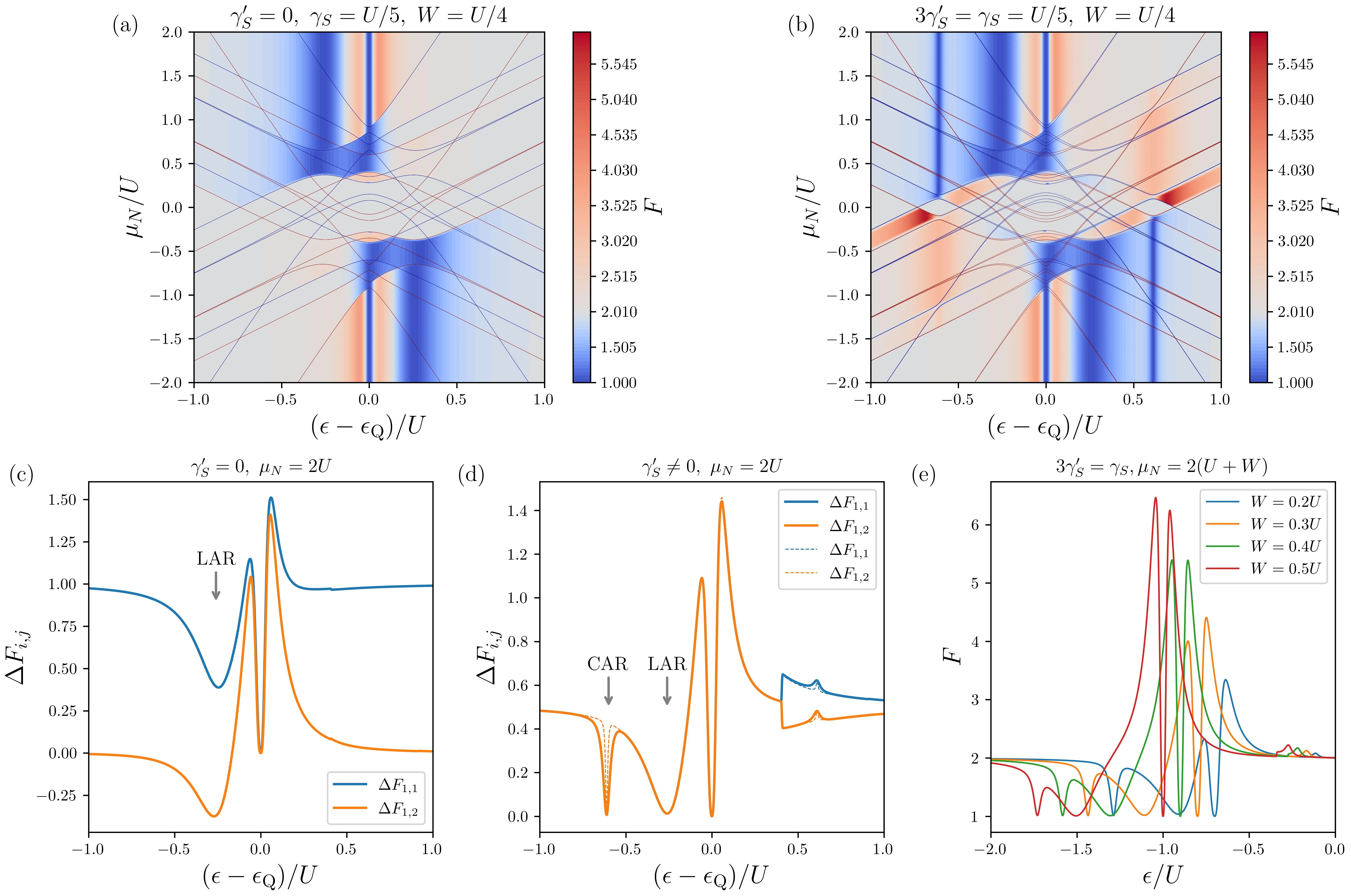
The researchers didn't just predict quartets theoretically. They calculated specific electrical signatures: a distinctive peak in the current, as well as an unusual noise ratio in the two wires. When quartets form and decay synchronously, current fluctuations in the left and right contacts become identical, as if two people were clapping their hands at the same time. Such a coincidence of noises is almost impossible to explain by anything other than rapid oscillations between two pairs and a quartet.
This work builds a bridge from the familiar physics of pairs to the exotic world of many-body correlations. If quartets can be stabilized, they could become building blocks for new quantum materials — substances with unusual properties born from the collective behavior of electrons. And all this on a platform that can be assembled in an ordinary laboratory using well-established technologies.
Original abstract
as written by the authors arXiv:2604.16647
Cooper quartets are aggregates of four electrons that generalize the concept of Cooper pairs, and their study can unfold unexplored perspectives in correlated matter and many-body physics. We propose a method to isolate them in a double-quantum-dot system coupled to conventional superconducting and normal leads. By driving the system out of equilibrium, we show that a resonance between the vacuum $$|0\rangle$$ and the four-electron state $$|4e\rangle$$ emerges in the high bias voltage regime, which involves a two-Cooper pair exchange process and is characterized by finite quartet correlations. We study the transport properties of the system and show that a peak in the Andreev current at high bias voltage has a width that scales with the magnitude of the quartet coupling $$\Gamma_{4e}$$, which can be tuned by the phase of additional superconducting leads, yielding distinctive signatures. By further studying the current-current correlations and the Fano factor, we establish a regime characterized by equal auto- and cross-correlations, which we interpret as a definitive signature of fast coherent two-Cooper-pair oscillations between the dots and the superconducting leads. The proposed platform, experimentally accessible in a quantum solid-state laboratory, enables exploration of quartet correlations and multifermion-correlated states of matter.
Cooper pairs, discovered in the mid-20th century, resemble pairs in ballroom dancing: electrons with opposite momenta and spins move in sync. Quartets, on the other hand, are like a quadrille, where four particles briefly form a single figure.