Drops That Choose Their Own Path express
A drop of water on a table usually sits still. But make the table slightly softer on one edge and stiffer on the other, and the drop will crawl toward the stiffer side. This phenomenon is called durotaxis: the liquid itself chooses where to flow, without pumps or electricity.
This trick works because the surface under the drop is not uniform. If the substrate is soft in one spot and hard in another, the drop deforms it differently. The resulting difference in forces pushes the liquid. It's like walking on a beach: stepping on soft sand is harder than on a packed path, so your steps naturally lead you to the firm ground.
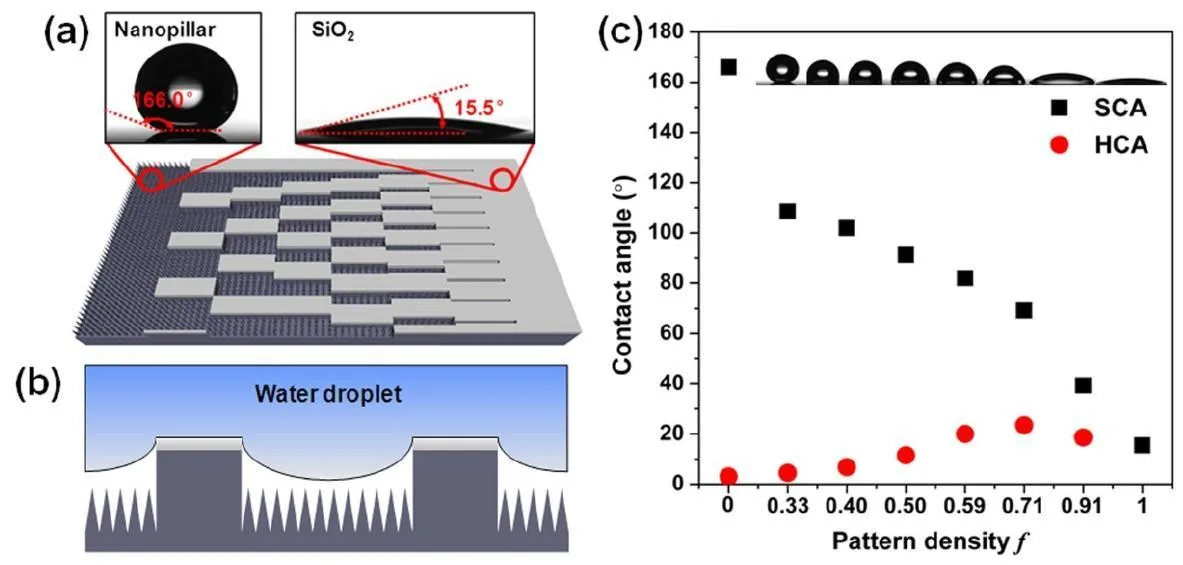
Scientists have learned to control this movement. They create surfaces with patterns, variations in wettability, and pressure. The drop, like a tiny robot, follows a predetermined route. This matters for medical chips, where you need to mix and move tiny volumes of liquid without external devices.
Someday, such surfaces could become the basis of portable labs. A drop of blood would crawl across the chip on its own, meet reagents, and produce a test result. All without a single wire.
Original abstract
as written by the authors arXiv:2604.16974
Applications such as digital microfluidics and bio-diagnostics rely on droplet locomotion. A prominent example of such motion is durotaxis, a phenomenon that requires a stiffness gradient along a surface for the transport of liquids, cells, or other nano-objects. Using surfaces with varying properties in specific directions can be exploited as a universal concept for fluid transport with or without external energy supply. Changes in properties may refer to substrate patterns, Laplace pressure changes, wettability gradients, etc., leading to exciting phenomena, which can be employed in novel applications in various technologies. Here, we report on key results and progress in the area of directed droplet motion over the years, and we provide perspectives and implications for anticipated applications.
Cellular durotaxis was discovered when researchers noticed that cells on a soft gel spread out, while on a stiff gel they cluster into a dense layer.