How to Hear the Shiver of Superconducting Boundaries express
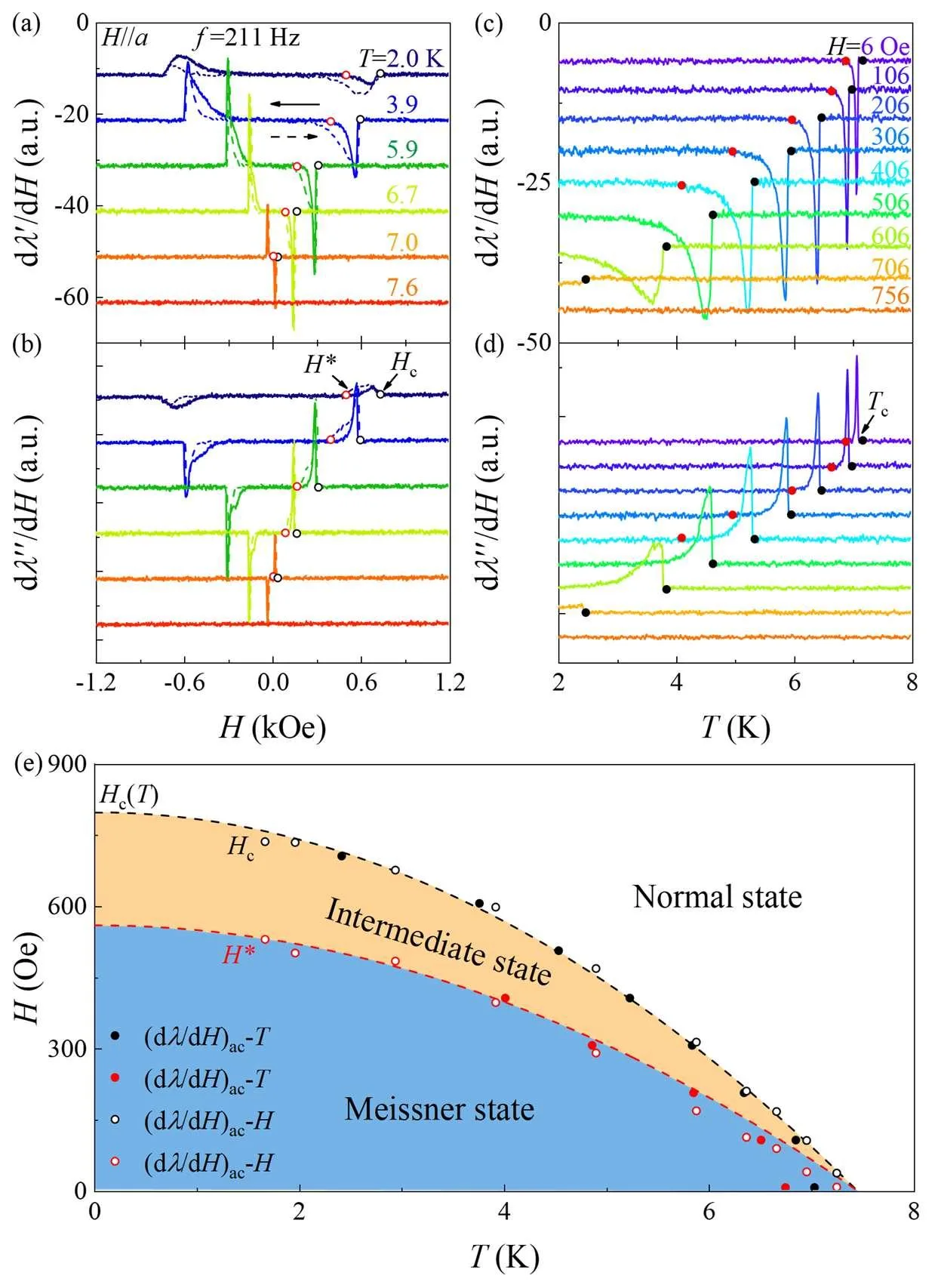
Ordinary magnetic measurements only see the surface of a superconductor, where barriers and viscous flows of magnetic field get in the way. Inside, in the so-called intermediate state, superconducting and normal domains coexist, separated by thin walls. These walls can oscillate, but hearing them directly has been difficult.
In the new work, instead of the magnetic response, they measured how a lead sample changes its length under an alternating magnetic field — an effect called magnetostriction. It turned out that the domain boundaries oscillate not with simple damping, as expected, but almost resonantly: the imaginary part of the response changes sign, and the real part behaves non-monotonically with frequency.
The authors attribute this to collective oscillations of the boundaries, pushed by eddy currents that arise in the normal domains. These currents, like whirlpools in a river, drag the walls and make them move in concert. The method turned out to be more sensitive than traditional magnetic measurements and for the first time allowed seeing this hidden channel of dynamics.
This approach is like a stethoscope applied to the internal boundaries of a superconductor. It opens the way to studying phases with spatial modulation in other materials, where boundaries may also hide their oscillations.
Lead becomes superconducting at about 7.2 kelvin — colder than the surface of Pluto.