Magnets Without Metal: How Organics Learn from Bees express
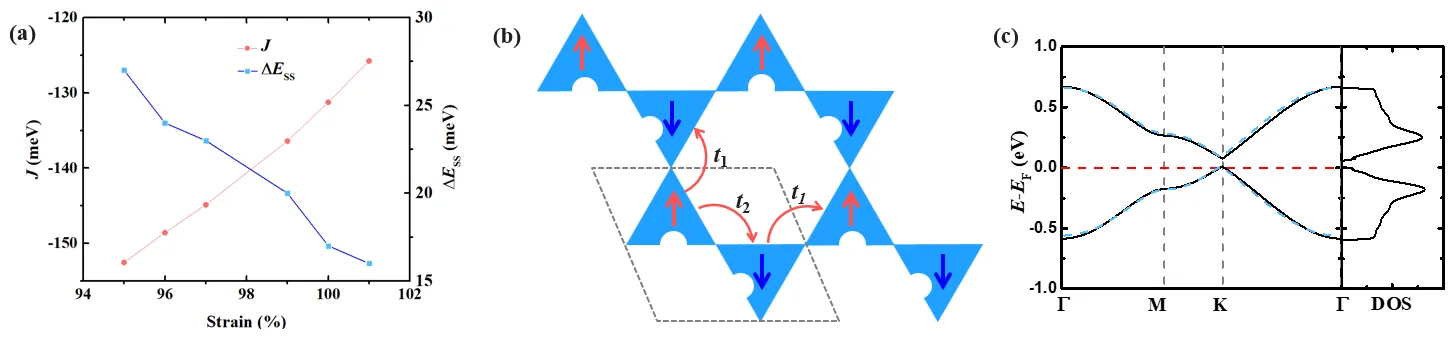
Honeycombs are built from identical cells, but tweak the shape of just one, and the whole structure gains new properties. Researchers did something similar to create a magnet without a single metal atom. They took flat carbon molecules shaped like triangles, triangulenes, and arranged them in a hexagonal lattice, just as bees build honeycombs. But instead of perfect symmetry, where a triangle can be rotated by 120 degrees without changing, they used molecules with reduced symmetry, as if slightly squashing the triangle to remove extra rotation axes. This broke the crystal's mirror symmetry but preserved its bipartite structure — the alternation of two types of nodes.
The key to the effect is anisotropic overlap of pi orbitals. The electron clouds of neighboring molecules interact more or less strongly depending on direction, like two magnets that attract or repel with different orientations. First-principles calculations showed that the exchange interaction reaches -130 meV (a measure of magnetic coupling strength), and the splitting of electronic states at a special point in the Brillouin zone is 17 meV. This corresponds to d-wave symmetry, as in high-temperature superconductors. Meanwhile, the system remains an insulator with a gap of 1.26 eV — roughly like a red LED. All of this is fully consistent with Lieb's theorem, linking magnetism to lattice topology.
Such a material is an organic substance capable of controlling spin current with an electric field, without fearing external magnetic interference. Unlike metallic counterparts, it is lightweight, flexible, and potentially biocompatible. By changing the triangle's geometry, we get not just a pattern but a functional magnet, as if bees were building not only a home but also an antenna.
Original abstract
as written by the authors arXiv:2604.17386
Altermagnetism combines momentum-dependent spin splitting of opposite-spin channels with zero net magnetization, enabling electric-field control of spin transport that is robust against external magnetic fields. Although widely explored in inorganic systems, metal-free altermagnets with pi-spin splitting, particularly in two-dimensional organic frameworks, have remained elusive. Here, we introduce a molecular design strategy that achieves designer metal-free altermagnetism in honeycomb 2D crystals. By reducing the monomer point-group symmetry from D3h to C2v in triangulene-derived radicals, inversion symmetry is selectively broken while the bipartite lattice is preserved. Spin-polarized density-functional-theory calculations reveal strong antiferromagnetic couplings of -130 meV, d-wave spin splitting of 17 meV at the M point, and Mott-Hubbard gaps of 1.26 eV, all fully consistent with Lieb's theorem. A minimal tight-binding model shows that anisotropic nearest-neighbor hopping arising from direction-dependent pi-orbital overlap is the microscopic origin of spin splitting and altermagnetism. Biaxial compressive strain further enhances the spin splitting to 27 meV. These results establish a general approach to room-temperature organic altermagnets and open a pathway toward carbon-based altermagnetism via engineered inversion-symmetry breaking.
Triangulenes, from which this magnet is assembled, are relatives of graphene: their flat shape and aromatic rings make them ideal building blocks for carbon electronics.
Organic magnets resemble the technology of 'living crystals' from China Miéville's novels — materials whose properties are determined not by composition but by geometry.