The Quantum Pond: How an Ion Crystal Catches Dark Matter express
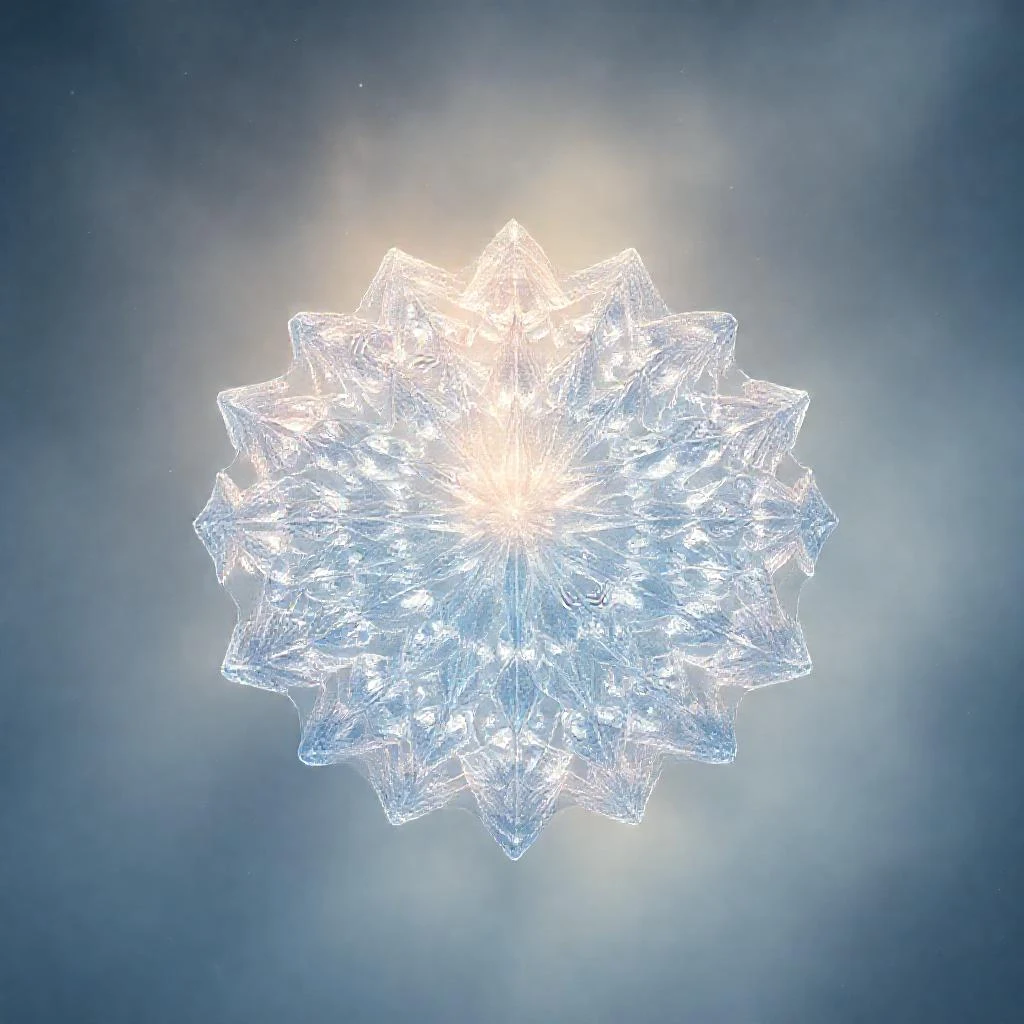
A flat crystal of charged atoms suspended in an electromagnetic trap behaves like a perfectly calm pond. The slightest breeze, and ripples spread across its surface. This 'pond' catches the splashes from dark matter particles and the ripples of spacetime — high-frequency gravitational waves.
But the natural calm surface is always covered with random ripples — thermal noise. Scientists applied quantum squeezing: it suppresses the chaotic swirls, making the surface eerily quiet in a specific direction. Then, even a faint push becomes visible. At the same time, each new ion doesn't just increase the detector area but amplifies its responsiveness like an avalanche: their teamwork transforms a barely noticeable breeze into a palpable jolt.
Calculations confirm: such a detector can feel the gravitational waves born in the first moments after the Big Bang, and bring us closer to solving the mystery of dark matter.
Original abstract
as written by the authors arXiv:2604.22336
We propose a quantum-enhanced sensing scheme for the detection of wave-like dark matter and high-frequency gravitational waves using two-dimensional ion crystals in a Penning trap. The protocol employs spin-motion squeezed states to improve the signal-to-noise ratio and enable a super-Heisenberg scaling with respect to the number of ions over a broad parameter range. We analyze the sensitivity of the protocol to representative wave-like dark matter candidates, including the axion-like particle and the dark photon, as well as to high-frequency gravitational waves, taking into account the decoherence and dephasing of the ion spins. Our results indicate that two-dimensional ion crystals and this new protocol provide a promising platform for probing previously unexplored parameter space in searches for light dark matter and high-frequency gravitational waves.
Lasers can make this crystal vibrate like a quantum drum: its vibrations are so pure that they can sense the passage of a single dark matter particle.