The Gravitational Orchestra Loses Its Rhythm express
A figure skater glides across the ice, gradually moving toward the center. Their trajectory isn't a perfect spiral: sometimes they catch the rhythm of the music and add an extra turn, slightly changing their speed. That's roughly how a small black hole behaves when it falls into a supermassive one. This process is called extreme mass ratio inspiral, and it produces gravitational waves — ripples in spacetime that detectors like LISA pick up.
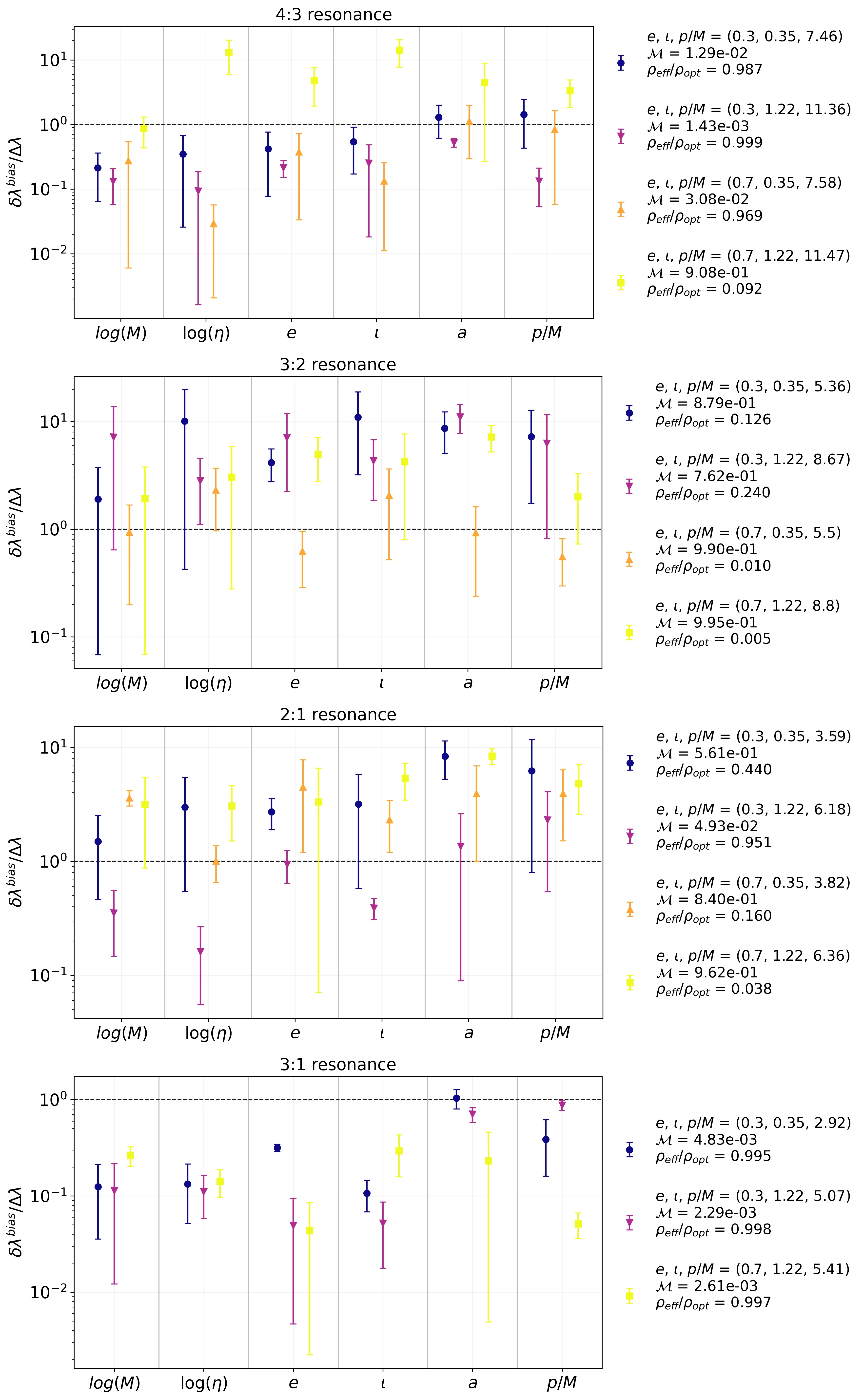
But there's a catch in this cosmic dance. The orbit isn't always smooth: sometimes the small object's orbital frequency matches the system's oscillation frequency. A resonance occurs — a brief moment when the motion changes abruptly, as if a swing starts moving in sync with your pushes. The authors of the study examined what happens if such a resonance is missed when analyzing the signal. It turns out that even weak resonances, like 3 : 1 (three orbits per one oscillation), can confuse things: the detector might "think" the object is more massive or closer than it actually is.
The scientists used a mathematical tool, the Fisher matrix, to estimate how much resonances shift our understanding of the system. They found that if these moments are ignored, we could lose up to a third of the signal's strength. That means we risk missing the faint whispers of distant black holes or mistaking one object for another.
If judges fail to notice that a skater lost the rhythm for just a moment, they might misjudge the performance. It's the same with gravitational waves: a missed resonance is an error in the Universe's "score." To hear the music of the cosmos without false notes, we need to learn to recognize every note, no matter how short.
A resonance can last only a few seconds, but in that time, the small black hole manages to complete thousands of orbits around the giant one.
In Carl Sagan's novel "Contact," a signal from space was initially mistaken for noise — much like how resonances can masquerade as ordinary gravitational waves.