Gravitational wave resonance is a phenomenon where orbiting bodies, such as neutron stars or black holes, interact with each other in a way that amplifies the emission of gravitational waves. This occurs when the orbital frequency of the system matches a natural resonant frequency of the bodies themselves, causing them to deform and oscillate more strongly. The effect can significantly enhance the energy lost to gravitational radiation, speeding up the inspiral of the binary system and producing stronger signals than would be expected from a simple point-mass model.
History
The concept of tidal resonance in binary systems was explored in the 1970s and 1980s, with key contributions from theorists like Peter Goldreich and Scott Tremaine in the context of planetary moons, and later applied to neutron star binaries by researchers such as Lars Bildsten and Curt Cutler in the 1990s.
How it works
In a binary system, each body has its own natural oscillation modes, similar to how a bell rings at specific frequencies. As the two bodies orbit each other, their gravitational pull causes tidal deformations. When the orbital frequency sweeps through one of these natural frequencies, the deformation is amplified — the body 'rings' like a struck bell. This resonant oscillation extracts extra orbital energy, which is radiated away as gravitational waves. The effect is strongest during the final moments before merger, when the orbital frequency rapidly increases through a range of resonant frequencies.
In practice
Resonance effects are crucial for accurately modeling gravitational wave signals from neutron star binaries, helping detectors like LIGO and Virgo extract precise information about the stars' internal structure and equation of state.
Fun fact
The resonance can be so strong that it causes the neutron star to deform into a prolate (cigar-like) shape, dramatically increasing the gravitational wave amplitude just before merger.
The early universe underwent rapid expansion — inflation. According to one theory, the driving force of this process (the inflaton) behaved like an axion — a particle interacting with a gauge field through a special coupling (an analog of the Chern–Simons effect).
In the first moments after the Big Bang, the Universe hummed like a bell. Inflation, the epoch of rapid expansion confirmed by measurements of the cosmic microwave background, ended, and the inflaton field began oscillating around the minimum of its potential.
Two ultradense spheres, each the size of a city, whirl in a dance. Their masses are less than the Sun's, but inside them is matter compressed to unimaginable limits. One sphere is a neutron star; the other is a strange star, made entirely of quarks — the elementary particles that build up protons and neutrons.
A black hole with a magnetic field resembles a whirlpool in a river, where water doesn't flow into the vortex but swirls in place. Usually, the hole's rotation picks up waves and amplifies them: this is called superradiance. But add a magnetic field, and everything changes.
Ripples on a pond spread in circles from a thrown stone. Now imagine the pond itself begins to tremble — the water oscillates not only from the stone but also on its own. That's roughly how gravitational waves behave in space where a special scalar field pulsates.
When two superdense stars circle in a tight dance, the space around them shudders. This shudder, gravitational waves, is caught by giant detectors on Earth. But deciphering the signal is tricky: you need to figure out what exactly you're dealing with — a pair of black holes or neutron stars.
The Sun is not just a source of light but a giant laboratory where ghostly particles are born. Every second, billions of neutrinos fly through your body, barely noticing you. But inside the Sun, these particles behave differently: they change their type on the fly, like an actor playing three roles in a single play.
A dead star with a magnetic field billions of times stronger than Earth's is a magnetar. Its crust cracks, sending a powerful X-ray burst into space. But some of that light doesn't reach us in its usual form. In an ultra-strong field, photons can turn into gravitational waves — the trembling of space itself.
Blacksmith's bellows fan the fire by forcefully pushing out air. In space, the shock wave from a supernova, a concept introduced by Fritz Zwicky, acts like such bellows: it catches up with a giant bubble of charged particles and magnetic fields formed around a spinning neutron star…
Gravitational waves are not vibrations of matter, but tremors of spacetime itself, predicted by Albert Einstein. They travel at the speed of light and pass through objects, stretching and squeezing them.
A figure skater pulls their arms in, and their spin suddenly accelerates. When a massive star exhausts its fuel and its core collapses, something similar happens, but on a cosmic scale. The core shrinks to a city-sized sphere, and if it is spinning rapidly, a peculiar instability can arise.
In the first moments after the Big Bang, the universe was a boiling cauldron. But then, according to a new hypothesis, it suddenly cooled dramatically — far more than previously thought. In this icy world, dark matter particles, like tiny pendulums, froze and did not begin their oscillations.
In 2017, detectors picked up a tremor in space — gravitational waves from the merger of two neutron stars. At the same moment, telescopes saw a flash. For the first time, one event spoke in two languages at once: light and gravity.
A stone falls into a pond — ripples spread across the water. If the stone doesn't fall but whizzes over the surface at tremendous speed, a straight wave runs along the water. When it hits a floating log, ripples spread out from the point of impact. That's roughly how gravity works in the new study.
A figure skater glides across the ice, gradually moving toward the center. Their trajectory isn't a perfect spiral: sometimes they catch the rhythm of the music and add an extra turn, slightly changing their speed. That's roughly how a small black hole behaves when it falls into a supermassive one.
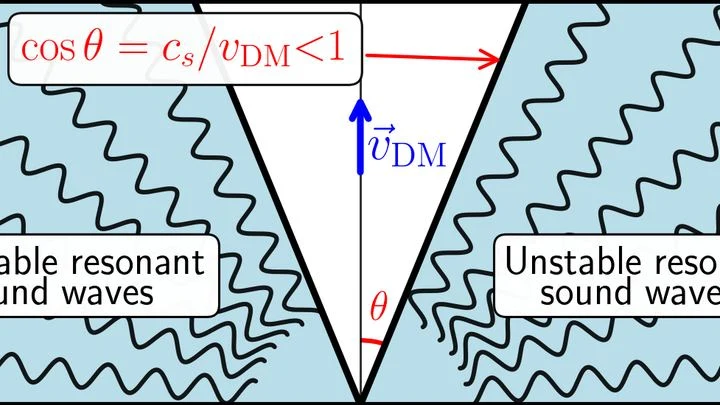
After the Big Bang, dark matter and ordinary matter (mostly hydrogen) went their separate ways in terms of speed. Their gravitational pull acts like a bow gliding across a string: when frequencies match, resonance occurs, and sound waves start to rapidly grow in ordinary matter.
A tuning fork, once struck, makes neighboring strings vibrate. Much the same happens with a cloud of ultralight particles (also called axions) around a rapidly spinning black hole. The hole, like a motor, spins up the particles, and they begin to emit gravitational waves — a trembling of space itself.
At the heart of the Milky Way spins a stellar bar — an elongated cluster, like a rotating paddle. Its gravity creates a rhythmic field around it, like waves from a speedboat.
In 2019, gravitational-wave detectors caught a signal from the merger of distant objects. One was a black hole of 23 solar masses. The other weighed just 2.5 solar masses — and that's weird.
Usually, neutron stars don't get heavier than two solar masses: beyond that, they collapse into a black hole.
Magnetic materials can store oscillatory energy, like a tuning fork that keeps ringing after being struck. When such a material is placed in a microwave cavity, its oscillations (magnons) start interacting with light (photons).
Gravitational waves are ripples in spacetime curvature that imperceptibly stretch and squeeze everything around. But the Moon, like a bell, catches these waves: as a gravitational wave passes through it, it makes our satellite vibrate.
Two giant black holes spiral together and collide — a ripple of spacetime spreads across the Universe. Detectors of gravitational waves catch this ripple. But the signal may hide more than just mass and distance: if the laws of physics differ ever so slightly in different directions, the wave will be distorted.
The Moon is not just a rocky sphere, but a giant bell. Passing through it, gravitational waves cause it to vibrate almost imperceptibly. This tremor was predicted by Einstein, and Weber was the first to try to hear it with Earth-based detectors.
A guitar string after being plucked produces not only the fundamental note, but also quiet overtones. A similar phenomenon appeared in the gravitational waves from the merger of two black holes (event GW250114).
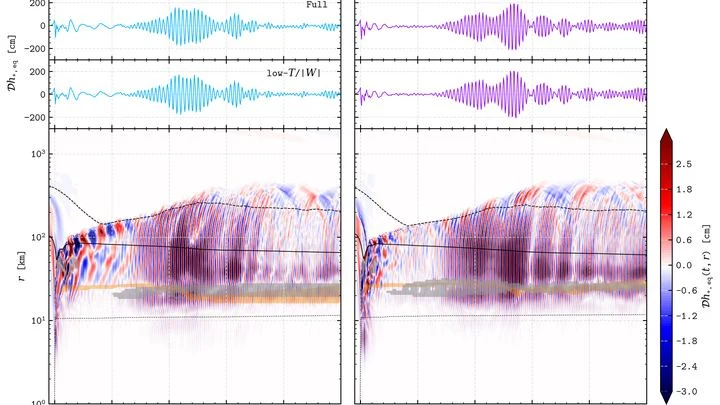
The collision of two neutron stars is a strike heard across the universe. Gravitational wave detectors pick up the ripples in spacetime, but the most interesting sound begins after the impact: the merger remnant, a rapidly spinning hypermassive neutron star, continues to vibrate, emitting waves for a few more…