Orbitalfrequency is the rate at which an object completes one full orbit around another body, typically measured in revolutions per second or hertz. It is a fundamental parameter in celestial mechanics, describing the motion of planets, moons, satellites, and binary star systems. The frequency is inversely related to the orbital period and is determined by the gravitational interaction between the two bodies.
History
The relationship between orbital period and distance was first formulated by Johannes Kepler in the early 17th century, based on Tycho Brahe's observations. Newton later derived it from his law of universal gravitation.
How it works
For a two-body system, the orbitalfrequency is given by Kepler's third law, which relates the square of the orbital period to the cube of the semi-major axis. In general relativity, the orbital frequency also affects the emission of gravitationalwaves, causing the orbit to shrink and the frequency to increase over time, a process known as inspiral.
Betelgeuse, the red supergiant familiar from Orion's shoulder, keeps surprising us. After the mysterious Great Dimming of 2019–2020, when the star suddenly dimmed, it didn't just recover; it changed its ways.
The spiral of water draining into a sink spins faster and faster toward the center. In an ordinary black hole, that funnel ends in an infinitely sharp point — a singularity where the laws of physics break down. But this new work considers a different picture: the funnel doesn't taper to a needle but ends in a smooth, swelling bubble.
A spinning top whirls at great speed and, instead of a steady hum, emits a quiet buzz — because it is slightly dented. Neutron stars work much the same way: city-sized spheres compressed to such density that a teaspoon of their material weighs as much as a mountain.
In the basements of four European institutes stood seven devices: each can be compared to a tuning fork of unimaginable precision. But instead of sound, they emit 'ticks' made of light: oscillations of a laser locked to a specific frequency by atoms of strontium, ytterbium, or mercury.
Radio pulsar J1574+4703 behaves like a finicky lighthouse. Instead of shining steadily, it turns its radio beam on in short flashes and then falls silent for long stretches. Objects like this are called 'rotating radio transients', or RRATs for short.
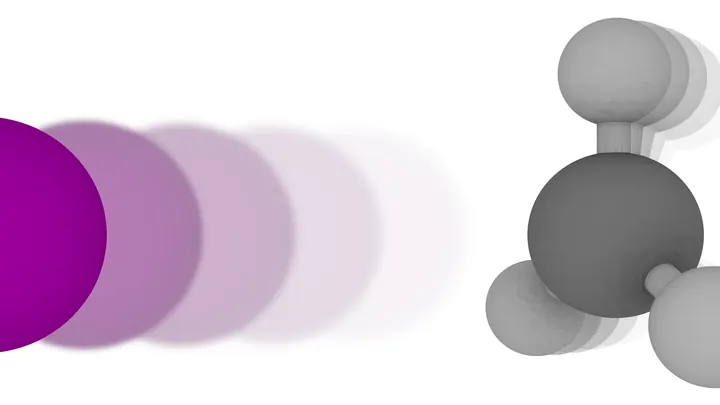
A chemical bond is like a stretched spring between atoms. When it's snapped, the molecular fragments fly apart, but they don't freeze: they keep vibrating, like a plucked string. That's exactly the vibration a team of researchers caught when they broke a methyl iodide molecule with an ultraviolet laser.