How Crystal Shape Changes the Color of Electrons express
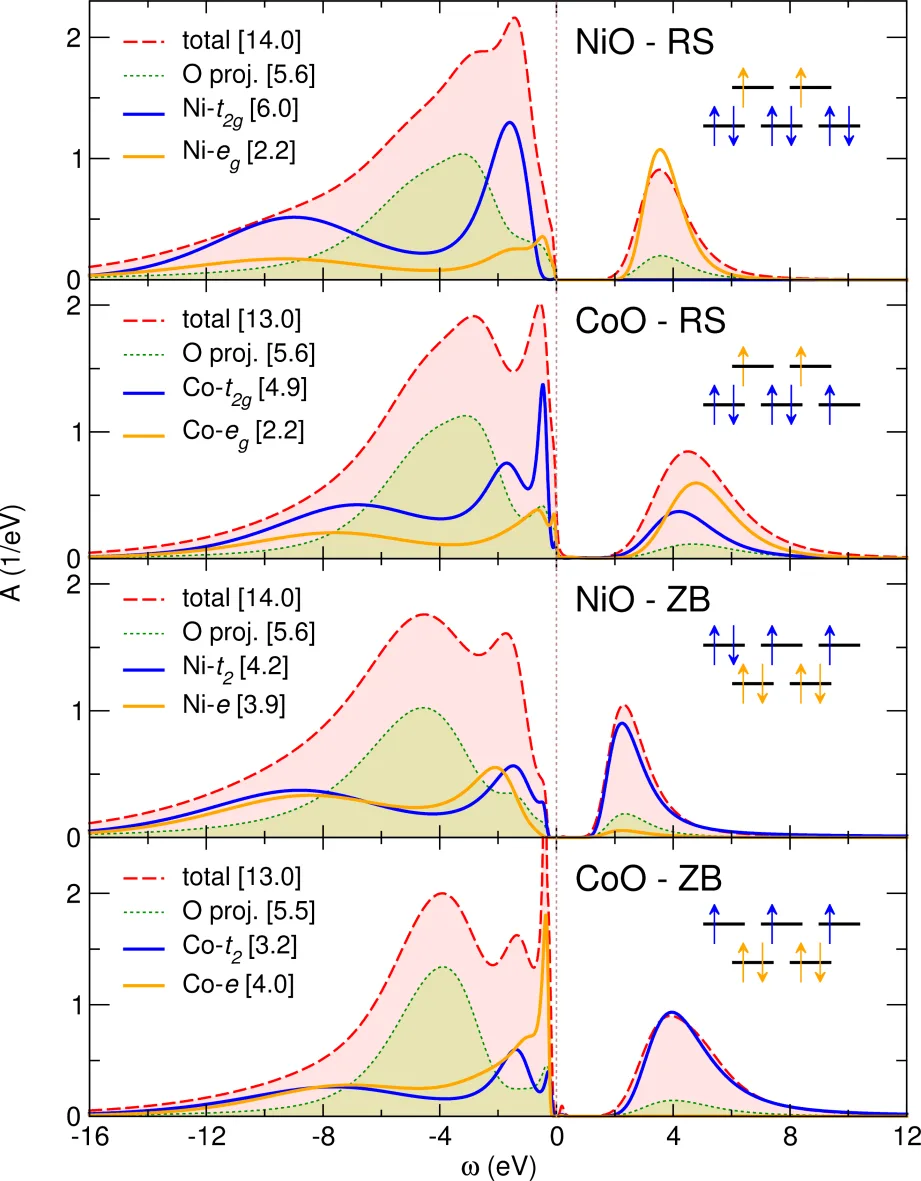
If you change not the composition but only the arrangement of atoms, you can make the same material conduct electricity or absorb light differently. That's exactly what the authors did with nickel and cobalt oxides. In one case, atoms are stacked like balls in a cubic box: each metal atom is surrounded by six oxygen atoms (rock salt structure). In the other, it's as if the box is slightly skewed, and there are only four neighbors (zinc blende structure).
This rearrangement is not just a geometric game. It reshuffles the electrons' "schedule." In nickel oxide, electrons that usually sit deep in the atoms start moving differently when the packing changes. Their energy required to escape the material (the spectral function) shifts by 1.5–2 electronvolts — about the same energy as a photon of red light. In cobalt oxide, the shift is even more pronounced. The reason is that the force with which neighboring oxygen atoms press on the metal's electron clouds changes.
The authors didn't just calculate these shifts; they also tested how strongly electrons interact with each other. They essentially "turned the knob" of interaction strength (parameter U) and watched how the picture changed. It turned out that without accounting for correlations in the oxygen electrons, the calculation lies — the spectrum comes out smeared. Only when they added a correction for oxygen self-interaction did the theoretical curves match the experimental ones like a key in a lock.
Such a detailed look at the electronic structure helps explain why some oxides become magnets and others insulators, even though they consist of almost identical atoms. In the long run, this could enable more precise design of materials for batteries, sensors, or spintronics devices, where not only the electron's charge but also its intrinsic spin matters.
Original abstract
as written by the authors arXiv:2605.03526
The intriguing physics and rich application potential of strongly correlated first-row transition metal oxide compounds result from the complex interplay of several factors that influence the electronic structure. To shed light on the effect of composition, structure, and correlation strength, we apply a well-established charge self-consistent combination of density functional theory and dynamical mean field theory, which has proven to give electron binding energies in good agreement to experimentally derived excitation spectra. For paramagnetic NiO and CoO, we analyze the effect of rock-salt and zincblende structures and their different ligand fields on the spectral functions. By varying the value of the interaction parameter U, different correlation strengths among the transition-metal 3d electrons are considered, as well as the effect of additionally accounting for correlations in the oxygen 2p orbitals by a self-interaction-correction pseudopotential scheme.
Nickel oxide is used to make "smart" windows: they darken when a voltage is applied because electrons in the material change their state.