Quark structure probing is the study of how quarks—the elementary building blocks of protons, neutrons, and heavier particles—are arranged and bound together inside composite particles like mesons and baryons. This field investigates the internal dynamics of quarks, including their masses, spins, and the strong force interactions that hold them together. The research uses high-energy collisions, magnetic fields, and light interactions to reveal the subtle patterns of quark organization.
History
The concept of quarks was introduced by Murray Gell-Mann and George Zweig in 1964, and deep inelastic scattering experiments at SLAC in the late 1960s provided the first direct evidence for their existence.
How it works
Physicists probe quark structure by scattering particles (such as electrons or photons) off the target particle and analyzing the deflection patterns. The way the probe interacts with the quarks reveals their distribution and motion. In heavy particles, the mass of the constituent quarks plays a dominant role, leading to asymmetries where 'heavy' parts dominate the behavior—similar to how a drop of fat in milk behaves differently from the surrounding liquid. Magnetic fields and polarized light can also align quark spins, allowing researchers to map the spin structure of the proton.
In practice
This research underpins our understanding of nuclear forces and is essential for interpreting data from particle accelerators like the Large Hadron Collider, as well as for developing models of matter under extreme conditions.
Fun fact
The mass of a proton is mostly not from its quarks but from the binding energy of the strong force—quarks contribute only about 1% of the total mass.
A fusion reactor is like a super-hot furnace where plasma reaches millions of degrees. The walls are made of tungsten, the most refractory metal there is. But even tungsten needs protection: fast particles from the plasma bombard the surface and knock atoms loose. These ejected atoms enter the plasma and cool it down, like a spoonful of cold milk in hot tea.
The proton is not a solid ball but a tiny prison. Inside it, three quarks are locked up, and the gluon field keeps them from escaping — something like invisible threads that only grow stronger if the quarks try to move apart.
Inside the proton, life is boiling. Quarks don't just sit there: they're glued together by carrier particles called gluons (from the word glue). Usually, this glue is spread evenly, like butter on a skillet. But when energies become enormous, gluons start clumping together. This is the gluon condensate — an ultra-dense state of the gluon field.
A drop of cream in a glass of milk. Shake it, and the fat doesn't spread evenly: it clumps into denser blobs that move differently from the rest of the liquid. Quarks inside mesons, tiny particles that live for mere fractions of a second, behave in much the same way.
A meson consists of a quark and an antiquark, and they are rarely equals.
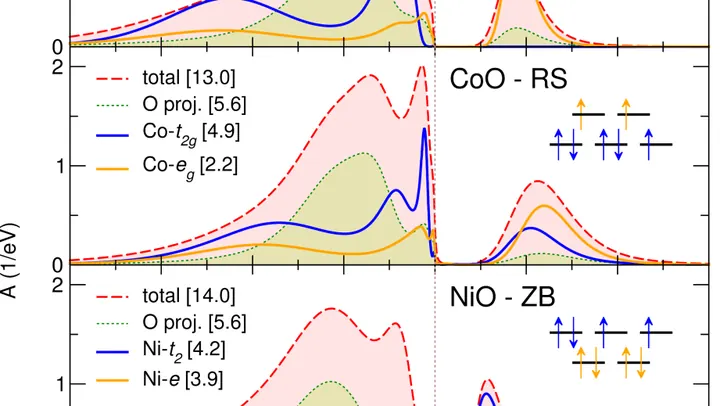
If you change not the composition but only the arrangement of atoms, you can make the same material conduct electricity or absorb light differently. That's exactly what the authors did with nickel and cobalt oxides. In one case, atoms are stacked like balls in a cubic box: each metal atom is surrounded by six oxygen atoms (rock salt structure).
The crystal CeB6 is like a box with a secret: inside it, electrons can occupy four nearly identical positions, like four chairs around a table. While no one is watching, the electron seems to sit on all four at once. Physicists call this hidden state quadrupolar, and it affects magnetic properties, but it is hard to see directly.
The proton is not a solid ball. Its charge, mass, and other properties are distributed differently in space, and each property has its own radius. Physicists have long been able to measure where the proton's charge is concentrated and where its mass lies.
Pour a handful of dry sand: it will spread into a neat cone. Now grab a box of star-shaped pasta: the pile will stand almost vertical. Why? It's all about particle shape.
Physicists built cylindrical piles from particles of different geometries — from smooth spheres to 'polypods' with several arms, like a sea star.
Inside every living cell, chemical transformations are constantly taking place. Some of them create unstable particles whose electrons behave like paired magnets. Their interaction resembles a dance: each movement of the pair responds to external magnetic fields, as if to a changing rhythm.