Simple

Invisible Black Holes Put Gravity to the Test

Original: "Black-Hole Scattering in Einstein-scalar-Gauss-Bonnet: Numerical Relativity Meets Analytics"
arXiv:2605.04224v1 · 2026-05-05 · CC BY 4.0 · ⏱ 1 min · General Relativity HEP Theory
A dance of black holes confirms: an invisible field leaves gravity intact.
Abstract

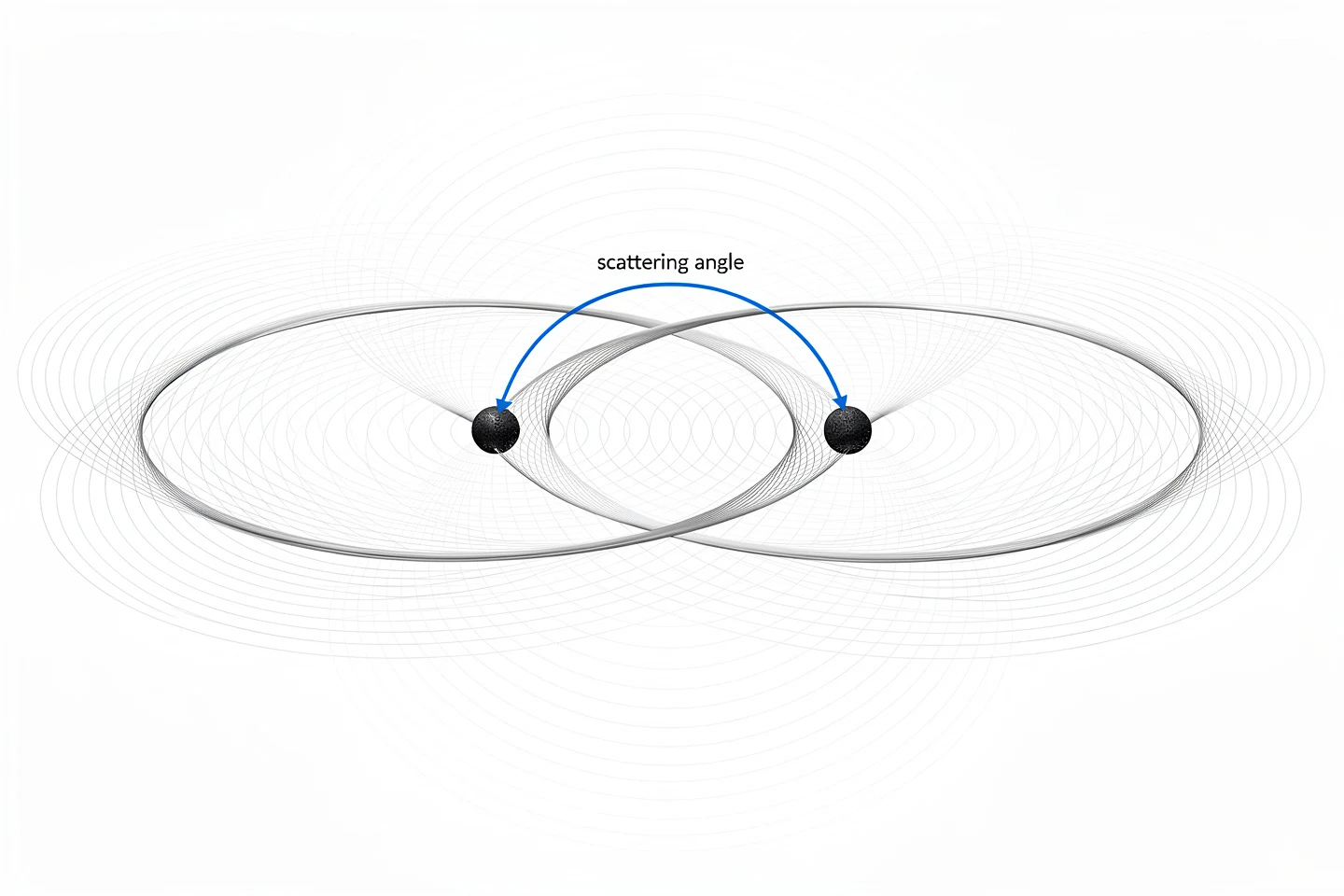
Picture two black holes whizzing past each other like billiard balls. Scientists calculated their deflection angle in a gravity theory with an extra field. Computer simulations matched the math perfectly, confirming the theory in strong fields. Will we ever capture the 'sound' of such encounters?

Links in the knowledge graph 1

A century ago, Albert Einstein rewrote the laws of gravity: it’s not a force but the curvature of spacetime — as if massive bodies dent a stretched sheet, making neighbors roll into their embrace. If you weave an invisible field into this ballet, the dance of black holes gets more tangled: each one grows 'hair' — a unique cloud that alters its motion.

Scientists carried out computer simulations of a duet of two 'hairy' holes at close range. It turned out that their deflection angle matches formulas to within a fraction of a degree, even when the swing exceeds 200°. Precision like a ballet where every step is measured to the millimeter.

This result is a pass for simplified calculations when searching for defects in gravitational waves caught by LIGO-class detectors. After all, if somewhere in the rhythm of the Universe a false note is heard, we’ll be the first to know. It’s no wonder Stephen Hawking and Kip Thorne taught us: even where time stretches slower and hidden information (entropy) is colossal, physics remains predictable.

🎯 The black holes' deflection angle was predicted with precision equivalent to hitting a coin tossed from the summit of Mount Everest.

🎬 If a scalar field existed in 'Interstellar,' the black hole Gargantua could distort not only light but also time so fantastically that the heroes would lose track of years.

S = \frac{1}{16\pi} \int d^4x \sqrt{-g} \left( R - 2(\nabla \varphi)^2 + 2\lambda \varphi \, R^2_{GB} \right)
The scalar field φ couples to curvature via the Gauss-Bonnet invariant, adding a correction to standard Einstein gravity.
\chi^{BH}_{EsGB} = \chi^{BH}_{GR} + \chi^{BH}_{mod}
The total deflection angle is the sum of the GR prediction and an extra contribution from the scalar field, allowing precise computation of corrections.
Scientists
Stephen HawkingJacob BekensteinAlbert EinsteinFritz ZwickyVera RubinBernhard Riemann
Tags
black hole gravitational waves numerical simulation spacetime curvature gravity LIGO entropy Time dilation
Laws
second law of thermodynamicsHawking radiationgravitational lensingBekenstein-Hawking entropyEinstein field equationsLorentz transformations
Original: arXiv:2605.04224v1 · CC BY 4.0 · bridge42worlds