Hyperbolic scattering of black holes: testing modified gravity in the strong field ✛ ✦
Context
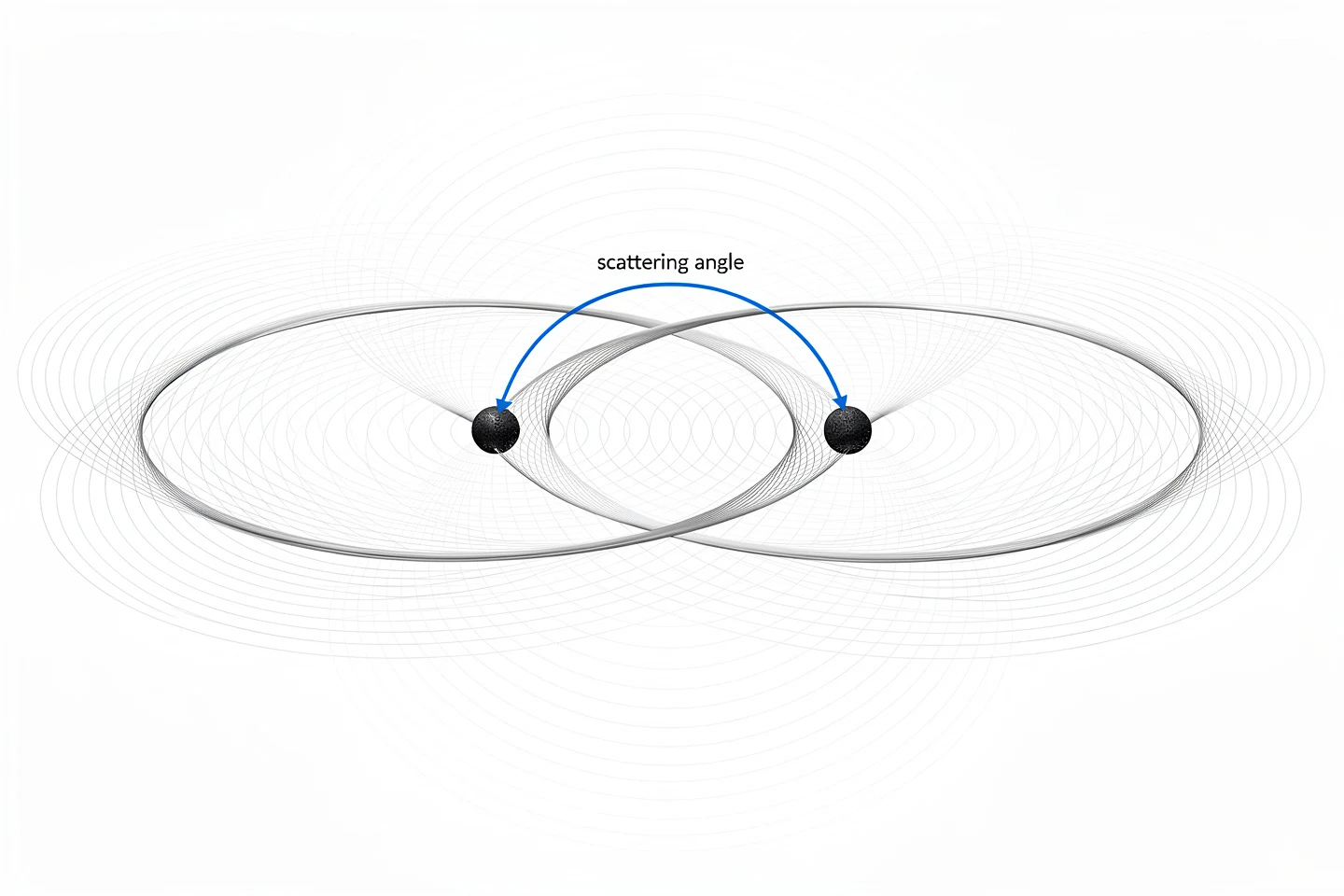
Black holes are ideal laboratories for testing gravity in the strong-field regime. Since the first detection of gravitational waves from a pair of black holes by the LIGO detectors in 2015, we have obtained abundant evidence of the accuracy of the theory laid down by Albert Einstein. However, inconsistencies—from the dark matter problem to the quantization of gravity—motivate the search for deviations. Einstein-scalar-Gauss-Bonnet theory adds a scalar field coupled to the spacetime curvature, endowing black holes with 'scalar hair.' Hyperbolic encounters—fly-bys of black holes past each other—provide an additional test channel, as the scattering angle is a gauge-invariant observable. Previously, there were no nonlinear simulations of such encounters in this theory, and analysts relied only on approximations.
Methods
The calculations were conducted along two fronts. On the analytical side, using the effective one-body formalism, corrections to the potential up to the third post-Minkowskian order were derived, drawing on results from effective field theory. On the numerical side, the code GRFolres, which extends GRChombo for theories with higher derivatives, was employed. The equations were solved in the mCCZ4 formalism with a modified harmonic gauge, ensuring the well-posedness of the problem. For initial data in general relativity, TwoPunctures was used—the scalar field was set to zero, which produced a short-lived transient. An adaptive mesh was refined near singularities and along wavefronts. Five simulations were conducted, varying the coupling constant λ and the impact parameter, and scattering angles were extracted via polynomial fitting of trajectories.
Results
For an impact parameter b=9.7M, where the scattering angle exceeded 200°, the difference between numerical and analytical angles was less than 1 degree—within simulation errors. For weak coupling (λ/M²=0.0175), the 2PM analytical prediction already gave a deviation δχ≈-0.2, and for strong coupling (λ/M²=0.0325), going from 2PM to 3PM improved accuracy fourfold: δχ changed from -3.07 to -0.72. For a larger impact parameter b=11.0M, the effects of modified gravity weakened, and results approached GR predictions. Remarkably, unlike bound orbits, where a merger delay was observed, on hyperbolic trajectories the imperfection of initial data is negligible. This makes the scattering regime ideal for testing theories. Moreover, the evolution of irreducible masses, computed via Wald's entropy, which generalizes ideas of Stephen Hawking, confirmed the rapid scalarization of the holes.
Implications
The agreement between numerical and analytical results demonstrates that the effective one-body formalism, developed for GR, can be successfully applied to modified theories—at least for non-spinning equal masses. This paves the way for fast semi-analytical models of gravitational-wave signals without costly full simulations. Such templates are critically important for detection and parameter estimation of events in future observing runs of LIGO, in the development of which Kip Thorne participated.
Future development
In the future, scientists plan to include radiation corrections from scalar dipole emission, which are relevant for systems with unequal masses or spin. It is also necessary to construct fully self-consistent initial data in Einstein-scalar-Gauss-Bonnet theory to eliminate transient artifacts. Extension to spinning black holes and realistic astrophysical scenarios will allow the creation of accurate templates for searching for GR violations in gravitational-wave data.
Impact
The results will impact gravitational-wave astrophysics (improving GR tests), fundamental gravity theory (understanding strong-field effects in theories with higher curvatures), and computational physics (advancing numerical relativity methods for modified theories).
Next steps
Increase simulation accuracy by improving initial conditions; include scalar radiation in the analytics; extend the study to spinning configurations and systems with unequal masses.
Key open problems
The search for deviations from GR is directly motivated by the unsolved mysteries of dark matter and dark energy. Theories with a dynamical scalar field, such as Einstein-scalar-Gauss-Bonnet, can leave characteristic signatures in gravitational waves, allowing these hypotheses to be tested on astrophysical scales.
The knowledge machine's view
This section is addressed to the author of the paper and their colleagues. Neighbouring works were found by meaning-based search across our archive, not by word overlap. We do not review: we show the field around the work.
What the work does
This work presents the first numerical simulations of hyperbolic black hole flybys in Einstein-scalar-Gauss-Bonnet theory using the GRFolres code. Comparison of scattering angles with analytical predictions up to 3PM shows agreement within errors, and the evolution of irreducible masses confirms rapid scalarization.
Where its strength is
The work lays the foundation for using hyperbolic encounters as a clean channel to test modified gravity, where the non-ideal nature of initial data is irrelevant and the scattering angle serves as a gauge-invariant observable.
Where it could go next
- It might be interesting to compare the developed approach with the analysis of extreme configurations and theory limits discussed in the neighboring work on black holes at the limit, to outline the boundaries of the method's applicability.based on: Black Holes on the Brink: When Theory Breaks Down arXiv:2608.05268v1
- Nearby lies work on testing a new theory of gravity with gravitational waves; perhaps transfer their methodology to hyperbolic events to expand tests.based on: Gravitational Waves to Put New Theory to the Test arXiv:2606.15295
- It is interesting to consider the connection with the work on the gravitational waltz with quirks, where similar modifications might be studied on other orbits, to identify common patterns.based on: A Gravitational Waltz with Quirks arXiv:2604.27734
Worth trying
- Test the computation of the scattering angle for several impact parameter values to build a continuous dependence and verify analytical formulas over a wider range.
- Run simulations with a nonzero initial scalar field to assess how the transient affects results for different parameters.
- Investigate the behavior of the irreducible mass near the capture threshold using the criterion from the work on black holes at the limit.
Why this may matter
Hyperbolic encounters could become a new tool for testing modified gravity, complementing merger observations, and will allow probing theories in the strong-field regime without the complications associated with quasinormal modes.
Nearby works in our archive
- Quantum Computer Solves Einstein's Equations for the First Timesimilarity 0.67
- How Black Holes Keep Gravity's Secretsimilarity 0.66
- Black Holes on the Brink: When Theory Breaks Downsimilarity 0.65
- Gravitational Waves to Put New Theory to the Testsimilarity 0.65
- A Gravitational Waltz with Quirkssimilarity 0.65
- The Acceleration of Invisible Pairs: What the Dance of Black Holes Revealssimilarity 0.64
The closest work in the archive sits at 0.67 by meaning — the usual level for our corpus.
Original abstract
as written by the authors arXiv:2605.04224v1
The study of hyperbolic binary black hole encounters yields an effective probe of the strong field regime of black holes, thus providing an additional channel to test General Relativity. We study the scattering of two black holes in Einstein-scalar-Gauss-Bonnet gravity, a well-motivated effective field theory of gravity, by comparing the scattering angle obtained from the first fully nonlinear black hole scattering simulations with its effective-one-body analytic description. We obtain excellent agreement between analytics and numerics, exhibiting accurate capturing of strong-field scalar-gravitational dynamics. Our work paves the way towards semi-analytical waveform templates of compact object binaries in modified theories of gravity.
In Einstein-scalar-Gauss-Bonnet theory, black holes acquire 'scalar hair,' which violates the famous no-hair theorem of GR: their properties begin to depend on the additional field.
In the movie 'Interstellar,' the characters use the black hole Gargantua for time travel. If a pervasive scalar field existed, the properties of such black holes could become even more exotic, exactly as in this modified theory.
Key numbers
- largest simulated coupling constant λ/M²: 0.0325
- scattering angle range for b=9.7M: 274°–280°
- impact parameters in simulations: 9.7M and 11.0M
- error in scattering angle due to finite resolution: ~0.1°
- resolution on the finest grid level: M/80