The Einstein Probe is a space telescopedesigned to monitor the sky for transient X-ray and gamma-ray sources — brief, powerful flashes that signal some of the most violent events in the universe, such as supernovae, neutron star mergers, and black hole feeding episodes. Unlike observatories that stare at a fixed patch of sky, it scans wide fields repeatedly, catching events that flare and fade within seconds or minutes. Its wide-field X-ray cameras act like a cosmic security camera, always watching for sudden changes.
History
The Einstein Probe is a Chinese Academy of Sciences mission, launched in January 2024, with international collaboration including ESA and the Max Planck Institute for Extraterrestrial Physics. It is named after Albert Einstein, reflecting his legacy in astrophysics.
How it works
The probe uses lobster-eye optics — arrays of tiny square channels that reflect X-rays at grazing angles, focusing them onto a detector over a huge field of view. This design trades sharp resolution for enormous sky coverage, letting it spot a burst and quickly alert ground-based telescopes for follow-up. It also carries a narrow-field X-ray telescope to zoom in on the most interesting sources once detected.
In practice
It is used to locate and characterize transient cosmic events, from supernova shockwaves to tidal disruption events, and to study the behavior of matter under extreme gravity near black holes and neutron stars.
Fun fact
Its lobster-eye optics are inspired by the structure of lobster eyes, which use square channels to focus light from many directions at once.
In active galactic nuclei, supermassive black holes are surrounded by a dense ring of dust that acts like a curtain: it hides everything happening at the center. If a star ventures too close to the black hole, tidal forces tear it apart, and the resulting flare is usually visible in optical and X-ray light.
The night forest is full of fireflies, but before, we only saw those that happened to be in the beam of a flashlight. That was the case with ultraluminous X-ray sources: points in other galaxies that shine in X-rays more brightly than a stellar-mass black hole can steadily emit. Telescopes looked at galaxies chosen for other purposes, missing most of the fireflies.
The calm surface of a lake suddenly ripples — somewhere in the depths, an underwater cliff has collapsed. The water trembles almost imperceptibly, and the circles spread wider and wider until they reach a bobber near the shore.
The hunter of ancient light, the James Webb Telescope, aimed its mirrors at a tiny patch of sky and caught a strange beacon. The object, with the working name beacon_1420-$$5253_{4770}$$, flashed and faded. At first, it was logged as a candidate for the most distant galaxy, as if we were seeing it just 300 million years after the big bang.
The light of a distant star briefly brightens when a massive invisible object passes between it and a telescope. This phenomenon, gravitational microlensing, acts as a natural telescope. Usually, the lens is a black hole, warping the spacetime around it.
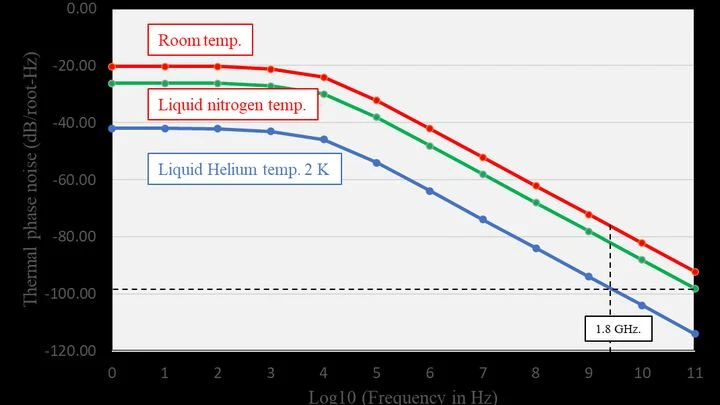
In absolute silence, you need to hear a feather drop. But someone keeps rustling a plastic bag. For the space-based LISA observatory, that 'rustling' will come from charged particles in space.
When two neutron stars, compressed to the size of a city, approach in their final dance, the spacetime around them comes alive, emitting gravitational waves.
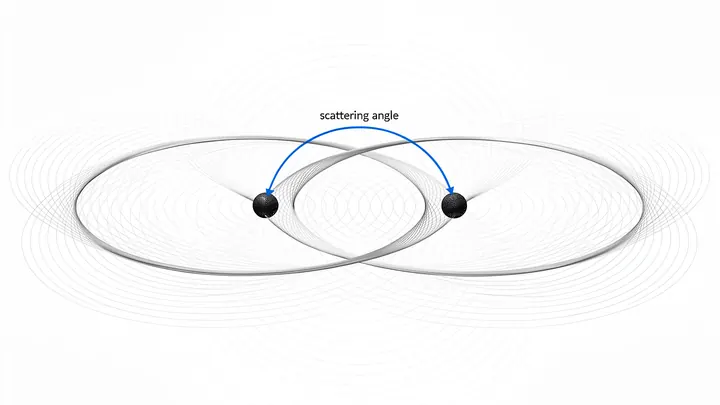
When black holes approach and then fly apart — without merging, just grazing each other's gravitational fields — they become ideal projectiles for testing the laws of gravity. In extreme fields, where time dilation reaches monstrous magnitudes, any crack in the theory would flash dazzlingly bright.
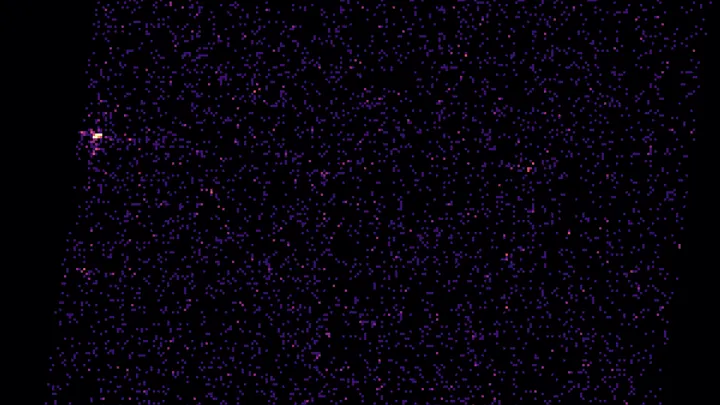
In a distant galaxy, at a distance that light takes 11 billion years to cross, something flashed. The Einstein Probe X-ray telescope caught a brief, needle-prick-like burst: it lasted only a few dozen seconds.
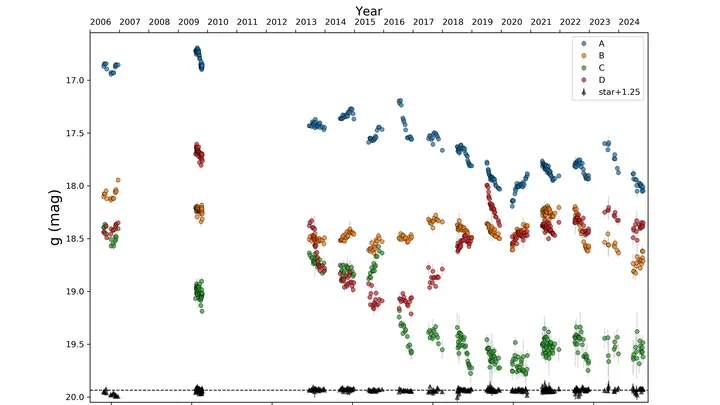
A distant quasar appears as four points of light arranged in a cross. This is how the gravity of a galaxy lying along our line of sight distorts the view: it acts like imperfect glass, multiplying the image. Each point is the same object, but its light travels different paths.
The Einstein Probe space telescope detected a celestial storm: after a short (0.4-second) gamma-ray burst — a cosmic lightning bolt — came a long roll of X-ray thunder. It lasted nearly 10 minutes. This is the first direct proof that such explosions leave a lingering X-ray afterglow.
In a dark corner of the Milky Way, a natural metronome is at work. Every 8196 seconds, about 2 hours and 16 minutes, X-ray light flares on the surface of a neutron star. The star EP J171159.4-333253 pulls gas from a neighboring star, and this gas, falling inward, accumulates on its surface.
Mass curves spacetime like a heavy stone pressing into an asphalt road. Light passing by skirts around this dent, its path lengthens, and it arrives late. Astronomers have observed this Shapiro effect many times near the Sun and planets.
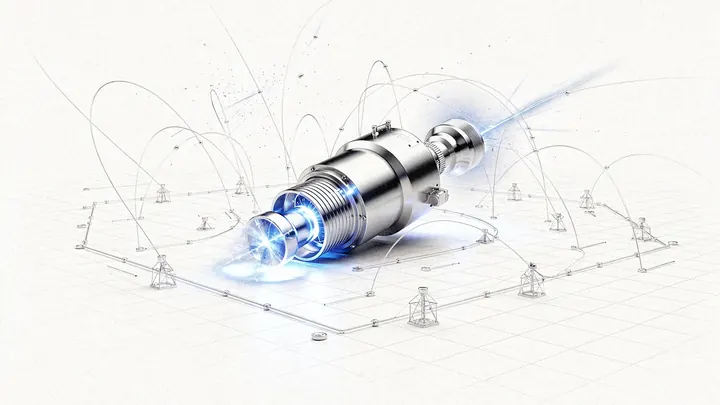
A new plan proposes to recreate this delay on a lab bench.
A firefly blinks for one ten-billionth of a second somewhere above the Siberian taiga. Seeing such a thing is impossible, but the TAIGA-HiSCORE array, spread across a valley in the Tunkinsky district of Buryatia, tried to catch exactly such flashes — not from insects, but from the depths of space.
Deep in the Siberian taiga, there are a hundred light traps: each about the size of a small table, but together they cover a square kilometer. At night, these traps gaze at the sky, catching faint flashes of light born when cosmic particles slam into the atmosphere. The setup is called TAIGA-HiSCORE, and it usually works as a giant "eye" for such particles.