Quantum gravity and symmetry is a research program that seeks to unify general relativity with quantum mechanics by using symmetry principles as a guiding light. The core problem is that gravity, described by Einstein's theory as the curvature of spacetime, resists the standard quantum field theory framework used for other forces. Symmetry — the idea that certain transformations leave a system unchanged — has been a powerful tool in physics, and researchers hope that identifying the right symmetries will reveal the underlying quantum structure of spacetime itself. This approach is particularly relevant to understanding black holes, where quantum effects and extreme gravity meet, and to explaining cosmological puzzles like the accelerated expansion of the universe.
History
The modern emphasis on symmetry in quantum gravity gained prominence in the late 20th century, particularly through work on string theory and loop quantum gravity, but the foundational idea traces back to the 1960s and the pioneering efforts of physicists like Bryce DeWitt and John Wheeler to quantize gravity.
How it works
The idea is to start with symmetries that are known to hold in classical gravity, such as diffeomorphism invariance (the freedom to choose any coordinate system), and then find quantum versions of these symmetries. By imposing these symmetries on a quantum theory, physicists can constrain the possible forms of the theory, much like how requiring a theory to be Lorentz-invariant (the same for all inertial observers) led to special relativity. In practice, this involves mathematical tools like group theory and representation theory, and it often leads to predictions about how quantum fluctuations of spacetime might manifest, for example, as slight modifications to the behavior of black holes or gravitational waves.
In practice
While a full theory of quantum gravity remains elusive, symmetry-based approaches inform research in black hole thermodynamics, early-universe cosmology, and the search for quantum gravitational signatures in cosmic observations.
Fun fact
The concept of 'spacetime foam' — a churning, quantum-fluctuating spacetime at the Planck scale — was coined by John Wheeler in the 1950s, long before any concrete quantum gravity theory existed.
An ordinary mirror swaps left and right. Many laws of physics don't notice the swap: they are mirror-symmetric. But some phenomena, like the weak interaction, break this symmetry. Until now, it was thought that gravity and light each break mirror symmetry in their own independent way.
Ultra-sensitive scales try to detect the difference between two nearly identical grains of sand. One is a perfect mirror reflection of the other. In the world of elementary particles, such mirror reflection is called P-parity, and its violation is one of the great mysteries of physics.
An invisible scaffold holds galaxies together, keeping them from flying apart. This is dark matter — matter that doesn't shine and barely interacts with ordinary stuff. Astrophysicists have long debated what it's made of.
In the far reaches of space, there exists a hypothetical object: an ultracold black hole. It is charged and resides in an expanding universe (de Sitter space). Its temperature hovers just above absolute zero — about one trillionth of a degree above it.
An old house. The facade is freshly painted, the stairs don't creak. A pretty picture. But try to move in heavy furniture, and the floorboards give way. The beauty of the facade says nothing about the strength of the floors.
It's much the same with black holes without singularities.
A cloud of waves collapses under its own gravity. While it's loose, everything goes by the book: the field oscillates gently in nearly flat space, and approximate formulas work perfectly. But add just a bit more energy, and the picture changes.
Physicists used a numerical model to catch the moment when simple calculations stop describing reality.
At the center of nearly every galaxy lurks a supermassive black hole. Its gravity is so strong that it warps space itself. But few stop to wonder: what does it do to the very fabric of reality — the fields that permeate the cosmos?
One such field is the Higgs field.
The Standard Model of particle physics is a catalog of all known building blocks of the universe: electrons, quarks, and others. But it is silent about dark matter and doesn't get along with gravity.
Usually, a black hole is described as a frozen frame: there's mass, there's charge, and it's all static. But real objects live in time. They radiate, lose energy, and change.
A light ray skimming along a black hole horizon doesn't just move: it carries heat and information. Physicists have long suspected that the geometry of such rays obeys strict rules, but the details remained blurry. The new work turns these rules into a sharp inequality.
Gravity in our world is curved spacetime. That's how Einstein's general theory of relativity describes it. But what happens to gravity at the level of atoms and particles, where quantum mechanics rules? This question has remained unanswered for nearly a century.
13.8 billion years ago, the universe swirled in a waltz. The right turn was forbidden. Today, the echoes of that cosmic ball reach us as a barely perceptible ripple in spacetime — gravitational waves. Their existence was predicted by Albert Einstein.
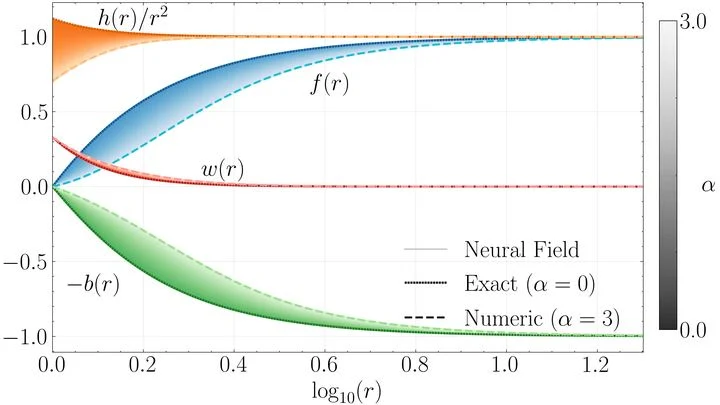
A black hole is not just a dark spot. It rotates, drags space along with it, and can carry imprints of the quantum world. To describe such a hole, one must solve gravitational field equations.
Two light rays meet at a point and then diverge. Their paths form two intersecting surfaces in spacetime — null hypersurfaces (boundaries along which light propagates). It is on such a pair of surfaces that physicists can set initial data for Einstein's equations. This is called the characteristic Cauchy problem.
In cricket, there's a special delivery — the googly. The ball spins in a way that deceives the batsman. Physics had its own googly: for nearly half a century, mathematicians couldn't make twistor theory work with real gravity. It described 'nice' fields perfectly, where everything twists in one direction. But as soon as an 'awkward' component appeared, the machinery broke down.
At the centers of many galaxies lurk supermassive black holes. One of them, Sagittarius A* at the heart of the Milky Way, has become a testing ground for a new idea. The authors of the work took Einsteinian gravity and added an unusual electromagnetic field to it.
The standard model of cosmology, based on the field equations proposed by Einstein, describes the Universe as a cocktail of dark matter (discovered thanks to Vera Rubin) and dark energy in roughly a 1:3 ratio.
At the center of galaxy M87, 55 million light-years away, lurks a black hole with a mass of 6.5 billion Suns. In 2019, the Event Horizon Telescope (EHT) gave us its first portrait: an orange donut with a dark core. But the donut is not the abyss itself.
When massive bodies accelerate (say, two stars orbiting each other) the space around them doesn't stay calm. It trembles like the surface of a pond after a stone is thrown. These tremors are called gravitational waves. They carry energy away, and the source gradually loses mass.
When a grain of sand falls on a table, its impact is predictable. But if you squeezed it down to the size of an atomic nucleus, the familiar laws of gravity would break down — the force of gravity would grow without bound.
In the early 20th century, Einstein showed that gravity is the curvature of space and time. A bit earlier, Maxwell had unified electricity and magnetism into a single theory.
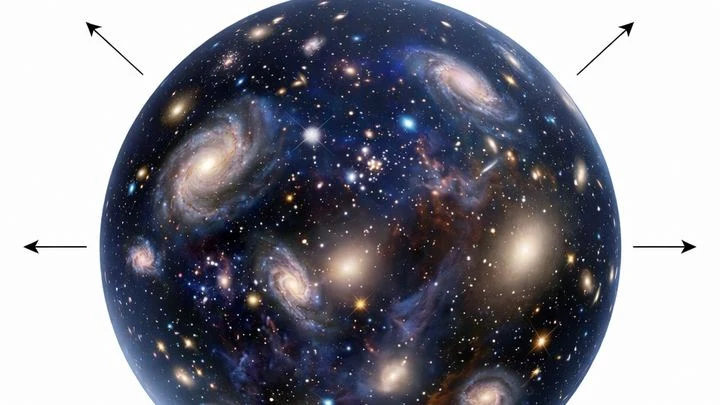
The Universe behaves like a soap bubble swelling in a multidimensional foam. The dark bubble model explains why it's expanding ever faster: the spacetime bubble grows, and its membrane gains a tiny thickness — about a micron, like a bacterium. At such distances, gravity 'blurs' across this thickness and weakens.
A black hole is not just a dark spot in space. It is a region where gravity compresses matter so intensely that even light cannot escape. Among all possible black holes, one stands out — the rotating Kerr black hole. Its description was long thought to be tied to Einstein's equations, like a recipe tied to a specific cookbook.
In the hot early universe, like in an overcrowded dance hall, magnetic monopoles swirled — loner particles carrying only a north or only a south pole. In an ordinary magnet, poles always come in pairs, but here each one is on its own. Theories that unify all forces of nature predict that such particles should have been produced in vast numbers, yet today we don't see them.
Time is a fickle thing. Inside a massive star, it flows calmly, like sand in an old clock on a mantelpiece. Outside, on the scale of the entire universe, it stretches along with space, as if the same clock were in an elevator that speeds up and slows down. For a long time, physicists puzzled over whether these two worlds could be glued together without visible seams.
A soap bubble hangs in the air, and its shape already contains everything needed to calculate the internal tension. A similar principle worked in a new study on quantum gravity. Physicists took a closed surface, an analog of such a bubble, and specified a few numbers on it: for example, the electric field strength and the curvature.
The shadow of a black hole is not just a silhouette. It's the edge of the abyss, where space and time are twisted so tightly that even light is forced to swirl like a wood chip in a whirlpool. This 'cosmic whirlpool' arises from the monstrous mass warping spacetime.
The quantum world is known for uncertainties: for example, you can't measure a particle's position and its speed at the same time. But new research shows that in a 'fuzzy' spacetime, even probability itself — the measure of chance — loses sharpness. A foggy compass doesn't give an exact direction: its needle wavers.
For nearly a century, astronomers have watched galaxies spin as if held together by invisible mass. Fritz Zwicky first noticed it, and Vera Rubin precisely measured the speeds of stars at the edges.
Two electrically charged spheres attract each other with a certain force. If you replace their charges with magnetic poles, a spring scale shows exactly the same force. Black holes, it turns out, behave the same way — except instead of springs, the fabric of spacetime itself does the work.
The event horizon of a black hole is often depicted as a one-way membrane: everything falls in, nothing comes out. But what if it's not an empty boundary but a cloud of the tiniest 'bits' of spacetime itself?
A hot coffee on the table cools down: heat spreads from the hot center to the edges. The authors suggest that the universe behaves in a similar way, just on scales of billions of light-years. Their model describes not the usual dark energy, but a smooth redistribution of energy within the cosmos, akin to the slow flow of heat from denser regions to rarefied ones.
When two dead stars collide in a distant galaxy, two messengers bring us the news: a shiver in space, a gravitational wave, and a flash of light. Both messengers race toward us across the entire Universe, but their paths can differ slightly. Light sometimes gets delayed by cosmic dust, while gravitational waves pass through everything almost without noticing obstacles.
A mathematical doughnut, a torus, sits on the boundary of a three-dimensional world where gravity acts. You can crumple and stretch it, and physicists decided to see how it behaves. Inside this world, space can be flat like a table, expanding like a soap bubble, or curved like a saddle. The doughnut boundary refused to stay smooth.
A heavy object falls into a pond, and ripples spread in all directions. Similarly, any motion of a massive body creates ripples in the fabric of space: gravitational waves. But when you try to describe these ripples using the laws of the quantum world, the calculations blow up with infinities.
A massive nanodiamond inside a quantum interferometer splits in two, pulling itself into two realities. Its gravity — tiny, almost imperceptible — stirs the quantum field of the vacuum, giving rise to coherent clouds of gravitons. These are the gravitational shadows cast by each position of the mass.
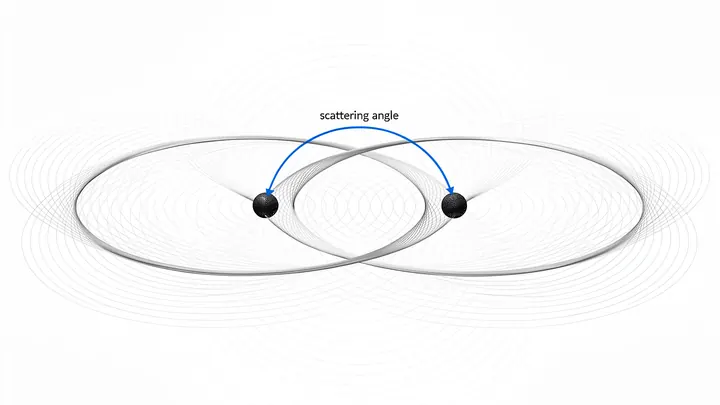
When black holes approach and then fly apart — without merging, just grazing each other's gravitational fields — they become ideal projectiles for testing the laws of gravity. In extreme fields, where time dilation reaches monstrous magnitudes, any crack in the theory would flash dazzlingly bright.
In the first second after the Big Bang, the universe was a boiling cauldron of energy. Particle-antiparticle pairs were born and instantly annihilated each other. But for every billion such pairs, one particle of matter survived, and that leftover became stars, planets, and people.
New research blames modified gravity for this.
Throw a stone into a pond — ripples spread out, changing the scale of the wave. The new theory works much the same way: it gives each particle its own "scale ripple," and it's this curvature of an invisible space that turns out to be the source of mass.
A pencil dropped on the floor hits with its entire surface at once. But if the floor were quantum, made of countless vibrating grains of sand, the pencil would never touch a single point.